
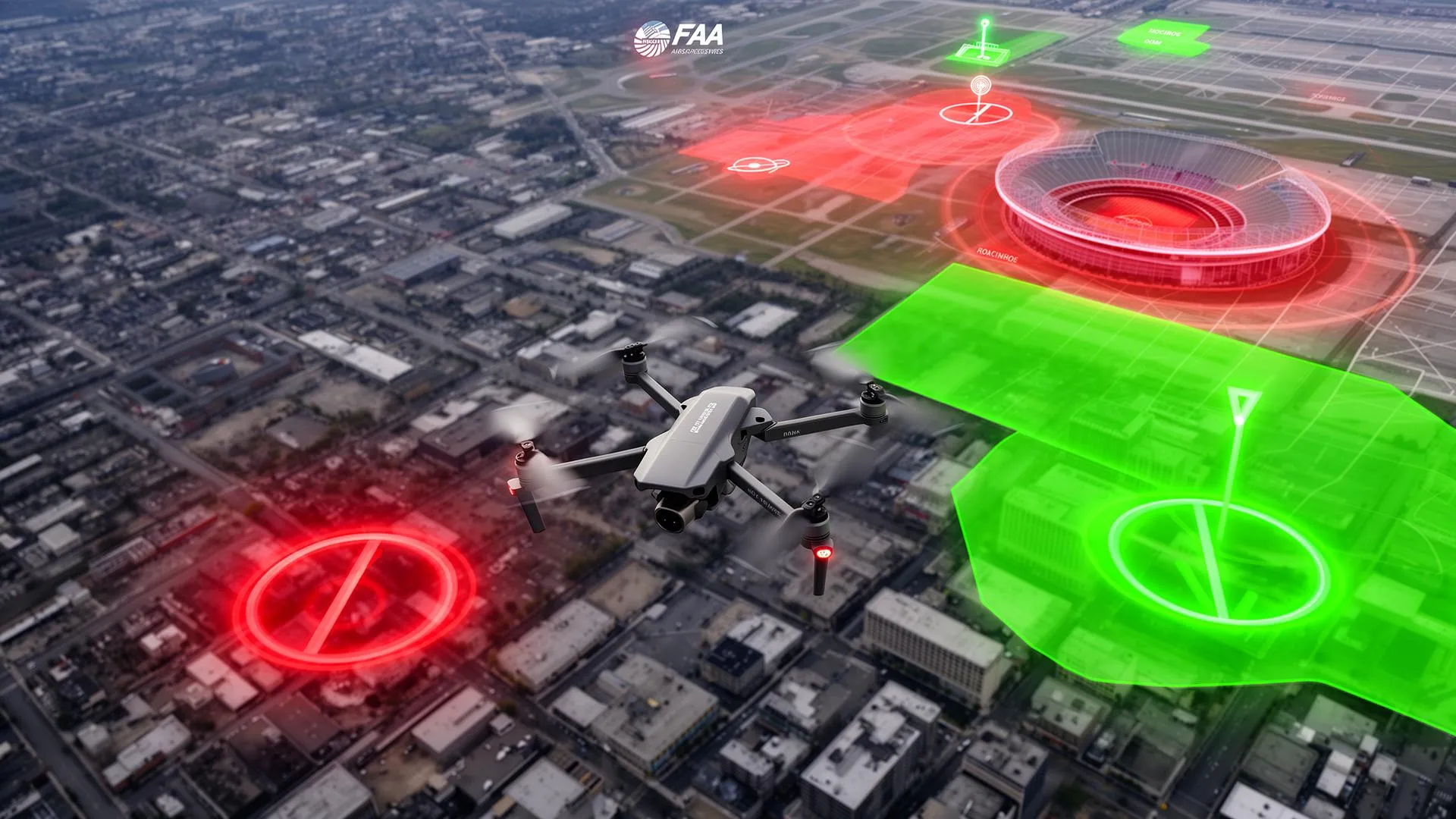
You charged the batteries, calibrated the compass, and you are ready to fly. The harder question is not how to fly but where it is legal. In the United States the FAA controls essentially all navigable airspace, and "it's just my backyard" is not a defense if that backyard sits under a controlled-airspace shelf or inside a temporary flight restriction. This guide is for recreational and Part 107 pilots who want a clear, accurate picture of where you cannot fly in 2026, how to check any specific spot before launch, and what the penalties actually are. It is built on FAA and National Park Service primary sources, not forum hearsay.
The one thing to know: nearly every airspace restriction applies to all drones, regardless of weight. The sub-250-gram exemption only spares you from FAA registration, not from airspace rules. Before any flight, check the location in the FAA's B4UFLY service. If it shows controlled airspace, get a LAANC authorization first. If it shows a TFR, prohibited area, or national park, do not fly.
How US airspace is classified
Most of the "where can I fly" question comes down to airspace class. Recreational and Part 107 drones are limited to 400 feet above ground level, so you will never legitimately touch the high-altitude classes, but the controlled airspace near airports is where most pilots run into trouble. The table below summarizes what each class means for a drone pilot. The authoritative source for these definitions is the FAA's airspace restrictions hub.
| Airspace | Where it is | Can you fly? |
|---|---|---|
| Class G | Uncontrolled, mostly rural and lower altitudes | Yes, no authorization needed |
| Class B, C, D, E surface | Controlled airspace around airports | Only with LAANC or DroneZone authorization |
| Prohibited / Restricted areas | Military, sensitive sites, hazardous activity | No, without using-agency permission |
| Class A | 18,000 ft and above | No, far above the 400 ft drone ceiling |
If a location reads as Class G in B4UFLY and is clear of any of the no-fly zones below, you can generally fly without prior authorization, keeping the aircraft below 400 feet and within visual line of sight. Everything else in this guide describes the places where the answer is no, or "not without paperwork."
Controlled airspace near airports
Controlled airspace surrounds airports in layered shelves to keep crewed traffic safe. You may not fly a drone there without prior FAA authorization, but "controlled" does not mean "forbidden." The standard path is the Low Altitude Authorization and Notification Capability (LAANC), a partnership between the FAA and approved app providers that grants near-instant approval up to the published grid altitude on the UAS Facility Maps. As of 2026 the FAA reports LAANC is available at 726 airports (FAA LAANC overview).
When LAANC does not cover a grid (the red zero-altitude squares on the facility map) or you need to fly above the posted altitude, you request manual authorization through the FAA DroneZone, which can take up to 90 days. Recreational flyers and Part 107 pilots both qualify for LAANC. If you fly in the US regularly, understanding these requirements alongside Remote ID compliance and the FAA registration and licensing process is essential, since they are enforced together.
Permanent and standing no-fly zones
Some restrictions never lift. These are the places where no LAANC grid will ever turn green, and where flying is either outright prohibited or requires permission from a specific agency that recreational pilots will almost never obtain.
National Parks
NPS Policy Memorandum 14-05 bans launching, landing, and operating drones on park lands and waters. The ban is enforced at ground level; the airspace above remains FAA-controlled.
Washington DC (SFRA / FRZ)
Drones are banned within the 15-mile inner ring of the DC Flight Restricted Zone and tightly limited across the wider 30-nautical-mile Special Flight Rules Area.
Military & sensitive sites
Prohibited and restricted areas cover military bases and national-security facilities. Many have a no-drone zone from the ground up to 400 ft AGL.
Critical infrastructure
A growing list of power plants, refineries, and similar facilities carry FAA-designated airspace restrictions to 400 ft AGL.
National Parks versus National Forests
This trips up countless pilots. The National Park Service bans drones across its lands under Policy Memorandum 14-05. National Forests, managed by the US Forest Service, generally do allow recreational drone flying, with the major exception of designated Wilderness areas and any local fire or wildlife closure. Different agency, different rule. Always confirm the boundary, because they often sit side by side. Our dedicated guide to drone rules in national parks covers the exceptions and the legal nuance of flying just outside park boundaries.
Temporary flight restrictions: stadiums, security, and disasters
Temporary flight restrictions (TFRs) appear and disappear, which makes them the easiest restriction to miss and one of the most aggressively enforced. They are published as FDC NOTAMs, usually three to five days before a planned event, so a location that was legal last week can be off-limits today.
The most common standing example is the sporting-event TFR. Federal law restricts drones at or below 3,000 feet AGL within a 3-nautical-mile radius of any stadium seating 30,000 or more people during a Major League Baseball game, a regular or post-season NFL game, an NCAA Division I football game, or a major motor speedway event. It takes effect one hour before the scheduled start and lifts one hour after the event ends (FAA stadiums and sporting events).
Security and disaster TFRs are the other big category. Presidential movements, large public gatherings, and wildfires all generate them. Wildfire TFRs are especially serious: an unauthorized drone can ground the firefighting aircraft entirely, and the FAA's message is blunt. If you fly, they cannot. For 2026 specifically, the FAA, in coordination with DHS and DOJ, has designated all FIFA World Cup 2026 match stadiums, fan events, and team base camps as "No Drone Zones," with TFRs prohibiting drones within a 3-nautical-mile radius up to 3,000 feet AGL on match days (FAA FIFA World Cup 2026 announcement).
The Washington DC Special Flight Rules Area
The airspace around the nation's capital is the single most restricted area for drones in the country. The DC Special Flight Rules Area (SFRA) is a roughly 30-nautical-mile circle centered on Reagan National Airport. Inside it sits the Flight Restricted Zone (FRZ), about 15 nautical miles in radius. Per the FAA, flying any unmanned aircraft within the 15-mile inner ring is prohibited without specific FAA authorization, and operations across the wider SFRA are tightly controlled (FAA DC prohibited and restricted airspace). In practice, if you are anywhere near DC, assume you cannot fly and verify before you even leave home.
How to check before every flight
Checking takes a few minutes and removes nearly all of the legal risk. Use these official tools, in this order, every single time you fly somewhere new.
1. B4UFLY
The FAA's official airspace status service shows controlled airspace, special-use airspace, active TFRs, national parks, and military training routes with a simple go / no-go indicator for your exact location.
2. LAANC
If B4UFLY shows controlled airspace, request authorization through an approved LAANC app for near-instant approval up to the posted grid altitude, or use the FAA DroneZone for areas LAANC does not cover.
3. The TFR list
Check the FAA's official TFR page on the day of your flight. TFRs are published shortly before events, so a clear B4UFLY check days earlier is not a guarantee on the day itself.
4. Aeronautical charts
For complex areas, VFR sectional charts show airspace boundaries, prohibited and restricted areas, and special-use airspace in full detail beyond the app summary.
New pilots often ask whether all of this is worth the hassle. It is, and it becomes second nature fast. If you are still deciding whether the whole hobby fits your situation, our take on whether buying a drone is worth it in 2026 covers the practical and regulatory realities, and the broader regulations hub collects our country-by-country guides.
Penalties for getting it wrong
The financial and legal exposure is real, and it climbed in recent years. Under the FAA Reauthorization Act of 2024, civil penalties for unsafe or unauthorized drone operations can reach $75,000 per violation. Where an operation endangers people, violates airspace restrictions, or furthers another crime, law enforcement can pursue criminal fines up to $100,000 and up to one year in federal prison, and the FAA can suspend or revoke your remote pilot certificate (FAA enforcement update).
Enforcement is not theoretical. The FAA has publicly announced large batches of proposed civil penalties against individual operators, and at high-profile venues authorities now use counter-drone tools to intercept and seize aircraft on the spot. The takeaway is simple: a few minutes of checking is far cheaper than a five-figure penalty.
Key takeaway
Airspace rules apply to every drone, not just registered ones. Treat B4UFLY plus a same-day TFR check as a mandatory pre-flight step. Stay clear of national parks, the DC SFRA, military and security-sensitive sites, and any active stadium or wildfire TFR. In controlled airspace near airports, get LAANC authorization first. Do that consistently and you will fly within the law nearly everywhere a hobbyist would want to.
Frequently asked questions
Do airspace rules apply to drones under 250 grams?
Yes. The sub-250-gram threshold only exempts recreational drones from FAA registration. Every airspace restriction in this guide, controlled airspace, TFRs, national parks, the DC SFRA, and prohibited areas, applies to all drones regardless of weight.
Can I fly a drone in a National Forest?
Generally yes, unlike National Parks. National Forests are managed by the US Forest Service, which does not have a blanket drone ban. The key exceptions are designated Wilderness areas, which are off-limits, and any temporary fire or wildlife closure. Always confirm the exact boundary and check B4UFLY for overlapping airspace.
How do I legally fly near an airport?
Request an airspace authorization through LAANC using an FAA-approved app, which usually approves it within seconds up to the posted grid altitude. For areas LAANC does not cover, or to fly higher than the grid allows, submit a manual request through the FAA DroneZone, which can take up to 90 days.
What is the penalty for flying in a restricted area?
Civil penalties can reach $75,000 per violation under the FAA Reauthorization Act of 2024. For operations that endanger people or violate airspace restrictions, criminal penalties can reach $100,000 and up to one year in federal prison, plus possible certificate suspension or revocation and confiscation of the aircraft.
Can I fly over a stadium during a game?
No. A standing TFR prohibits drones at or below 3,000 feet AGL within a 3-nautical-mile radius of any stadium seating 30,000 or more during MLB, NFL, NCAA Division I football, and major motor speedway events, from one hour before to one hour after. For 2026, FIFA World Cup match venues carry the same restriction on match days.
Why are TFRs so easy to miss?
TFRs are temporary and published as FDC NOTAMs, often only three to five days before an event. A location can be perfectly legal one day and restricted the next, which is why you should check the FAA's TFR list on the actual day you plan to fly, not only days in advance.
This guide summarizes US drone airspace rules based on FAA and National Park Service primary sources. Regulations and temporary restrictions change frequently, so always verify the current status of your specific location with the FAA before flying. Information verified June 2026.
Frequently Asked Questions
Do airspace rules apply to drones under 250 grams?
Yes. The sub-250-gram threshold only exempts recreational drones from FAA registration. Every airspace restriction, including controlled airspace, TFRs, national parks, and the DC SFRA, applies to all drones regardless of weight.
Can I fly a drone in a National Forest?
Generally yes, unlike National Parks. National Forests are managed by the US Forest Service, which has no blanket drone ban. The exceptions are designated Wilderness areas and any temporary fire or wildlife closure. Always confirm the boundary and check B4UFLY for overlapping airspace.
How do I legally fly near an airport?
Request an airspace authorization through LAANC using an FAA-approved app, usually approved within seconds up to the posted grid altitude. For areas LAANC does not cover, or to fly above the grid altitude, submit a manual request through the FAA DroneZone, which can take up to 90 days.
What is the penalty for flying in a restricted area?
Civil penalties can reach $75,000 per violation under the FAA Reauthorization Act of 2024. Operations that endanger people or violate airspace can draw criminal penalties up to $100,000 and up to one year in federal prison, plus certificate suspension and aircraft confiscation.
Can I fly over a stadium during a game?
No. A standing TFR prohibits drones at or below 3,000 feet AGL within 3 nautical miles of any stadium seating 30,000 or more during MLB, NFL, NCAA Division I football, and major motor speedway events, from one hour before to one hour after. FIFA World Cup 2026 venues carry the same restriction on match days.