
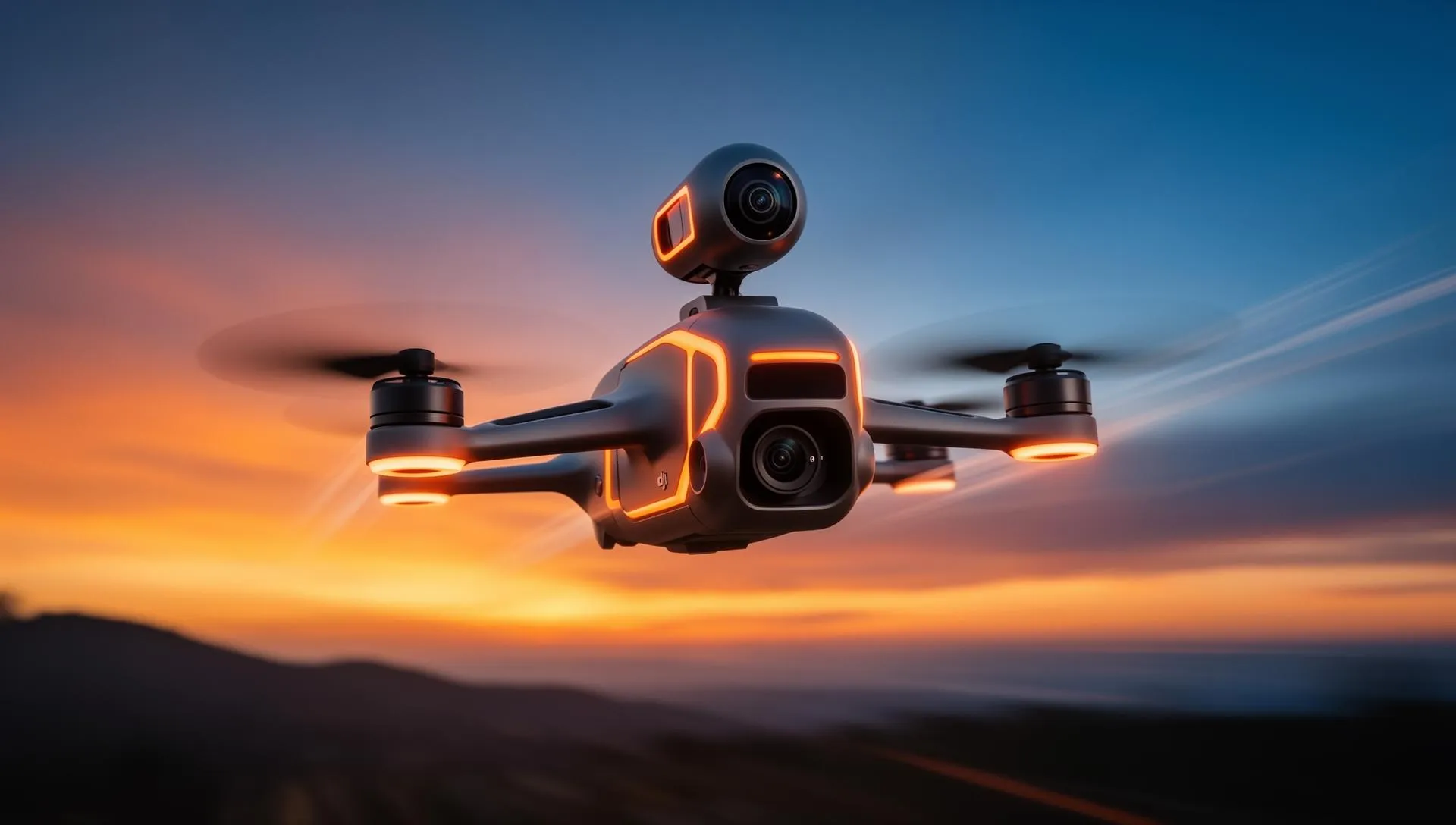
For two years the only way to get true spherical footage out of an FPV drone was to bolt an Insta360 action camera onto a cinewhoop and live with the weight, the stitching seams, and the lost flight time. The DJI Avata 360 was built to remove that compromise: a dedicated 360 camera baked into an Avata-style airframe. This guide separates what DJI has actually confirmed from what was only ever a leak, lines the drone up against the Avata 2 and the Insta360-backed Antigravity A1, and gives plain buyer guidance. No invented test results, just sourced facts and where the honest unknowns still are.
The one thing to know: the DJI Avata 360 is real and shipping. DJI launched it on 26 March 2026 with native 8K/60fps 360 video, dual 1-inch-equivalent sensors, a camera that tilts into a normal forward-facing FPV mode, and O4+ transmission, starting around 459 EUR for the drone alone. The headline is the price: it undercuts the comparable Antigravity A1 by a wide margin. The catch for US readers is availability, which is tangled up in the wider DJI import situation.
Confirmed vs rumored: a quick reality check
Much of what circulated before launch turned out to be close, but not exact. It is worth keeping the two columns separate so you are not buying on a spec that was never official. The figures below are drawn from DJI's reveal and contemporaneous launch reporting (DroneXL launch coverage, The Drone Girl).
| Status | Detail |
|---|---|
| Confirmed | Launched 26 March 2026; native 360 capture with two 1-inch-equivalent sensors |
| Confirmed | 8K/60fps HDR spherical video, 120MP stills, 10-bit footage |
| Confirmed | Tiltable module that switches to a forward-facing 4K/60fps FPV mode |
| Confirmed | O4+ transmission, around 23 minutes flight time, roughly 400 g, built-in prop guards |
| Was rumored | Early leaks floated $499 and sub-250 g weight; the real figures came in higher |
| Still unverified | Long-term stitching quality, low-light noise, and real mixed-flight battery life await independent testing |
What is the DJI Avata 360?
The Avata 360 is DJI's first drone with a native 360-degree camera system rather than a single forward-facing lens. Two outward-facing sensors capture the full sphere around the aircraft, which you reframe afterward in editing, the same workflow people already know from action-cam 360 footage. The clever part is that the camera module physically tilts: power it forward and the Avata 360 behaves like a conventional Avata-class FPV drone shooting 4K/60fps, so you are not locked into the 360 workflow for every shot.
It keeps the Avata DNA that made the line popular: a compact cinewhoop body with integrated propeller guards, which makes it far more forgiving to fly near people, indoors, or through tight gaps than an open-prop quad. If you are new to this category, our beginner's guide to FPV drones explains how immersive flying differs from a standard camera drone and what gear you actually need to start.
Confirmed specifications
The table below uses figures DJI confirmed at launch, set next to the Avata 2 so you can see what actually changed. DJI's official Avata 2 page is the reference for that column (DJI Avata 2 specs).
| Feature | DJI Avata 360 | DJI Avata 2 |
|---|---|---|
| Camera | Dual 1-inch-equivalent sensors (2.4 um pixels) | Single 1/1.3-inch sensor |
| 360 video | 8K/60fps HDR (native) | Not supported |
| FPV / single-lens video | 4K/60fps (tilted forward) | 4K/60fps |
| Stills | 120MP | 12MP |
| Transmission | O4+ (rated 20 km, 1080p feed) | O4 |
| Flight time | ~23 min (rated) | ~23 min (rated) |
| Weight | ~400 g | 377 g |
| Prop guards | Integrated | Integrated |
| Starting price | ~459 EUR (drone only) | ~999 USD (combo) |
A few notes on honesty here. The flight time and weight figures are DJI's own rated numbers; real mixed flying with the goggles and aggressive maneuvers will sit lower, as it always does, but no credible independent long-term battery testing existed at the time of writing. Likewise, "1-inch-equivalent" sensors in a tiny 360 module are not the same as the single large sensor in a Mavic, so treat low-light expectations with realism until reviewers publish night footage. If you want to understand why sensor size matters more than the megapixel headline, our explainer on drone camera sensors is the right primer.
The tilting camera and the cinewhoop body
The standout design choice is a module that mechanically tilts between two roles. Pointed outward it records the full sphere; tilted forward it gives you a normal FPV view and 4K/60fps front-facing video that matches the Avata 2. That dual nature is what makes the drone more than a one-trick 360 novelty: you can shoot reframable spherical clips when you want creative freedom in the edit, then switch to conventional FPV when you just want a fast, immersive line through a scene.
DJI also added a practical touch reported at launch: the camera rotates to a protected position when the drone powers down, shielding the lower lens, the part most exposed to scuffs on landing. Combined with the integrated guards, this is clearly aimed at the same near-people, near-obstacle flying the Avata line is known for. For where you are actually allowed to fly an aircraft of this weight, our regulations hub covers the rules by region, since a roughly 400 g drone sits firmly in the registration-required bracket almost everywhere.
Pricing and bundles
DJI's European pricing at launch is the clearest published reference. As always, confirm the figure for your region and currency before buying, since US retail and exchange rates shift these numbers (pricing breakdown).
That positioning is the real story. Even the top European combo lands below the standalone price of the closest 360-drone rival, which reframes the whole category. If you are weighing whether to commit at all, our piece on whether buying a drone is worth it in 2026 walks through the running costs, spare batteries, ND filters, and care plans that sit on top of the sticker price.
Avata 360 vs Antigravity A1
The Avata 360's natural rival is the Antigravity A1, the first 8K 360 drone, co-engineered by Insta360 and launched in December 2025 at 1,599 USD (Insta360 announcement). They take genuinely different approaches, so this is not a simple spec race. The table reflects each maker's published figures.
| Feature | DJI Avata 360 | Antigravity A1 |
|---|---|---|
| Starting price | ~459 EUR (drone only) | 1,599 USD (full bundle) |
| Max 360 video | 8K/60fps | 8K/30fps |
| Weight | ~400 g | 249 g (sub-250 g class) |
| Rated flight time | ~23 min | 24 min (39 min big battery) |
| Transmission | O4+ | Insta360 system |
| Forward FPV mode | Yes (tilting module) | 360-first design |
The headline differences are weight and price. The A1's 249 g body keeps it in the lightest regulatory class in many countries, a real advantage for casual travel flying, and its higher-capacity battery option pushes flight time further. The Avata 360 counters with 8K at a higher 60fps frame rate, the dual-role tilting camera, O4+ transmission, and a price that is in a different league. For the deeper backstory on the Insta360-backed rival, see our Antigravity A1 review. Both remain new enough that long-term stitching and image-quality verdicts depend on extended independent testing.
The catch for US buyers
Availability is the real risk, not the specs
At launch the Avata 360 was not sold on DJI's own US store and shipped to American buyers later than the rest of the world, through third-party retailers. This sits inside the broader uncertainty around DJI imports in the United States. If you are in the US, check current availability and the regulatory picture before counting on stock, starting with our coverage of the DJI ban and NDAA situation.
Outside the US the picture is simpler. The drone went on sale or pre-sale in most regions on launch day, with a separate, slightly later US window through retail partners. Wherever you buy, remember that a roughly 400 g drone is well above the 250 g registration threshold, so you will need to register as an operator and follow the local rules before your first flight.
Who should buy it, and who should wait
A strong fit if you
- • Want native 360 footage without the action-cam workaround
- • Value reframing shots in the edit instead of nailing framing in flight
- • Like the idea of one drone that does both 360 and normal FPV
- • Want DJI's O4+ link and want to spend far less than the A1
- • Already fly an Avata 2 and shoot a lot of social content
Hold off if you
- • Need a sub-250 g drone for the lightest legal class
- • Shoot mostly at night and need proven low-light results
- • Are in the US and need guaranteed, immediate availability
- • Want a traditional camera drone, not an FPV cinewhoop
- • Prefer to wait for extended independent stitching reviews
The bottom line
The Avata 360 turned a long-running leak into a shipping product, and the most disruptive thing about it is the price. Native 8K/60fps 360 capture, a camera that doubles as a normal FPV view, and O4+ transmission, all starting well below the closest rival, is a genuinely strong package on paper. The honest caveats are that real-world stitching, low-light, and mixed-flight battery numbers need independent testing time to settle, and that US availability is the wild card rather than the hardware. For a wider look at the lineup, browse our drones overview.
Frequently asked questions
Is the DJI Avata 360 actually released?
Yes. DJI launched it on 26 March 2026 with native 8K/60fps 360 video, dual 1-inch-equivalent sensors, and a tilting camera module. It is a shipping product, not a rumor, though US availability arrived slightly later through retail partners.
Can it shoot normal FPV video, not just 360?
Yes. The camera module tilts forward into a conventional FPV orientation and records 4K/60fps front-facing video, matching the Avata 2. That dual role is one of its main selling points over a 360-only drone.
How does it compare to the Antigravity A1?
The Avata 360 is far cheaper, shoots 8K at 60fps versus the A1's 30fps, adds O4+ transmission, and has a forward FPV mode. The A1's advantages are its 249 g sub-250 g weight class and an optional larger battery for longer flights. Real-world image-quality verdicts depend on independent testing.
Does the Avata 360 need to be registered?
In most places, yes. At roughly 400 g it is well above the common 250 g threshold, so EU pilots register as an operator and label the drone, and US pilots register with the FAA. Check our regulations hub for the rules in your country.
Can I buy it in the United States?
At launch it was not on DJI's own US store and reached American buyers later through third-party retailers, against the backdrop of ongoing uncertainty about DJI imports. US buyers should confirm current stock and the regulatory situation before relying on availability.
What is still unverified about it?
The hard numbers are confirmed, but real-world stitching quality, low-light noise, and battery life under aggressive mixed flying need extended independent reviews to settle. Treat DJI's rated flight time as a best-case figure.
This guide is based on DJI's launch announcement and reputable third-party reporting. It is not sponsored by DJI, and the site may earn an affiliate commission on purchases made through retailer links. Specifications and prices verified June 2026, and updated as independent testing and regional pricing develop.
Frequently Asked Questions
Is the DJI Avata 360 actually released?
Yes. DJI launched it on 26 March 2026 with native 8K/60fps 360 video, dual 1-inch-equivalent sensors, and a tilting camera module. It is a shipping product, not a rumor, though US availability arrived slightly later through retail partners.
Can it shoot normal FPV video, not just 360?
Yes. The camera module tilts forward into a conventional FPV orientation and records 4K/60fps front-facing video, matching the Avata 2. That dual role is one of its main selling points over a 360-only drone.
How does it compare to the Antigravity A1?
The Avata 360 is far cheaper, shoots 8K at 60fps versus the A1's 30fps, adds O4+ transmission, and has a forward FPV mode. The A1's advantages are its 249 g sub-250 g weight class and an optional larger battery for longer flights. Real-world verdicts depend on independent testing.
Can I buy the Avata 360 in the United States?
At launch it was not on DJI's own US store and reached American buyers later through third-party retailers, against the backdrop of ongoing uncertainty about DJI imports. US buyers should confirm current stock and the regulatory situation before relying on availability.