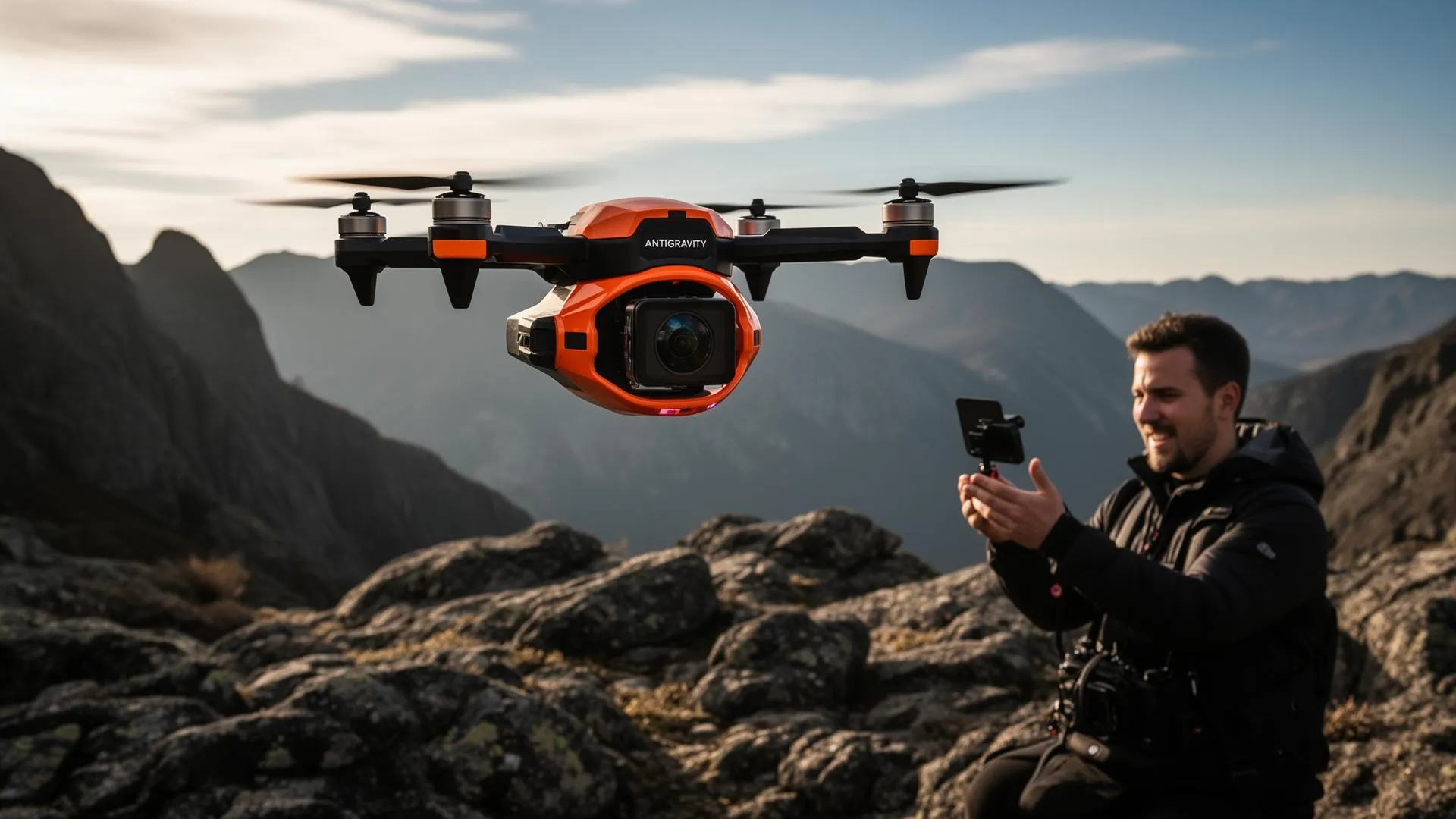
The Antigravity A1 is the first consumer drone built around a single radical idea: instead of pointing a camera at a subject, it films everything around itself in 8K and lets you choose the shot afterward. It is the debut product of Antigravity, a drone brand incubated by 360 camera specialist Insta360, and it does something no DJI or Autel drone does. This review explains, with verified specifications and no invented hands-on testing, what makes the A1 genuinely different, where the trade-offs are honest, how it stacks up against a normal FPV drone, and who should actually consider spending the money.
The one thing to know: the A1's value is the "reframe later" workflow. Because the dual-lens system captures a full 360-degree sphere in 8K, you decide framing, pans, and the invisible-drone effect in editing rather than in flight. That creative freedom is real and unmatched right now. The cost is a smaller-than-flagship sensor, short flight time, and a price that DJI's later Avata 360 dramatically undercut.
What makes the Antigravity A1 unique
Conventional camera drones, including dual-camera models like the DJI Air 3, fix the camera on a gimbal and you compose the shot by aiming the aircraft. The A1 inverts that. Its two ultra-wide lenses sit top and bottom and record the entire sphere at once, so the drone is never pointed "wrong." You fly the flight path you want and then crop a flat, traditional-looking video out of the sphere in post, complete with virtual pans, tilts, and tracking. Antigravity calls the result a way to capture first and frame later.
Two consequences follow. First, the much-loved "invisible drone" effect, where the aircraft and its arms are stitched out of the footage, leaving what looks like a camera floating in mid-air, comes essentially for free because the software already has a full sphere to work with. Second, you can produce several distinct shots from one flight, which is genuinely useful for solo creators and action sports where you only get one pass. The trade-off is that 360 editing is a workflow you have to learn, and a 8K sphere reframed down to a normal 16:9 clip uses only a slice of that resolution, so the deliverable is closer to action-camera quality than cinema camera quality.
Verified specifications
Every figure below is taken from Antigravity's published specification sheet (Antigravity A1 specs). Where the original launch coverage rounded numbers differently, the manufacturer figures take priority.
| Specification | Antigravity A1 |
|---|---|
| Camera system | Dual 1/1.28-inch sensors, f/2.2, full 360-degree capture |
| Video | 8K @ 30fps / 5.2K @ 60fps / 4K @ 100fps |
| Photo | 55 MP (10496 × 5248) 360 sphere |
| Takeoff weight | 249 g (Flight Battery) / 291 g (High-Capacity Battery) |
| Flight time (rated) | 24 min (standard) / 39 min (high-capacity) |
| Max speed | 16 m/s (S Mode) |
| Wind resistance | 10.7 m/s (24 mph), Level 5 |
| Obstacle sensing | Forward, 0.5–18 m |
| Transmission | OmniLink 360, up to 10 km (FCC) |
| Storage | 20 GB internal + microSD (up to 1 TB) |
| Price (US) | From $1,599 (Standard) / $1,899 Explorer / $1,999 Infinity |
A note on the 10 km transmission figure: that is a best-case FCC rating in clear, interference-free conditions, and it is not the practical limit you should plan around. Digital Camera World's review reported real-world radio range closer to a few hundred metres before the link became unreliable (Digital Camera World review). In any case you are legally required to keep the drone within visual line of sight in nearly every jurisdiction, so the headline range is largely academic.
Goggles and controller: how you actually fly it
The A1 has no smartphone mount and no controller with a built-in screen. You fly it entirely through the Vision Goggles, which use dual 1.03-inch Micro-OLED panels at 2560 × 2560 each and pancake optics to create a large virtual screen. The goggles weigh about 340 g, use a split battery design that moves weight off the face, and run roughly 2.5 hours per charge with diopter adjustment from −5.0 D to +2.0 D for glasses wearers, per the manufacturer specs. Because the goggles stream the live 360 sphere, you can turn your head to look around in flight, which is the part reviewers consistently describe as the standout experience.
Piloting is done with a one-handed Grip motion controller: you point where you want to go and the drone follows, with head tracking steering the live view independently of the flight path. This is closer to the immersive feel of an FPV setup than to twin-stick drone flying, and the learning curve is gentler than a manual acro quad because the aircraft holds a stable path while you aim.
Important: goggles flying and the line-of-sight rule
Because the headset covers your eyes, you cannot personally maintain visual line of sight with the aircraft. Most jurisdictions still require an unaided line of sight to the drone, which in practice means flying with a visual observer who keeps eyes on it, or holding the relevant authorisation. In the EU, FPV and goggles flying are addressed in our EU drone regulations for FPV pilots, and the visual-observer principle applies just as firmly in the US. Treat the visual observer as mandatory, not optional.
Image quality: impressive sphere, honest limits
The dual 1/1.28-inch sensors are the same class of camera hardware Insta360 ships in its flagship action cameras, so the 360 capture is strong and the colour science is mature. Reviewers found the result genuinely impressive as a creative tool. Digital Camera World called it "an impressively successful fusion of two technologies" that the writer felt they "could use," while still flagging the resolution maths (Digital Camera World). TechRadar summed it up as "a niche, unrivalled and expensive 360 drone" (TechRadar).
The honest caveat is what happens when you reframe. An 8K sphere sounds enormous, but once you crop a normal 16:9 shot out of it you are using only a portion of those pixels, so the finished clip is closer to high-quality action-camera footage than to single-sensor cinema drones. Stills are weaker than video, and a fixed f/2.2 with no ND filter limits control in bright light. If you want to understand why sensor size and aperture, not the megapixel number on the box, drive real image quality, our explainer on drone camera sensors is the right background.
Strengths
- • Reframe later: many shots from a single flight
- • "Invisible drone" effect comes naturally from the 360 capture
- • Immersive head-tracked goggles view in real time
- • 249 g with the standard battery in many regions
- • Mature Insta360 camera and editing ecosystem
Limitations
- • Reframed clips use only part of the 8K sphere
- • No ND filter support, fixed f/2.2 aperture
- • Short rated flight time (24 / 39 min)
- • Goggles flying needs a visual observer
- • Far pricier than DJI's later Avata 360
Flight time and the editing workflow
Antigravity rates the standard Flight Battery at 24 minutes and the High-Capacity Battery at 39 minutes. As with every drone, those are best-case figures, and once you allow a safety margin before low-battery warnings the usable numbers come in lower, so plan shoots accordingly. Conventional camera drones in this price bracket are rated noticeably higher, so the shorter endurance is part of the trade you accept for the 360 system. If you mainly do short, planned passes for action content this matters less; for long roaming flights it is a real constraint.
Budget time for editing too. The "decide it later" promise is only as good as the reframing work you put in afterward, and 360 video is heavier to store and process than flat footage. The upside is that Antigravity inherits Insta360's well-developed desktop and mobile editing tools, including AI-assisted subject tracking, so the learning curve is manageable if you already work with spherical video.
Antigravity A1 vs a normal FPV drone, and vs DJI Avata 360
A standard FPV drone shows you a single fixed forward view and you commit to the framing as you fly. The A1's selling point over that model is forgiveness: you are never aimed wrong, and you can extract a clean, stabilised, traditional shot from a sphere afterward. The cost is the reframing workflow and lower effective resolution per delivered clip.
The most important comparison, though, is DJI's own answer. The DJI Avata 360 launched in March 2026 and, per DroneXL, opened US orders at about $719, undercutting the A1 by more than a thousand dollars (DroneXL). DJI's drone also adds a single-lens mode so it can work as a conventional 4K FPV drone, a flexibility the 360-only A1 lacks. The A1's counterweights are the Insta360 camera pedigree, the immersive goggles experience, and the fact that it does not carry DJI's US regulatory uncertainty; for that context see our coverage of the DJI ban and the NDAA.
| Feature | Antigravity A1 | DJI Avata 360 |
|---|---|---|
| 360 resolution | 8K @ 30fps | 8K @ 60fps (reported) |
| Single-lens FPV mode | No (360 only) | Yes |
| Weight | 249 g (standard) | ~455 g (reported) |
| US starting price | $1,599 | ~$719 |
| Ecosystem | Antigravity / Insta360 | DJI Fly |
Who the Antigravity A1 is for
A good fit if you
- • Already work with 360 or spherical video
- • Shoot action sports needing reframe flexibility
- • Want the invisible-drone floating camera look
- • Value the immersive head-tracked goggles experience
- • Prefer a brand outside DJI's US regulatory question
Look elsewhere if you
- • Need cinema-grade single-sensor image quality
- • Want the lowest price for a 360 drone (see Avata 360)
- • Need long flight time per battery
- • Always fly solo with no visual observer
- • Prefer traditional twin-stick control
The verdict
The A1 is a genuinely original product and the first to make full 360 aerial capture with reframe-later editing a real consumer experience. For creators who already think in spheres, nothing else feels quite like it. The honest brakes are the effective resolution after cropping, the short flight time, the visual-observer requirement, and a price that DJI's Avata 360 undercut heavily. Buy it for the workflow and the experience, not as the cheapest way into 360 flying.
Frequently asked questions
Is the Antigravity A1 really the first 8K 360 consumer drone?
Yes. Antigravity and Insta360 marketed it as the world's first all-in-one 8K 360 drone, and it shipped from December 2025, ahead of DJI's competing Avata 360 which launched in March 2026. The A1 captures a full 360-degree sphere in 8K at 30fps rather than using a single forward-facing camera.
Can I fly the A1 without the goggles?
No. The A1 is piloted through the Vision Goggles and the Grip motion controller. There is no smartphone-screen alternative for flying, which is part of why a visual observer is needed: with the headset on, you cannot keep your own eyes on the aircraft.
Does the 249 g weight mean no registration?
With the standard Flight Battery the A1 is 249 g, which sits under the common 250 g threshold in many regions. The High-Capacity Battery raises it to about 291 g, which can change your obligations. Rules differ by country, so check the specifics, for example our guide to the US registration and licensing rules.
How does image quality compare to a normal camera drone?
The 360 capture is strong, but because a finished 16:9 clip is cropped out of the sphere it uses only a fraction of the 8K resolution. The result is closer to high-quality action-camera footage than to single-sensor cinema drones. You trade outright sharpness for the freedom to choose any framing after the flight.
Should I buy the A1 or the DJI Avata 360?
The Avata 360 is far cheaper (US orders opened around $719 versus $1,599) and adds a single-lens FPV mode. The A1's case rests on the Insta360 camera pedigree, the immersive goggles, and avoiding DJI's US regulatory uncertainty. If price is the priority, the Avata 360 wins; if you want the Insta360 ecosystem, the A1 holds its niche.
This review is based on Antigravity's published specifications and reputable third-party reporting. It is not a first-hand flight test and is not sponsored. The site may earn an affiliate commission on purchases made through retailer links. Specifications and pricing verified June 2026.
Frequently Asked Questions
Is the Antigravity A1 really the first 8K 360 consumer drone?
Yes. Antigravity and Insta360 marketed it as the world's first all-in-one 8K 360 drone, shipping from December 2025, ahead of DJI's competing Avata 360 in March 2026. It captures a full 360-degree sphere in 8K at 30fps rather than using a single forward-facing camera.
Can I fly the A1 without the goggles?
No. The A1 is piloted through the Vision Goggles and the Grip motion controller, with no smartphone-screen alternative. That is also why a visual observer is needed, since the headset stops you keeping your own eyes on the aircraft.
How does image quality compare to a normal camera drone?
The 360 capture is strong, but a finished 16:9 clip is cropped from the sphere and uses only a fraction of the 8K resolution, so the result is closer to high-quality action-camera footage than to single-sensor cinema drones. You trade sharpness for total framing freedom after the flight.
Should I buy the A1 or the DJI Avata 360?
The Avata 360 is far cheaper (US orders opened around $719 versus $1,599) and adds a single-lens FPV mode. The A1's case rests on the Insta360 camera pedigree, the immersive goggles, and avoiding DJI's US regulatory uncertainty. If price leads, the Avata 360 wins; if you want the Insta360 ecosystem, the A1 holds its niche.