
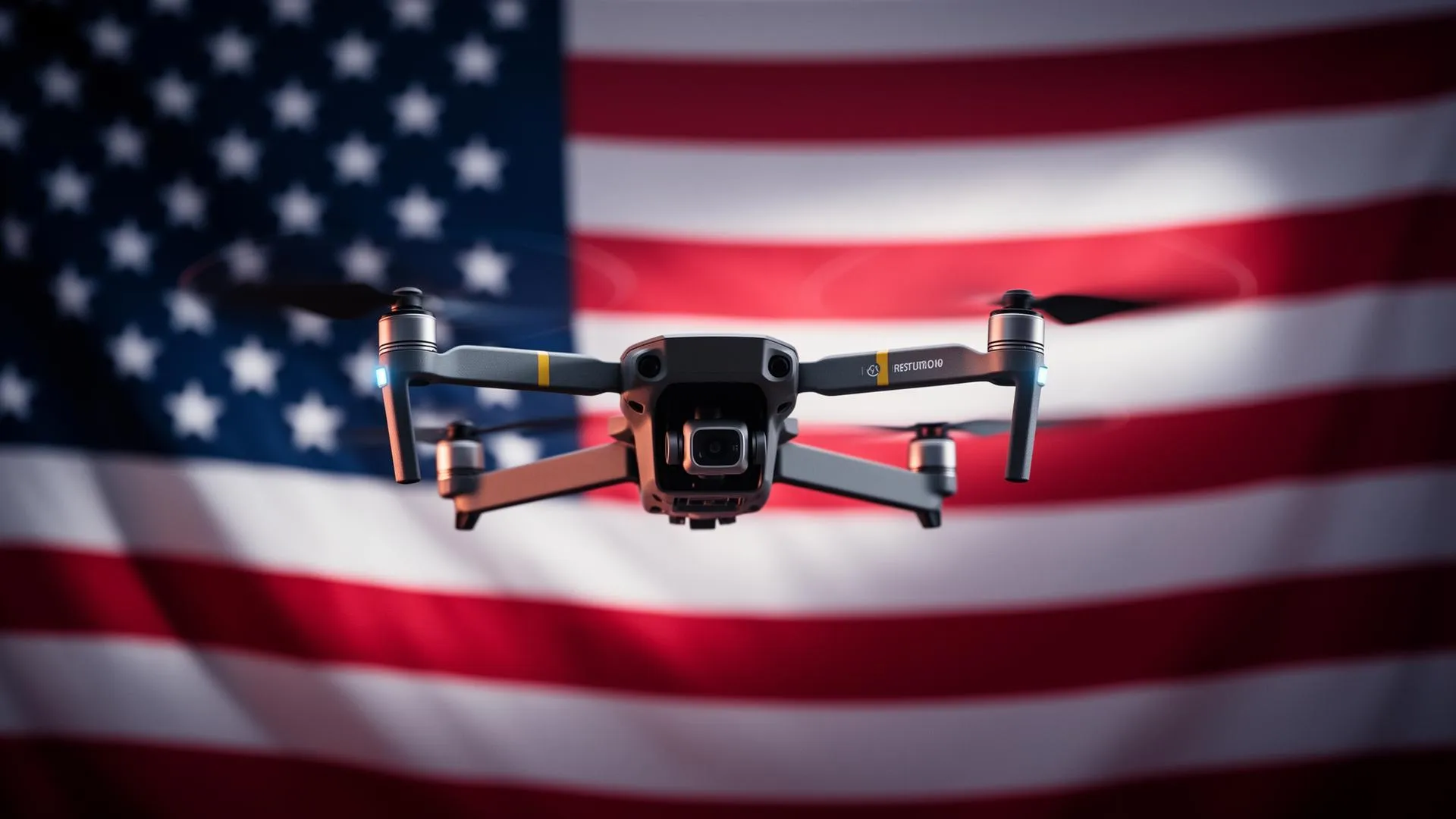
Is DJI banned in the United States? The short, honest answer is: not in the way most headlines suggest. As of 2026 you can still legally fly a DJI drone you already own, and previously authorized models can still be sold. What changed in December 2025 is that the door to new DJI products closed: the Federal Communications Commission added all foreign-made drones to its Covered List, which cuts off the FCC authorization a manufacturer needs to bring new models to market. This page explains exactly what the FY2025 NDAA did, what the FCC did on 22 December 2025, the difference between owning a drone and importing one, and what it all means before you buy.
The one thing to know: there is no law grounding the DJI drone in your bag. The 2025 measures target new equipment authorizations, imports, and sales, not personal operation of drones already in the country. The practical risk for owners is forward-looking: harder-to-find new models, possible firmware and support gaps, and faster depreciation. If you need a drone now and a verified, in-stock unit exists, you can still buy and fly it legally. The uncertainty is about tomorrow's hardware, not today's flights.
The status in one table
| Question | Status in 2026 |
|---|---|
| Can I still fly a DJI drone I already own? | Yes. Existing equipment authorizations are not revoked. |
| Can retailers still sell DJI drones? | Models authorized before 22 Dec 2025 may still be sold while stock lasts. |
| Can DJI get new US approvals for new models? | No. Foreign-made UAS cannot receive new FCC authorizations. |
| Were existing drones added to a banned list? | Equipment authorizations already granted remain valid. |
| Is this a consumer-flight ban? | No. It is a market-access and procurement measure. |
What the FY2025 NDAA actually said
The story most people call "the DJI ban" runs through the National Defense Authorization Act for fiscal year 2025. Lawmakers had pushed a standalone bill, the Countering CCP Drones Act, that would have placed DJI directly on the FCC Covered List. That specific bill did not make it into the final NDAA text, but Congress folded in a near-equivalent mechanism instead (DroneLife conference-text analysis).
Section 1709 of the FY2025 NDAA required a designated national security agency to conduct a formal evaluation of whether certain foreign-made drones and related communications and imaging equipment pose an unacceptable risk to US national security. The teeth were in the default: if no agency completed that review within one year of enactment, by 23 December 2025, the equipment would be automatically added to the FCC Covered List. In effect, Congress set a clock and made inaction the trigger rather than a finding of wrongdoing (DroneLife on the NDAA audit deadline).
Here is the wrinkle that defined 2025: the law required an audit but did not clearly assign any single agency to perform it. DJI publicly framed this as a "legislative gap" and, in letters dated 1 December 2025, urged the Department of Homeland Security, the Department of Defense, the FBI, the NSA, and the Office of the Director of National Intelligence to begin the review or grant an extension, arguing a credible audit could not realistically be finished in the time remaining (DroneDJ on DJI's last-minute letters). No agency publicly confirmed it had completed the review, so the deadline arrived with the default outcome looming.
What the FCC did on 22 December 2025
The actual action turned out broader than a DJI-only listing. On 22 December 2025 the FCC's Public Safety and Homeland Security Bureau added all foreign-produced uncrewed aircraft systems and their critical components to the Covered List, unless the Department of War or the Department of Homeland Security determines a specific product poses no risk. Rather than banning one company, the FCC effectively closed the US market to new foreign-made drones across the board (Wiley law-firm alert on the FCC action).
The definition of "critical components" is deliberately wide: data transmission devices, communications systems, flight controllers, navigation systems, sensors, cameras, batteries, and motors. DJI and Autel were singled out for stricter treatment, with their equipment remaining covered even if production were to move to the United States or run through domestic licensing arrangements. That detail matters because it forecloses the obvious workaround of relabeling or partial onshoring.
What "Covered List" means in plain English
- • The FCC Covered List names equipment deemed an unacceptable national-security risk.
- • Listed equipment cannot receive new FCC authorizations going forward.
- • Without an authorization, a new model cannot be legally imported or marketed in the US.
- • Authorizations granted before the listing are not automatically revoked.
- • It is a market-access rule, not a personal-use prohibition.
Existing owners vs new imports and sales
This is the distinction that gets lost in the headlines, so it is worth stating precisely. Covered List placement does not ground drones already in the country and does not make existing models illegal to operate. Industry and legal coverage is consistent that previously authorized equipment may still be sold and that existing certifications are not explicitly revoked by the underlying law. The FCC retains broader authority that it could theoretically use to revoke authorizations later, but there is no announced mandate to do so (DroneFly status guide).
DJI's own position aligns with that reading. The company states that owners can continue to use current DJI equipment and characterizes the threat as forward-looking: automatic listing would block future purchases and constrain new product launches rather than disable existing drones (DJI's official US-status explainer). For a hobbyist with a Mini or an Air in the bag, the day-to-day reality has not changed: you still register, you still fly within the rules, and your aircraft still works.
The customs angle is a separate problem
Layered on top of the NDAA and FCC story is a distinct supply issue at the border. Since late 2024, US Customs and Border Protection has detained DJI shipments under Section 307 of the Tariff Act and the Uyghur Forced Labor Prevention Act, which create a rebuttable presumption against goods linked to forced labor in the Xinjiang region. DJI is not on the UFLPA Entity List and says its production is based in Shenzhen and Malaysia, never Xinjiang, but the importer carries the burden of proof, so units have piled up in customs while DJI works to clear them (DroneDJ on the customs holds).
The combined effect of the customs holds and the FCC listing is why the practical experience for buyers in 2025 and into 2026 has been scarcity rather than a courtroom ban. DJI's US online store has shown popular models as sold out, and availability has tightened across retailers even though the drones themselves remain legal to own and fly (DroneLife on US consumer scarcity). Treat customs and the Covered List as two separate currents pushing the same direction: fewer new DJI units reaching American buyers.
Why this matters so much: DJI's market position
The reason a market-access measure lands like an earthquake is sheer dominance. DJI has long held the large majority of the US drone market, with estimates clustering well above 70 percent by sales, and its grip is even tighter in public safety, where it has supplied the overwhelming share of agency fleets. FAA research cited in 2026 found DJI accounting for the vast majority of detected US drone platforms, underscoring how much of the airspace runs on one company's hardware (DroneXL on FAA platform-detection data). When the dominant supplier loses its path to new authorizations, the ripple reaches hobbyists, real-estate shooters, agriculture, inspection, and first responders alike.
Timeline at a glance
CBP begins detaining DJI shipments under UFLPA
FY2025 NDAA enacted with the Section 1709 audit clock
DJI letters urge agencies to start the audit or extend
FCC adds all foreign-made UAS to the Covered List
Practical buyer guidance for 2026
None of this changes the basic legal duty of flying. Whatever drone you choose, US pilots still register with the FAA where required and comply with Remote ID. Our FAA registration and license guide and our Remote ID compliance guide cover those obligations, and they apply equally to DJI and to any alternative you pick.
Reasonable to buy DJI if you
- • Need a capable drone now and find a verified in-stock unit
- • Can accept possible firmware and support gaps over time
- • Are comfortable with faster resale depreciation
- • Want the maturity of DJI's camera and flight platform
Think twice if you
- • Run a public-safety or government program with procurement rules
- • Depend on guaranteed long-term parts and warranty support
- • Need to scale a fleet over several years
- • Want certainty about future model availability
If you are weighing alternatives, the comparison that matters most is DJI against the next-largest player. Our DJI vs Autel comparison is a useful starting point, though note that Autel is also foreign-made and falls under the same FCC listing, so it does not sidestep the regulatory question. For owners, the smart moves are unglamorous: back up flight logs, note your firmware versions, and pick up spare batteries and accessories before shortages bite. If you are still deciding whether to commit at all, our piece on whether buying a drone is worth it in 2026 walks through the total cost and the resale picture, and you can browse current options on our drones overview.
The bottom line
DJI is not banned from being flown in the United States. The 2025 measures, an NDAA audit that defaulted to action when no agency completed it, and an FCC listing that swept in all foreign-made drones, restrict new authorizations, imports, and sales rather than personal use. Existing drones keep flying and previously authorized models can still be sold. The real consequence is a slow squeeze on the future: scarcer new hardware, uncertain support, and softer resale value. Buy with eyes open, keep your registration and Remote ID in order, and plan around supply rather than a phantom flight ban.
Frequently asked questions
Is it illegal to fly my DJI drone in the US now?
No. The 2025 measures target new equipment authorizations, imports, and sales, not personal operation. Drones already in the country keep working, and existing FCC authorizations are not revoked. You still need to register with the FAA where required and comply with Remote ID.
What exactly did the FCC do on 22 December 2025?
The FCC's Public Safety and Homeland Security Bureau added all foreign-produced uncrewed aircraft systems and their critical components to the Covered List, unless a specific product is cleared by the Department of War or DHS. That blocks new FCC authorizations for those products, which are required to import and market new models.
Did the NDAA single out DJI, or all Chinese drones?
The NDAA set up an audit that defaulted to Covered List placement if not completed by 23 December 2025. The standalone Countering CCP Drones Act, which named DJI directly, did not make the final text. The FCC's actual listing went broader and covered all foreign-made drones, with DJI and Autel facing stricter treatment.
Is the customs issue the same as the FCC ban?
No, they are separate. US Customs has held DJI shipments since late 2024 under the Uyghur Forced Labor Prevention Act, a trade-and-labor matter. The FCC listing is a national-security spectrum-authorization matter. Both reduce new supply, which is why availability has tightened even though the drones remain legal to own.
Should I still buy a DJI drone in 2026?
You can, and it is legal to fly one. Accept that new models may be scarce, that firmware and support could face gaps, and that resale value may soften faster than before. If you run a government or public-safety program with procurement restrictions, or you need guaranteed long-term support, weigh the risk more carefully.
Could existing DJI drones be grounded later?
There is no announced plan to revoke existing authorizations. The FCC has broader authority it could theoretically use, but the underlying law did not mandate revoking already-certified equipment. The realistic near-term risks for owners are support and parts availability, not a forced grounding.
This explainer summarizes the FY2025 NDAA, the FCC's December 2025 Covered List action, and related customs developments using primary and reputable third-party reporting. It is general information, not legal advice; regulatory details continue to evolve, so verify the current status before importing, selling, or making a purchase decision. Sources verified June 2026.
Frequently Asked Questions
Is it illegal to fly my DJI drone in the US now?
No. The 2025 measures target new authorizations, imports, and sales, not personal operation. Drones already in the country keep working and existing FCC authorizations are not revoked. You still register with the FAA where required and comply with Remote ID.
What exactly did the FCC do on 22 December 2025?
It added all foreign-produced uncrewed aircraft systems and their critical components to the Covered List unless cleared by the Department of War or DHS. That blocks the new FCC authorizations required to import and market new models.
Is the customs issue the same as the FCC ban?
No. Customs holds since late 2024 stem from the Uyghur Forced Labor Prevention Act, a trade-and-labor matter. The FCC listing is a national-security authorization matter. Both reduce new supply, which is why availability tightened even though the drones stay legal to own.
Should I still buy a DJI drone in 2026?
You can, and flying one is legal. Accept that new models may be scarce, firmware and support could face gaps, and resale value may soften faster. Government and public-safety buyers with procurement rules should weigh the risk more carefully.