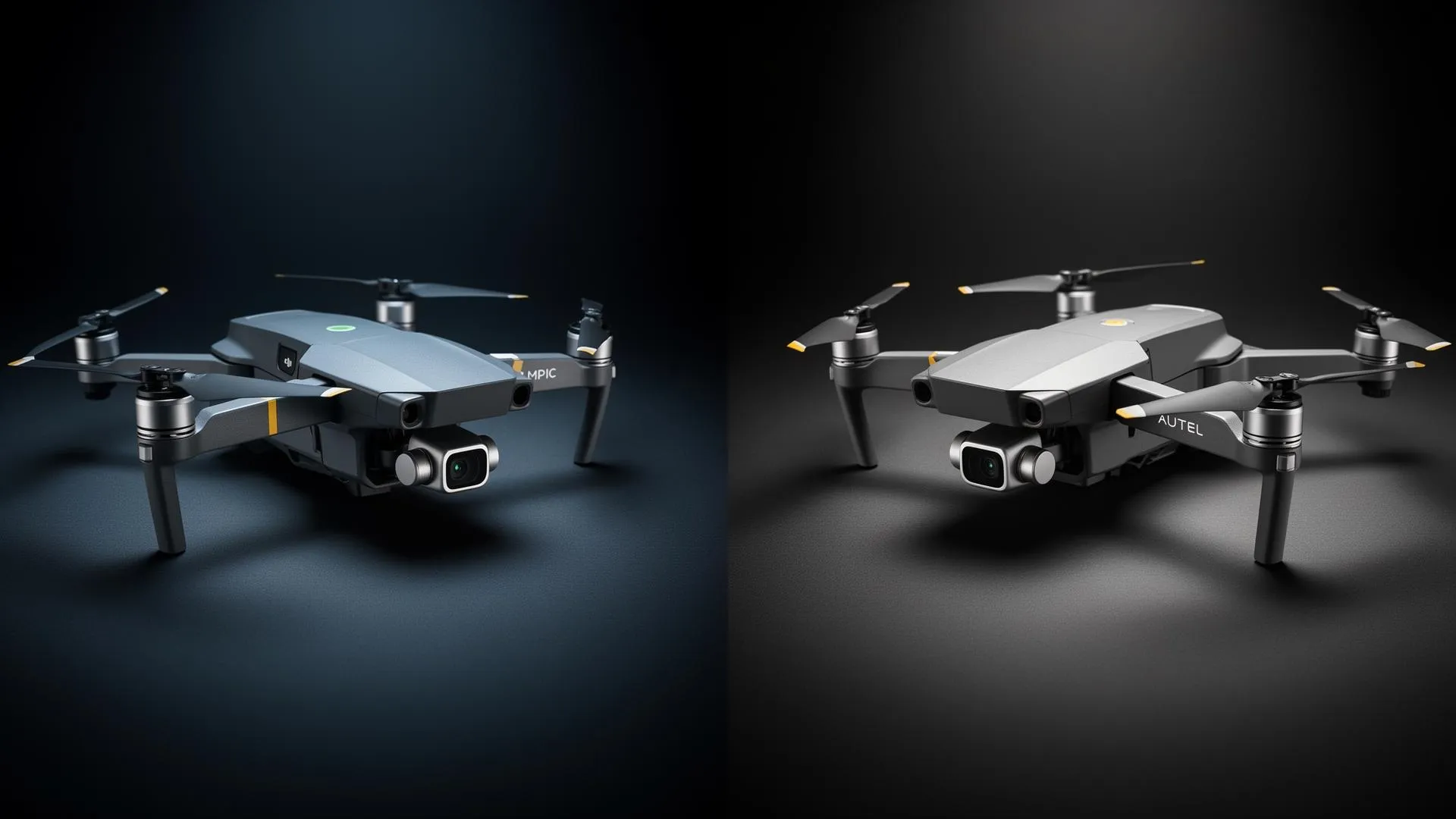
For most of the last decade, picking a consumer drone meant picking DJI, with Autel Robotics as the plucky alternative for buyers who wanted long flight times or a brand that was not DJI. In 2026 the question is more complicated, because the better drone on paper is not always the one you can legally buy where you live. This comparison looks at camera and sensor hardware, transmission range, obstacle avoidance, the apps you actually live with, real prices, and the US import situation that now hangs over both brands. It is written for buyers deciding where to put their money, not for brand loyalists.
The one thing to know first: on raw consumer hardware, DJI still wins on cameras, software polish, and the sub-250 g category. But both DJI and Autel were added to the FCC Covered List in December 2025, which blocks new US equipment authorizations for both. If you are buying in the United States, what you can actually purchase matters more than which brand benchmarks slightly higher.
Two Shenzhen companies, two very different scales
Both companies are headquartered in Shenzhen, China, but they are not the same size. DJI, founded in 2006, dominates the consumer market: estimates put its share of the US consumer drone market around 80% and roughly half to three quarters of the global civil market depending on how you slice it (CKGSB Knowledge). Autel Robotics, founded in 2014, is a much smaller player that has leaned heavily into the enterprise and public-safety market (thermal, zoom, RTK mapping) while keeping a thinner consumer lineup.
That difference shapes everything below. DJI iterates its consumer line constantly (Mini, Air, Mavic, Neo, Avata) and pours engineering into the app and color science. Autel's energy increasingly sits in commercial airframes like the EVO Max series, while its consumer EVO Lite+ and EVO Nano sit on an older release cadence. If you only care about a camera drone for travel and hobby footage, you are really comparing DJI's deep, fresh lineup against Autel's smaller, slower-moving one.
Camera and sensor: DJI's clearest lead
On the flagship tier, the gap is wide. DJI's Mavic 4 Pro pairs a 100MP 4/3 Hasselblad main sensor (variable aperture f/2.0 to f/11) with two tele cameras, and shoots up to 6K/60 HDR video (Hasselblad). Autel's flagship attention now goes to the EVO Max 4T V2, which is a quad-sensor enterprise platform (wide, 8K zoom, thermal, laser rangefinder) rather than a photographer's drone (Autel). Those two are not really aimed at the same buyer, which tells you something: DJI builds for creators, Autel increasingly builds for inspection and public safety.
The fairer consumer fight is mid-range. Here DJI's Air 3S uses a dual-camera setup, a 1-inch 50MP wide and a 1/1.3-inch 48MP medium tele, both with up to 14 stops of dynamic range and 4K/60 HDR (DJI Air 3S specs). Autel's EVO Lite+ answers with a single 1-inch 20MP sensor, an adjustable f/2.8 to f/11 aperture, and 6K/30 video (Autel). The EVO Lite+ has a deserved reputation for clean low-light files thanks to its sensor and aperture, but the Air 3S gives you two focal lengths, better HDR processing, and a much fresher pipeline. If image flexibility and post-processing latitude matter to you, read our guide to how drone camera sensors work before you fixate on megapixel counts.
| Spec | DJI Air 3S | Autel EVO Lite+ |
|---|---|---|
| Main sensor | 1" 50MP wide + 1/1.3" 48MP tele | 1" 20MP (single camera) |
| Video | 4K/60 HDR, 4K/120 slow-mo | 6K/30, 4K/60 |
| Dynamic range | Up to 14 stops | ~12 stops (per Autel) |
| Max flight time | 45 min | 40 min |
| Transmission system | DJI O4, up to 20 km (FCC) | SkyLink, up to ~12 km (7.4 mi) |
| Obstacle sensing | Omnidirectional + forward LiDAR | 3-direction (front/back/down) |
| Typical price | From $1,099 | ~$1,149 (street price varies) |
Figures above are drawn from each manufacturer's published specs for these models (DJI, Autel). Quoted transmission ranges are best-case figures under FCC limits with no interference; real-world line of sight is much shorter and you should always keep the aircraft within visual line of sight anyway.
Transmission range: both quote big numbers, DJI is more proven
DJI's current consumer drones use the O4 video transmission system, which DJI rates at up to 20 km in FCC regions with 1080p/60 feed, while the Mavic 4 Pro steps up to O4+ with a 30 km headline figure (DJI Air 3S specs). Autel's consumer SkyLink rates the EVO Lite+ at up to 7.4 miles (about 12 km), and the enterprise EVO Max 4T V2 pushes a 20 km SkyLink 3.0 figure with multi-band anti-jamming (Autel). In practice both are far more range than any legal recreational flight needs. What separates them is reliability of the link in cluttered RF environments, where DJI's OcuSync/O4 lineage has the longer track record and the larger pool of real-world feedback.
Obstacle avoidance: DJI broader, Autel solid where it counts
On the consumer side DJI is ahead in coverage and low-light sensing. The Air 3S adds forward-facing LiDAR on top of omnidirectional vision sensors, so it can detect obstacles in near-darkness (DJI Air 3S). Autel's EVO Lite+ uses a 3-direction system (forward, backward, downward), which is fine for cautious cruising but leaves the sides and top uncovered. On Autel's enterprise EVO Max line the avoidance story is much stronger, with 720-degree sensing, but that is a different price bracket. For a typical buyer choosing a sub-$1,500 camera drone, DJI's avoidance is the more complete safety net.
Software and app: DJI's quiet moat
Specs get the headlines, but software is what you touch every flight. DJI Fly is mature, responsive, and consistent across the lineup, with reliable QuickShots, well-tuned subject tracking, and a deep bench of tutorials and community knowledge. Autel's app has improved but still trails on polish, and firmware updates arrive less frequently. Third-party support also tilts DJI's way: established automation apps integrate more readily with DJI hardware, which matters if you plan mapping or repeatable cinematic moves. If you are weighing flight-automation tools, our drone guides hub covers the practical tradeoffs in more depth.
The sub-250 g category: not a contest
If you want the lightest possible drone (under 250 g brings real regulatory relief in the EU and a registration exemption for non-commercial flyers under FAA rules), DJI simply has no peer here. The Mini series, Flip, and Neo all live under 250 g, and the DJI Mini 5 Pro went further by putting a 1-inch sensor and forward LiDAR into a 249 g body, a first for the class (DPReview). Autel does not field a competitive sub-250 g camera drone. One important caveat: the Mini 5 Pro has not been released for the US market because of the regulatory situation, so its availability depends heavily on where you live. If light weight is your priority, browse current options in our drone reviews.
Price and availability in 2026
Sticker prices are close in the mid-range. The DJI Air 3S starts at $1,099, with Fly More Combos at $1,399 and $1,599 (DJI Store), while the Autel EVO Lite+ tends to sit around the $1,100 to $1,250 mark depending on bundle and retailer (Autel). DJI's flagship Mavic 4 Pro is a different league at $2,199 and up. Autel sometimes wins on promotional pricing and bundle value, which is its historic appeal. But in 2026 the bigger variable is not price, it is whether new stock keeps flowing into your region. That brings us to the part of this comparison that genuinely changed the calculus.
The US import situation: NDAA and the FCC Covered List
In December 2025 the FCC took a first-of-its-kind step and added foreign-produced unmanned aircraft and critical components to its Covered List, a move widely reported as the practical start of the "DJI ban" (DroneLife). Both DJI and Autel were swept in. The FY25 NDAA named Autel Robotics specifically, and the FCC's action added both companies' equipment to the list (Wiley Law analysis).
Here is what that does and does not mean. Being on the Covered List blocks new FCC equipment authorizations, which are required to import, market, and sell most wireless gear in the US. It does not retroactively ban drones the FCC previously authorized: existing models can still be imported, sold, and flown (Akin Gump). The practical effect is a cutoff for future market entry, not a grounding of what you already own. In May 2026, Autel filed a sharply worded challenge to the FCC, arguing the agency relied on broad national-security assumptions rather than an individualized review of Autel itself (DroneLife), so the situation is still moving.
What this means for a US buyer right now
You can still buy and legally fly existing, already-authorized DJI and Autel models. New US releases for both brands are blocked unless the policy changes, which is why a drone like the DJI Mini 5 Pro launched abroad but not in the US. Outside the US, neither the NDAA nor the FCC Covered List applies, so European, UK, and most other buyers shop on hardware merit alone. Either way, registration and Remote ID rules still apply: see our Remote ID compliance guide and, for US pilots flying commercially, the FAA Part 107 license overview.
Who should buy which
Lean DJI if
- Photography and color science are your priority
- You want a true sub-250 g option (Mini, Flip, Neo)
- App polish, tracking, and tutorials matter to you
- You want the broadest, freshest consumer lineup
- You can find authorized inventory in your region
Lean Autel if
- You value clean low-light single-sensor footage
- You need enterprise tools (thermal, zoom, RTK, laser)
- A promotional bundle price beats DJI in your market
- You want a brand distancing itself from DJI politically
- You do not need sub-250 g or dual focal lengths
Bottom line
Strip away the politics and DJI still gives most consumer buyers the better overall package: stronger cameras, broader obstacle avoidance, a more polished app, and an unmatched sub-250 g range. Autel earns its place as a genuine alternative, especially for low-light shooters who like its 1-inch sensor and for anyone needing thermal or zoom enterprise tools that DJI keeps in pricier or restricted lines. In 2026, though, the smartest move is to decide based on what you can actually buy and the role it will play, not on brand allegiance. If you are still narrowing the field, our deeper DJI Air 3 review and the full drone database are good next stops, and budget shoppers should start with the best drones under $200.
Frequently Asked Questions
Is DJI or Autel better for camera quality in 2026?
For most consumer buyers, DJI is ahead. The Mavic 4 Pro's 100MP 4/3 Hasselblad system and the Air 3S's dual-camera setup with up to 14 stops of dynamic range give DJI an edge in flexibility, HDR, and color science. Autel's EVO Lite+ has a well-regarded 1-inch sensor that does very well in low light, so it can be the better pick if clean night footage from a single camera is your main goal. For enterprise imaging (thermal, long zoom), Autel's EVO Max 4T V2 is a different category aimed at inspection and public safety rather than creators.
Are DJI and Autel drones banned in the US?
Not in the sense of an outright ground-stop. In December 2025 the FCC added foreign-made drones, including both DJI and Autel equipment, to its Covered List under the FY25 NDAA. That blocks new FCC equipment authorizations, which are needed to import, market, and sell new models in the US. Drones the FCC previously authorized can still be imported, sold, and flown. The main effect is a cutoff for future US releases, which is why some new models launch abroad but not in the US.
Does Autel have a sub-250 g drone to compete with the DJI Mini?
No, not a competitive one. DJI owns the sub-250 g camera-drone space with the Mini series, Flip, and Neo, and the DJI Mini 5 Pro even squeezed a 1-inch sensor and forward LiDAR into a 249 g body. Autel's consumer lineup (EVO Nano, EVO Lite+) does not include a sub-250 g model that matches DJI on camera and avoidance. If staying under 250 g for lighter regulation is important to you, DJI is effectively your only mainstream choice.
Which brand has longer flight time and range?
Flight times are now close. The DJI Air 3S is rated at up to 45 minutes and the Autel EVO Lite+ at up to 40 minutes, while DJI's Mavic 4 Pro reaches around 51 minutes. On transmission, DJI's O4 system is rated up to 20 km (and O4+ up to 30 km on the Mavic 4 Pro), versus about 12 km for the EVO Lite+ on SkyLink. All of these are best-case figures with no interference and far exceed what any legal, visual-line-of-sight flight requires, so reliability of the link matters more than the headline number.
Is Autel a safer long-term bet than DJI because it is challenging the FCC?
Not necessarily. Autel filed a challenge to the FCC in May 2026 arguing it should have received an individualized review rather than being grouped with DJI, but the outcome is unresolved and both companies sit on the Covered List today. Treat any "future-proofing" claim with caution: regulatory status can change in either direction. If long-term US availability is your main worry, base the decision on what is authorized and in stock now, and keep an eye on policy updates rather than betting on a court result.
I live in Europe. Does any of the US import drama affect me?
No. The NDAA and the FCC Covered List are US measures and do not apply in the EU, UK, or most other markets. European buyers can choose between DJI and Autel purely on hardware, price, and availability, and some DJI models (such as the Mini 5 Pro) reach Europe before or instead of the US. You still have to follow your own country's rules: EU operator registration, the A1/A3 competency proof for most camera drones, and Remote ID where required.