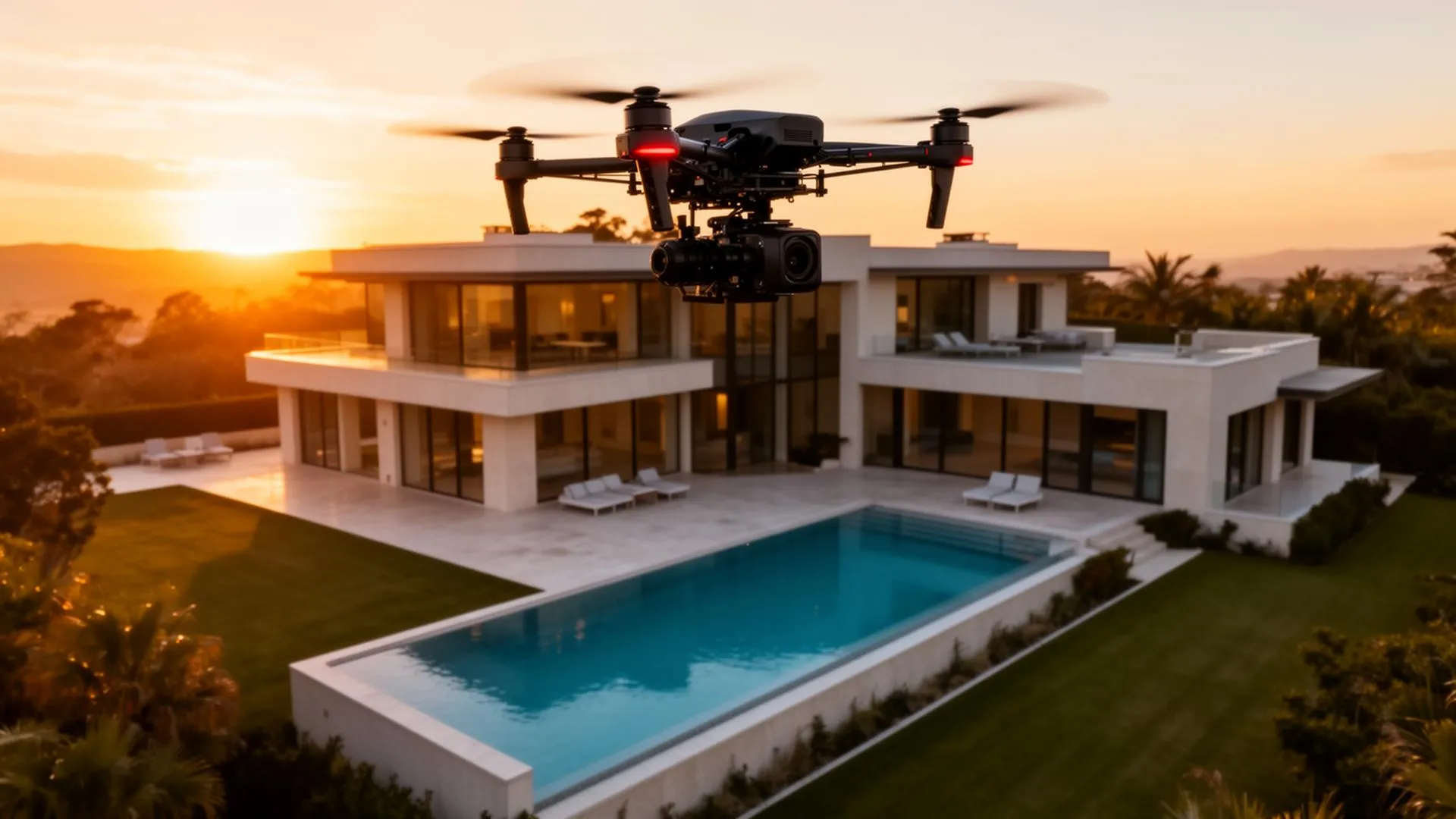
A good aerial shot does something interior photos cannot: it shows the lot, the roofline, the proximity to water or green space, and how a home actually sits on its street. That context sells. This guide is for real estate agents and photographers who want a drone that produces listing-grade stills and video in 2026, and it focuses on the four things that genuinely matter for property work: sensor and resolution, the ability to shoot clean vertical and 45-degree framings, low-light and dynamic-range performance for twilight shoots, and the automated flight modes that turn a 40-minute shoot into a 12-minute one. Every spec and price below is checked against the manufacturer or a reputable outlet, and the commercial-licensing angle is covered too, because in the US you legally need it before you can charge a cent.
The one thing to remember: for real estate you are buying the camera, not the airframe. A larger sensor (1-inch or bigger) with strong dynamic range is what lets you hold detail in a bright sky and a shaded porch in the same frame. If your budget forces a choice, spend it on the sensor and skip the extra accessories until you are booking regularly.
Why aerial photos matter for listings
The often-quoted figure that homes with aerial photography sell up to 68% faster comes from an MLS data analysis that has been cited across the industry for years (Redfin). Treat the exact percentage as marketing shorthand rather than peer-reviewed science, but the underlying point is sound: buyers increasingly expect an aerial view, and a drone is the cheapest way to add a perspective no ground camera can match. The question is no longer whether to offer aerial, it is which drone gives you reliable, print-quality results without a steep learning curve.
What actually makes a great real estate drone
Property work has its own demands that differ from travel or cinematic flying. Use these five criteria to judge any model.
1. Sensor size and resolution
This is the single biggest differentiator. A 1-inch sensor gathers far more light than the 1/1.3-inch sensors in cheaper drones, which means cleaner files, smoother gradients in skies, and far less noise once the sun drops. For stills, 48 to 50MP gives you room to crop and still deliver a sharp full-screen image on a listing portal. If you want to understand why sensor area matters more than the megapixel number on the box, our explainer on how drone camera sensors work breaks it down without the jargon.
2. Dynamic range and low-light performance
Real estate is a high-contrast game: bright sky, dark eaves, reflective windows. You want at least 14 stops of dynamic range so a single bracketed capture holds both highlights and shadows. Low-light ability is what unlocks the most profitable add-on in the business, the twilight shoot, where warm interior lights glow against a deep blue sky. Drones with larger sensors and an adjustable aperture handle this far better than fixed-aperture compacts.
3. Vertical and 45-degree framing
Two angles do most of the heavy lifting in property work: the classic 45-degree hero shot that shows the front elevation and the lot, and the true-vertical portrait frame that suits Instagram, Reels, and many MLS hero slots. Some drones rotate the gimbal a full 90 degrees for genuine vertical capture at full resolution. Others fake portrait orientation by cropping the horizontal sensor, which throws away pixels. If vertical social content is part of your offer, a rotating gimbal is worth paying for.
4. Automated and repeatable flight modes
Time on site is your real cost. Automated orbits give you a clean 360-degree showcase in one tap, and waypoint or saved-route features let you fly the identical path at every property (or at the same property week over week for new construction). The more the drone standardizes your shot list, the more consistent your deliverables and the more shoots you fit into a day.
5. Compliance with commercial rules
Spec sheets do not matter if you cannot legally fly the job. In the US, any paid real estate shoot is a commercial operation that requires an FAA Part 107 certificate and a Remote ID-compliant aircraft. We cover the legal side in its own section further down, because it should drive your buying decision as much as the camera does.
⚠️ A note on DJI availability in the US
As of December 23, 2025, DJI was added to the FCC Covered List, which blocks new DJI products from receiving fresh FCC authorization in the US (UAV Coach). Drones already authorized and on the market remain legal to buy and fly, and existing owners are unaffected, but stock can be tight and some newer models (such as the Mini 5 Pro) were never listed on DJI's US store. If supply certainty matters to you, factor that in and read the non-DJI section below.
The best real estate drones for 2026, by budget
Best overall: DJI Mavic 4 Pro
| Main sensor | 100MP Four Thirds (4/3) Hasselblad, adjustable f/2.0 to f/11 |
| Cameras | Triple: 28mm wide, 70mm medium tele, 168mm tele |
| Video | Up to 6K/60 HDR, 10-bit D-Log M on all cameras |
| Gimbal | 360-degree Infinity Gimbal, true vertical at full resolution |
| Flight time | Up to 51 minutes |
| Price | From about $2,199; Fly More Combo around $2,999 |
The DJI Mavic 4 Pro is the most capable consumer-class drone you can point at a property in 2026. Its 100MP Four Thirds Hasselblad sensor is physically larger than the 1-inch sensors in the rest of this list, and DJI rates the camera at roughly 15.5 stops of dynamic range, which is territory that used to be reserved for cinema bodies. For real estate that translates into highlight-protected skies, clean shadow detail, and twilight shots that hold up at full size.
Why it suits property work: the new 360-degree Infinity Gimbal rotates a full 90 degrees for genuine vertical capture with no cropping, and it can angle well upward for low, dramatic approach shots without catching the propellers (PetaPixel). The triple-camera setup means you can frame the lot at 28mm and pull a flattering, compressed elevation at 70mm without flying closer to the building. The 51-minute endurance lets you shoot a large estate on a single battery.
Honest limitations: it is the most expensive option here, and for a $300,000 starter home the results are arguably overkill. It is also a larger, heavier aircraft than a Mini, so it is less discreet on a tight urban lot. If you mainly shoot mid-market homes, the value pick below will serve you just as well for the listing.
Best value: DJI Air 3S
| Sensors | 1-inch 50MP wide + 1/1.3-inch 48MP 70mm tele |
| Dynamic range | Up to 14 stops on the 1-inch camera |
| Video | 4K/60 HDR, 4K/120 slow motion |
| Obstacle sensing | Forward LiDAR plus omnidirectional vision |
| Flight time | Up to 41 minutes |
| Price | From $1,099; Fly More Combo around $1,399 |
For most working real estate photographers, the DJI Air 3S is the sweet spot. It pairs a genuine 1-inch 50MP main sensor (a real upgrade over the earlier Air 3's twin 1/1.3-inch cameras) with a 70mm telephoto that gives you the compressed, flattering architectural look estate agents love. The forward LiDAR makes it notably confident around rooflines and trees in low light. Our hands-on look at the DJI Air series covers how the line has evolved if you are weighing a used Air 3 against the newer 3S.
Why it suits property work: the 1-inch sensor produces print-quality files that many high-volume shooters happily use over pricier flagships, and the 41-minute endurance covers a typical residential shoot with margin to spare. Automated orbits and QuickShots standardize your deliverables.
Honest limitations: portrait framing is achieved by cropping rather than a rotating gimbal, so dedicated vertical content loses some resolution. For pure twilight luxury work the Mavic 4 Pro's larger sensor still pulls ahead, but for the bread-and-butter listing the Air 3S is hard to beat on value.
Best lightweight option: DJI Mini 5 Pro (where available) or Mini 4 Pro
| Mini 5 Pro sensor | 1-inch (Type 1) 50MP, 14 stops dynamic range |
| Gimbal | 225-degree rotation, true vertical shooting |
| Weight | About 250g (EU C0 class) |
| Flight time | About 36 minutes |
| Price | From about $749; Fly More Combo around $1,099 |
The DJI Mini 5 Pro is a genuine breakthrough for the lightweight class: it is the first sub-250g drone with a 1-inch 50MP sensor and a rotating gimbal that does true vertical, so on paper it gives you flagship-grade stills and proper portrait video in a pocketable body. That makes it superb for townhouses, tight urban lots, and as a discreet second airframe. The catch is availability. DJI never listed it on its US store after a customs issue, so US buyers may have to rely on third-party stock or step to the earlier Mini 4 Pro (a 1/1.3-inch 48MP model with true vertical), which remains a strong sub-250g performer and is easier to source.
An important caveat: the sub-250g weight relaxes some recreational rules, but it does not exempt you from commercial requirements. In the US you still need Part 107 to fly any paid real estate job, regardless of how light the drone is.
Best non-DJI alternative: Autel EVO series
If you want to sidestep the DJI uncertainty entirely, Autel Robotics is the obvious place to look. Note that Autel wound down its consumer Lite+ and Nano+ lines in late 2024, so its current real-estate-relevant options are the prosumer EVO II V3 and the lightweight EVO Lite 6K Enterprise, the latter built around a 1-inch CMOS sensor with an adjustable f/2.8 to f/11 aperture and roughly 40 minutes per battery (Autel Robotics). That adjustable aperture and large sensor make it a credible twilight and low-light performer. Expect a slightly less polished app and a steeper learning curve than DJI's ecosystem, and confirm current pricing directly, as the lineup has shifted. For a fuller side-by-side, see our DJI vs Autel comparison.
Quick comparison
| Drone | Main sensor | Flight time | From price | Best for |
|---|---|---|---|---|
| DJI Mavic 4 Pro | 100MP 4/3 | 51 min | $2,199 | Luxury, twilight, video |
| DJI Air 3S | 1-inch 50MP + 48MP tele | 41 min | $1,099 | Best all-round value |
| DJI Mini 5 Pro | 1-inch 50MP | 36 min | $749 | Tight lots, vertical content |
| Autel EVO Lite 6K Ent. | 1-inch, adjustable aperture | 40 min | Varies | Non-DJI buyers |
The legal side: do not skip this before you buy
In the US, photographing a property for a paying client is a commercial operation, full stop. That means you need an FAA Part 107 Remote Pilot Certificate before you accept the job, no matter how light the drone is. The knowledge exam costs $175, runs 60 multiple-choice questions on airspace, weather, and safety, and recurrent training is now free online every 24 months (FAA). You will also register each aircraft with the FAA for $5 (valid three years). Our step-by-step FAA drone license guide walks through the whole process.
Two more compliance items round out the picture. Every drone you fly for hire must broadcast Remote ID; our Remote ID compliance guide explains how to confirm your model is covered and what to do if it is not. And because most agencies require contractors to carry one to two million dollars in liability cover, budget for a policy before your first booking. Our drone insurance comparison lays out the realistic options and pricing.
Shoot like a pro: the angles that sell
- The 45-degree hero. Fly to roughly 50 to 100 feet and capture the front elevation at a 45-degree down angle. This shows the house, the lot, and the street context in one frame. Higher than that and it starts to look like a satellite map.
- The straight-down (nadir) plan. A clean overhead shot communicates lot size and layout instantly, which buyers value for privacy and outdoor space.
- The slow orbit. An automated 360-degree orbit at a consistent altitude is the single most reusable video clip for a listing tour.
- The reveal. Start low behind a tree or hedge and rise to expose the property. Save the dramatic moves for video, not the still gallery.
- The twilight frame. Shoot the blue-hour exterior with interior lights on. This is where a large sensor earns its keep and where premium packages add the most revenue.
Common mistakes to avoid
- Over-editing. Natural, true-to-life color sells homes. Crushing the HDR sliders makes a listing look fake and erodes trust.
- Flying too high. Context is good; turning the house into a dot is not. Keep the home dominant in the frame.
- Ignoring permits and privacy. Some municipalities and HOAs require advance notice, and you should avoid framing neighbors' yards or windows.
- Skipping the walk-through. Walk the property first to spot wires, branches, and the best sun angle before you launch.
- Buying accessories before bookings. Spend on the camera and your certification first. Filters and cases can wait until the work is rolling in. If you are still unsure the investment pays off, our take on whether buying a drone is worth it runs the numbers.
The verdict
For most real estate professionals, the DJI Air 3S is the right buy in 2026: a true 1-inch sensor, a useful telephoto, confident obstacle sensing, and 41 minutes of flight time at a price that pays for itself quickly. Step up to the DJI Mavic 4 Pro if you shoot luxury listings, sell premium twilight packages, or want the cleanest possible video and a rotating gimbal for vertical work. Choose the DJI Mini 5 Pro or Mini 4 Pro when discretion and tight spaces matter, and look to the Autel EVO line if you would rather avoid DJI's US supply uncertainty altogether.
Bottom line: get Part 107 and insurance sorted first, then buy the biggest sensor your budget allows. The Air 3S is the value sweet spot, the Mavic 4 Pro is the no-compromise flagship, and the drone is only ever as good as the pilot behind the consistent, honest results that win repeat clients.
Frequently Asked Questions
Do I need a license to fly a drone for real estate photography?
Yes. In the US, any paid real estate shoot is a commercial operation that requires an FAA Part 107 Remote Pilot Certificate, regardless of drone weight. The knowledge exam costs $175 and covers 60 questions on airspace, weather, and safety. Recurrent training is now free online every 24 months. You also register each aircraft with the FAA for $5.
What sensor size do I really need for property photos?
For professional listings, aim for a 1-inch sensor or larger. It gathers far more light than the 1/1.3-inch sensors in budget drones, which means cleaner files, smoother skies, and much better twilight results. The DJI Air 3S and Mini 5 Pro both use 1-inch sensors, while the Mavic 4 Pro uses an even larger Four Thirds sensor. Resolution of 48 to 50MP gives you room to crop without losing sharpness.
Can I use a sub-250g drone like the Mini 5 Pro for commercial work?
Yes, but you still need a Part 107 certificate. The sub-250g classification only relaxes certain recreational rules; it does not exempt you from commercial requirements. The Mini 5 Pro is excellent for commercial work thanks to its 1-inch sensor and true vertical gimbal, though US buyers should check availability, as DJI did not list it on its US store.
Is DJI still a safe choice given the US situation?
For now, yes, with caveats. As of December 23, 2025, DJI was added to the FCC Covered List, which blocks new DJI products from getting fresh FCC authorization in the US. Drones already authorized and on the market remain legal to buy and fly, and existing owners are unaffected. The practical risk is supply: stock can be tight. If that worries you, the Autel EVO line is the leading non-DJI alternative.
How much should I charge for real estate drone photography?
Rates vary widely by market. A basic photo package (10 to 15 images) commonly runs $150 to $200, a standard package with a short video tour $250 to $350, and a premium package with a twilight shoot and full video $400 to $600. Luxury markets command more. Price to your market, the property value, and your deliverables rather than racing to the bottom.
Do I need true vertical shooting, or is cropped portrait good enough?
It depends on your offer. If vertical content for Reels, TikTok, or portrait MLS hero slots is part of what you sell, a rotating gimbal that captures true vertical at full resolution (Mavic 4 Pro, Mini 5 Pro) is worth it. If you mostly deliver standard landscape stills and the occasional vertical, the cropped portrait mode on the Air 3S is perfectly usable, you just lose some pixels in the process.