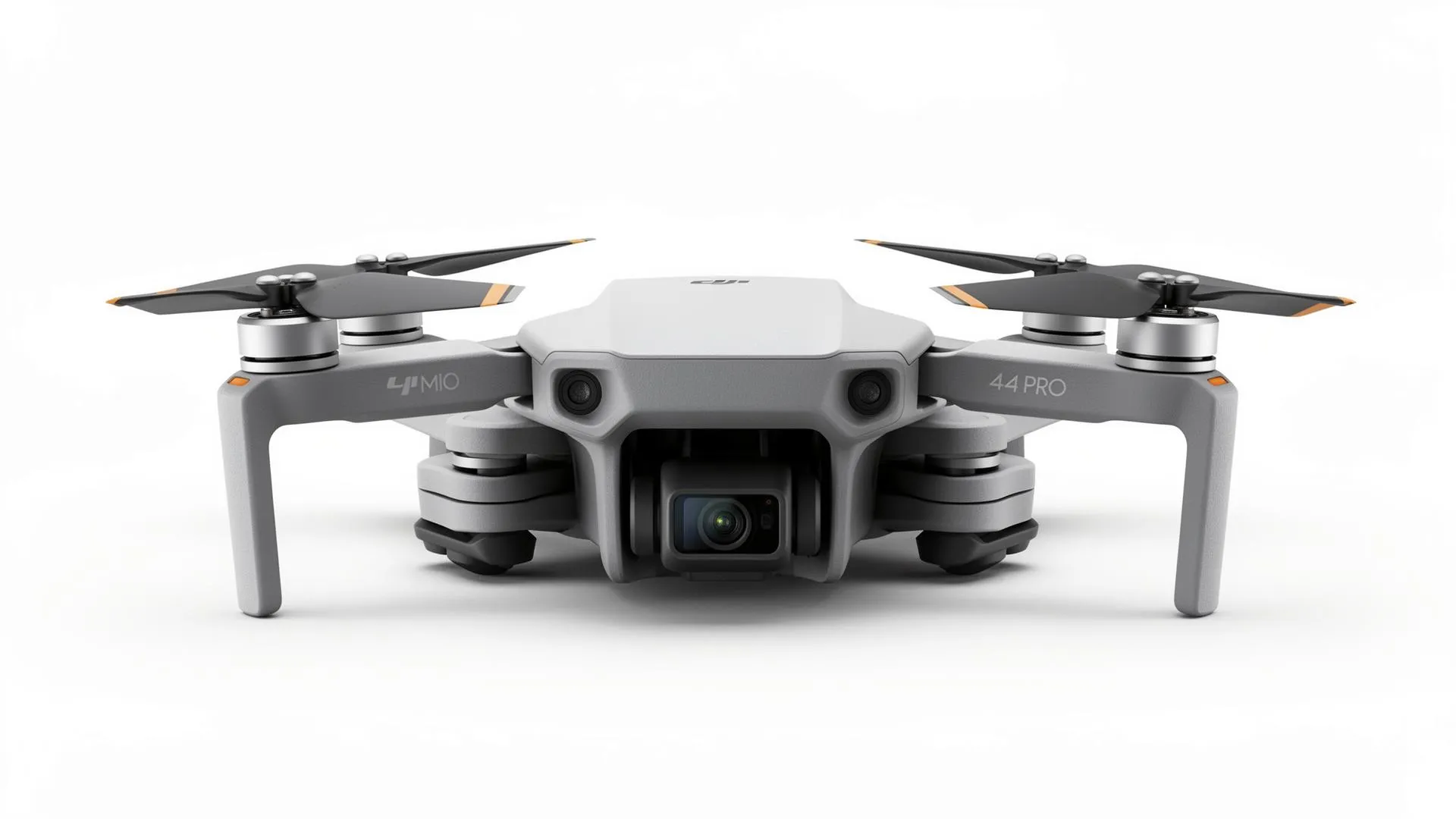
The DJI Mini 4 Pro is the drone that quietly solved the biggest headache in the hobby: weight. At under 249 grams it slips beneath the registration threshold in the US, the UK, the EU, and many other regions for recreational flying, yet it carries a 1/1.3-inch sensor, omnidirectional obstacle sensing, and 4K/60 HDR video that would have read as flagship-grade only a few years ago. This review is for the buyer deciding whether a sub-250g drone can really be a serious camera tool, how the Mini 4 Pro holds up in 2026 now that the Mini 5 Pro exists, and who should buy it instead of the cheaper DJI Flip or Neo, or the bigger Air 3. No hype, just the specs that matter and an honest read on where it fits.
The one thing to know: the Mini 4 Pro is still the most complete sub-250g drone you can buy with a screen-equipped controller in most markets. You get a genuinely capable 1/1.3-inch camera, true omnidirectional obstacle sensing, 4K/60 HDR plus 4K/100 slow motion, O4 transmission, and 34 minutes of flight on the standard battery, all under the weight that triggers registration. The newer Mini 5 Pro is technically better, but it is not officially sold in the US, which keeps the Mini 4 Pro the default recommendation for many buyers in 2026.
Specifications at a glance
Every figure below is taken from DJI's published specifications (DJI Mini 4 Pro spec sheet). The headline number, the sub-249g takeoff weight, is what makes everything else interesting: DJI had to fit a real camera and a full safety suite into the lightest possible airframe.
| Spec | DJI Mini 4 Pro |
|---|---|
| Sensor | 1/1.3-inch CMOS, 48 MP effective |
| Lens | 24 mm equivalent, f/1.7, 82.1° FOV |
| Max video | 4K up to 100 fps, FHD up to 200 fps, 4K/60 HDR |
| Colour profiles | 10-bit D-Log M and HLG, 150 Mbps bitrate |
| Photo | 12 MP and 48 MP, JPEG and DNG RAW |
| Takeoff weight | Under 249 g |
| Max flight time | 34 min (standard), 45 min (Battery Plus) |
| Transmission | O4, up to 20 km (FCC), 1080p/60 feed |
| Obstacle sensing | Omnidirectional vision + downward 3D infrared |
| Internal storage | 2 GB + microSD |
The 249-gram advantage: why weight is the whole point
Most people buy the Mini 4 Pro for one reason: it sidesteps registration in many places. In the US, recreational drones under 250 g do not need FAA aircraft registration (though the rules around flying, Remote ID, and the TRUST test still apply). In the EU it falls into the lightest C0 class, where many flights are far less restricted. That single number changes how casually you can pack a drone for a trip and how few forms stand between you and flying. Just be clear that weight relief does not mean rule-free flying: airspace, line-of-sight, and no-fly-zone rules still apply everywhere. For the specifics where you fly, see our guides on the FAA rules for US pilots and registering a drone in Germany.
The honest trade-off of staying under 249 g is wind resistance and stability. The Mini 4 Pro is rated for Level 5 wind (roughly 38 km/h gusts), which is genuinely good for its weight, but a heavier drone like the Air 3 simply plants itself more confidently in a stiff breeze. In calm to moderate conditions you will not notice; on an exposed clifftop in gusty wind you will. That is physics, not a flaw, and it is the price of pocketability.
Camera: a real 1/1.3-inch sensor, not a token one
The 1/1.3-inch CMOS sensor is the same size class DJI uses in the larger Air 3, which is remarkable given the weight budget. It shoots 48 MP stills (with a default 12 MP pixel-binned mode that is cleaner in low light), and captures 4K video up to 60 fps with HDR, 4K/100 for smooth slow motion, and 10-bit D-Log M plus HLG for anyone who grades footage. The f/1.7 aperture gathers a lot of light, so golden-hour and blue-hour clips hold detail better than older Mini generations managed. DNG RAW support means stills have real latitude for editing rather than baked-in JPEGs.
The honest caveat is the same one that applies to every small-sensor drone: push into deep shadow or full night and noise rises faster than it would on a 1-inch chip. In good light the Mini 4 Pro's output is genuinely hard to distinguish from much pricier drones, but it is not a low-light specialist. If you want to understand why sensor size and aperture matter more than the megapixel count on the box, our explainer on drone camera sensors goes deeper. A standout hardware trick worth flagging: the gimbal rotates to true vertical, so you get native, full-resolution 9:16 footage for social platforms without cropping a horizontal frame.
Obstacle sensing and ActiveTrack 360
This is where the Mini 4 Pro pulled ahead of every Mini before it. It has true omnidirectional vision sensing (forward, backward, left, right, up, and down) backed by a downward 3D infrared sensor. Earlier Minis only watched forward and down, so they could clip a tree branch on a sideways move. The full bubble of awareness makes the Mini 4 Pro far more forgiving for new pilots and far more trustworthy when you are concentrating on the shot rather than the sticks.
ActiveTrack 360 builds on that. Instead of just following a subject, you draw a path on a wheel and the drone orbits, leads, or trails along it while keeping the subject framed, routing itself around obstacles as it goes. For solo creators filming themselves cycling, hiking, or driving, it turns a one-person shoot into something that looks crewed. As always with vision-based safety, performance drops in poor light, which is one of the reasons the Mini 5 Pro later added LiDAR. US pilots should also note the Mini 4 Pro is Remote ID compliant out of the box; our Remote ID compliance guide explains what that means in practice.
Flight time, transmission, and batteries
DJI rates the standard Intelligent Flight Battery at 34 minutes, measured in ideal hovering conditions. Real mixed flying, with cruising, repositioning, and active tracking, realistically lands in the high 20s, which is plenty for a typical sortie. The Intelligent Flight Battery Plus pushes the rating to 45 minutes, but it nudges the drone over 249 g, so in regions where the weight class matters you give up the registration-free benefit the moment you fit it. That is a genuine decision point, not a footnote: standard battery for the legal sweet spot, Plus battery for endurance.
Transmission runs on DJI's O4 system, rated to 20 km (FCC) with a stable 1080p/60 feed. As with every consumer drone, the headline range is mostly irrelevant because you are legally required to keep the aircraft within visual line of sight nearly everywhere. What actually matters is link stability in cluttered radio environments, and O4 holds up well in congested urban spectrum where older Minis would stutter and drop frames.
Flight time, realistically
Price tiers and what you actually get
The Mini 4 Pro ships in several configurations. The base kit with the screenless DJI RC-N2 (you supply a phone) sits around 759 USD, while the base kit with the screen-equipped DJI RC 2 is roughly 959 USD. The Fly More Combo with the RC 2 adds two extra batteries, a charging hub, spare props, and a bag for about 1,099 USD, and a Combo Plus that swaps in three Battery Plus units runs near 1,159 USD (DJI Mini 4 Pro store page). Prices move with promotions and stock, so confirm current figures before buying.
For most buyers the Fly More Combo with the RC 2 is the configuration worth getting. The built-in screen is brighter in sunlight, removes the phone-and-cable hassle, and the extra batteries are close to essential once you fly for real. If you already own a recent DJI controller or are on a tight budget, the base RC-N2 kit is a legitimate way to save. Still weighing the whole purchase? Our piece on whether buying a drone is worth it in 2026 walks through the running costs beyond the sticker price.
How it compares: Mini 5 Pro, Flip, Neo, and Air 3
The Mini 4 Pro only makes sense once you see it next to its closest siblings. The table below uses published DJI specs and current reported pricing.
| Model | Sensor | Weight | Flight time | Position |
|---|---|---|---|---|
| Mini 4 Pro | 1/1.3" | Under 249 g | 34 min | Complete sub-250g all-rounder |
| Mini 5 Pro | 1" | Under 249 g | 36 min | Better image + LiDAR, limited US sales |
| DJI Flip | 1/1.3" | Under 249 g | 31 min | Cheaper, simpler, no side sensing |
| DJI Neo | 1/2" | Under 135 g | 18 min | Selfie drone, budget entry |
| Air 3 | 1/1.3" x2 | 720 g | 46 min | Dual camera, needs registration |
The Mini 5 Pro is the most important comparison and the direct successor. It squeezes a true 1-inch, 50 MP sensor and forward-facing LiDAR into the same sub-249g shell, with night obstacle sensing down to around 1 lux and a longer 225° gimbal rotation (DPReview report). It is the better drone outright, but the catch is availability: it is not officially sold in the US, which alone keeps the Mini 4 Pro the practical pick for many buyers. The DJI Flip shares the same 1/1.3-inch camera and 4K/60 HDR but drops to forward-only obstacle sensing and a cage-style design, trading the Mini 4 Pro's full safety bubble for a lower price near 439 USD. The DJI Neo is a different category, a palm-launch selfie drone under 135 g with a smaller sensor, 2.7K video, and 18 minutes of flight for under 200 USD: great fun and great value, not a Mini 4 Pro substitute. The Air 3 steps up to a dual-camera system and far better wind stability, but at 720 g it requires registration; read our full Air 3 review if you are weighing the jump up a class, or browse the whole lineup on our drones overview.
Who the Mini 4 Pro is for
A great fit if you
- • Want to avoid drone registration where weight allows
- • Travel light and value pocketable gear
- • Shoot travel, vlogs, or vertical social content
- • Are a beginner who wants full obstacle safety
- • Want flagship-style features at mid-range cost
Look elsewhere if you
- • Shoot mostly at night or in deep shadow
- • Need two focal lengths (Air 3)
- • Want the best small-sensor image (Mini 5 Pro)
- • Fly often in strong, gusty wind
- • Only want a cheap selfie drone (Neo)
The verdict
The Mini 4 Pro remains the smartest sub-250g drone for most people in 2026. The Mini 5 Pro is the better aircraft on paper, but its limited US availability and higher cost leave the Mini 4 Pro as the default: a complete, registration-friendly package with a real camera, full omnidirectional safety, and excellent transmission. It is not a low-light specialist and it gives ground in heavy wind, but for travel, social content, and beginners who want room to grow, nothing else this light does this much.
Frequently asked questions
Does the DJI Mini 4 Pro need to be registered?
With the standard battery it weighs under 249 g, so in the US it does not need FAA aircraft registration for recreational use, and in the EU it falls into the lightest C0 class with fewer restrictions. Flight rules, Remote ID, line-of-sight, and no-fly-zones still apply. Note that fitting the Intelligent Flight Battery Plus pushes it over 249 g and can change your obligations.
Should I buy the Mini 4 Pro or the Mini 5 Pro in 2026?
The Mini 5 Pro is the better drone, with a 1-inch sensor and forward LiDAR for night obstacle sensing, but it is not officially sold in the US. If you are in the US, or want to save money, the Mini 4 Pro is the practical choice. If you are outside the US and want the best small drone DJI makes, the Mini 5 Pro is worth the premium.
Is the Mini 4 Pro good for beginners?
Yes. The full omnidirectional obstacle sensing makes it very forgiving, GPS hold and automatic return-to-home keep it stable, and ActiveTrack 360 handles tracking shots for you. At the same time the camera and 10-bit colour are good enough that you will not outgrow it quickly.
What is the realistic flight time per battery?
DJI's 34-minute rating for the standard battery is measured hovering in ideal conditions. In normal mixed flying expect the high 20s. The Battery Plus is rated to 45 minutes but takes the drone over 249 g, so you trade the registration-free weight class for more endurance.
Mini 4 Pro or DJI Flip: which should I choose?
They share the same 1/1.3-inch camera and 4K/60 HDR. The Flip is cheaper and has built-in propeller guards, but it only senses obstacles forward, not all around. The Mini 4 Pro is the safer, more capable all-rounder; the Flip is the value pick if you mainly want easy, framed shots of yourself.
Which controller should I get, RC-N2 or RC 2?
The DJI RC 2 with its built-in screen is worth the premium for most people: it is brighter outdoors and removes the phone-and-cable workflow. The screenless RC-N2 (you attach your own phone) is the right call if you want to keep the cost down.
This review is based on DJI's published specifications and reputable third-party reporting. It is not sponsored by DJI, and the site may earn an affiliate commission on purchases made through retailer links. Specifications and prices verified June 2026.
Frequently Asked Questions
Does the DJI Mini 4 Pro require registration?
With the standard battery it weighs under 249 g, so US recreational pilots do not need FAA aircraft registration and EU pilots fall into the lightest C0 class. Flight rules, Remote ID, and no-fly-zones still apply, and the Battery Plus pushes it over 249 g.
Should I buy the Mini 4 Pro or the Mini 5 Pro in 2026?
The Mini 5 Pro is the better drone (1-inch sensor, forward LiDAR) but is not officially sold in the US. US buyers and anyone wanting to save money should pick the Mini 4 Pro; buyers outside the US who want the best small DJI drone can step up to the Mini 5 Pro.
Is the Mini 4 Pro good for beginners?
Yes. Full omnidirectional obstacle sensing, GPS hold, automatic return-to-home, and ActiveTrack 360 make it forgiving for new pilots, while the camera and 10-bit colour are good enough that you will not outgrow it quickly.
What is the realistic flight time per battery?
DJI rates the standard battery at 34 minutes hovering in ideal conditions; normal mixed flying lands in the high 20s. The Battery Plus is rated to 45 minutes but takes the drone over 249 g, trading the registration-free weight class for endurance.