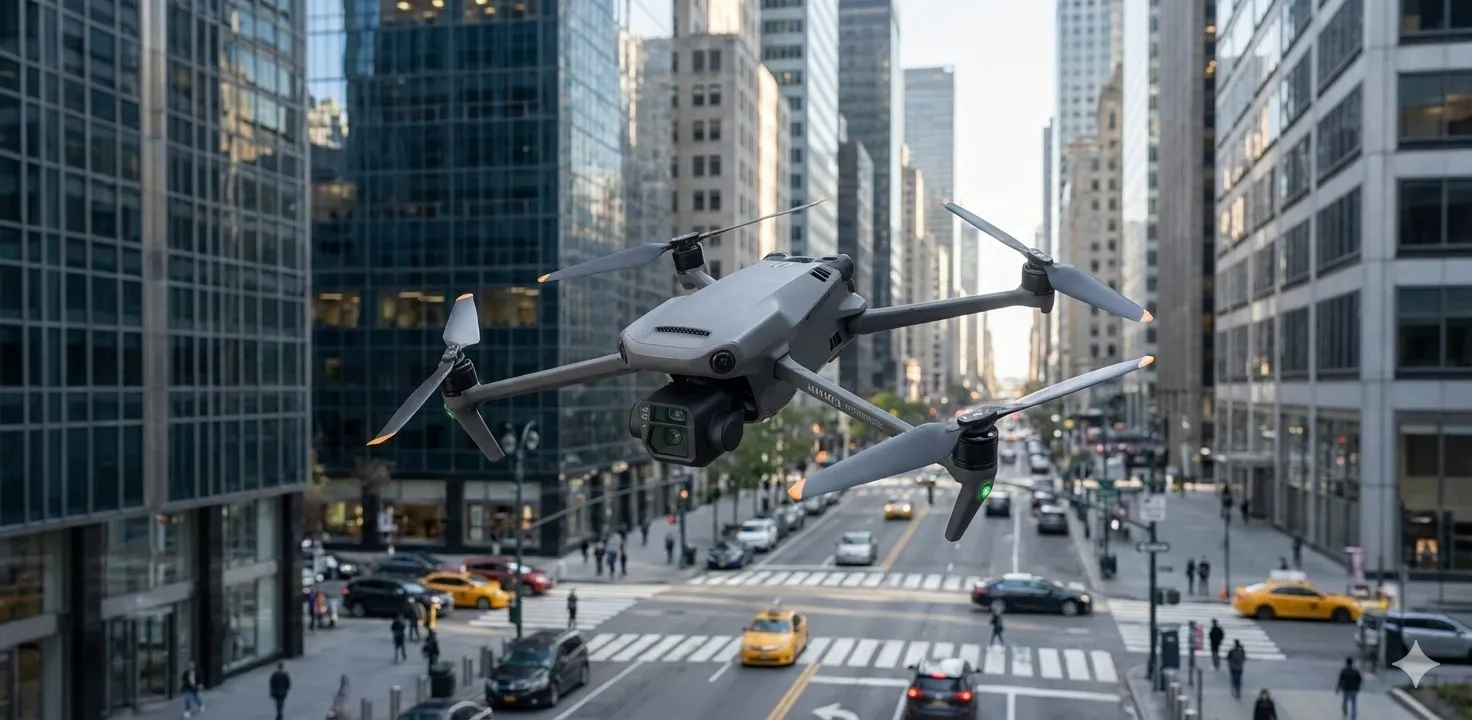
The DJI Mavic 4 Pro is the current flagship of DJI's folding camera-drone line, and it is unapologetically built for people who shoot for a living or take their aerial work seriously. The headline is a triple-camera system led by a 100MP Four Thirds Hasselblad main sensor, paired with two genuine telephoto lenses, all hung off a new gimbal that can rotate a full 360 degrees and tilt 70 degrees upward. This review is for the buyer deciding whether that camera package, plus a 51-minute flight time and O4+ transmission, justifies a flagship price, how it stacks up against the cheaper Mavic 3 Pro and the Air 3S, and what the messy US availability situation actually means for an American buyer in 2026. No marketing gloss, just the specs that matter and an honest read on where it fits.
The one thing to know: the Mavic 4 Pro is the most capable consumer-class camera drone DJI has ever shipped, and the triple-camera plus rotating gimbal combination genuinely removes creative compromises that every other folding drone still has. It is also heavy (1,063 g), expensive, and tangled in US import politics. If you are a professional or committed enthusiast who can live with the size and the price, it is the obvious flagship pick. If you mostly fly for fun, it is far more drone than you need.
Specifications at a glance
Every figure below is drawn from DJI's published specifications and the launch coverage from DPReview and PetaPixel. Unlike the Mavic 3 Pro, all three cameras here can record up to 4K/120, so you are not locked into the main lens for high-frame-rate work.
| Spec | Main (Hasselblad) | Medium tele | Tele |
|---|---|---|---|
| Sensor | 4/3" CMOS, 100MP | 1/1.3" CMOS, 48MP | 1/1.5" CMOS, 50MP |
| Focal length (equiv.) | 28 mm | 70 mm (2.5x) | 168 mm (6x) |
| Aperture | f/2.0-f/11 (adjustable) | f/2.8 | f/2.8 |
| Dynamic range | Up to 16 stops | 14 stops | 13 stops |
| Max video | 6K/60 HDR on the main camera, up to 4K/120 on all three, 10-bit D-Log M and HLG | ||
Airframe and flight
1,063 g
51 min
360° rotation, 70° up-tilt
O4+, up to 30 km (FCC) / 15 km (CE)
Omnidirectional + forward LiDAR
64 GB (512 GB on Creator Combo) + microSD
The triple-camera system: where the money goes
The Mavic 4 Pro's reason for existing is its imaging. The main camera moves to a 100MP Four Thirds Hasselblad sensor with a mechanically adjustable f/2.0 to f/11 aperture, which is the single most important spec on the aircraft. A larger sensor gathers more light and resolves more detail, and the adjustable aperture lets you control depth and motion blur instead of leaning on neutral-density filters for everything. DJI rates the main camera at up to 16 stops of dynamic range, which is the kind of latitude that lets you recover a blown sky or lift crushed shadows in the grade rather than reshoot. If you want to understand why sensor size beats the megapixel number on the box, our explainer on drone camera sensors walks through exactly that.
The two telephoto cameras are what separate this from a single-lens drone. The 70mm medium tele (1/1.3-inch, 48MP) is the everyday reach lens for compression and tighter compositions, while the 168mm tele (1/1.5-inch, 50MP) pulls distant subjects close, which is genuinely useful for wildlife, inspection-style work, and isolating detail without flying the aircraft dangerously near a structure or person. All three are optical focal lengths, not digital crops, so you keep real resolution at every length. The honest caveat: the two tele sensors are much smaller than the Hasselblad main, so they fall behind in low light. In daylight they are excellent, after dark they are utility lenses.
Main 28mm (Hasselblad)
- • 4/3" CMOS, 100MP
- • f/2.0-f/11 adjustable aperture
- • 6K/60 HDR, up to 16 stops DR
- • The workhorse for stills and hero shots
Medium tele 70mm
- • 1/1.3" CMOS, 48MP
- • f/2.8 aperture
- • 2.5x reach, compression and isolation
- • Best everyday second lens
Tele 168mm
- • 1/1.5" CMOS, 50MP
- • f/2.8 aperture
- • 6x reach for distant subjects
- • Wildlife and standoff detail work
The Infinity Gimbal: a real, not gimmicky, upgrade
DJI's new Infinity Gimbal is the structural change that earns the most attention. It rotates a full 360 degrees and tilts up to 70 degrees above the horizon. The 360-degree rotation lets you shoot true vertical (portrait) frames at full quality for social-first work without cropping, and it makes Dutch-tilt moves and roll transitions possible in a single take. The 70-degree up-tilt is the more practical part for most pilots: you can finally frame upward at bridges, cliff faces, building facades, and tall structures that previous Mavics simply could not point the camera toward. It is not a marketing toy, it removes shots that used to be impossible on a folding drone.
Flight time, transmission, and obstacle sensing
DJI rates the Mavic 4 Pro at 51 minutes per battery, measured hovering in ideal conditions. As with every drone, real mixed flying, with cruising, repositioning, and wind, realistically lands lower, in the low 40s for most pilots, which is still excellent for an aircraft carrying this much camera. The bigger battery is part of why the aircraft is heavy, and weight has regulatory consequences (more on that below). For a deeper look at what actually drains a pack and how chemistry affects endurance, see our drone battery technology guide.
Transmission moves to DJI's O4+ system, rated to 30 km (FCC) or 15 km (CE) with a 10-bit HDR feed. As always, the headline range is mostly academic because you are legally required to keep the aircraft within visual line of sight nearly everywhere; what matters is link stability in congested radio environments, and O4+ is the most robust system DJI has shipped. Obstacle avoidance is a genuine highlight: full omnidirectional vision sensing is backed by a forward-facing LiDAR unit that lets the drone detect obstacles and brake in near-darkness (down to roughly 0.1 lux), the same low-light safety net that debuted on the Air 3S. If you fly in the US, the Mavic 4 Pro is Remote ID compliant out of the box; our Remote ID compliance guide explains what that means for your flights.
Flight time, realistically
Price tiers and what you actually get
The Mavic 4 Pro ships in three configurations, all built around DJI's screen-equipped controllers. As of mid-2026, US pricing on the official DJI USA store runs roughly 2,199 USD for the standard kit with the DJI RC 2, around 2,899 USD for the Fly More Combo (extra batteries, charging hub, bag, all with the RC 2), and about 3,999 USD for the 512 GB Creator Combo with the higher-end DJI RC Pro 2. European pricing tracks near 2,099 EUR / 2,699 EUR / 3,539 EUR for the same tiers. Because US stock is finite (see the next section), confirm current pricing and availability before buying.
For most serious buyers the Fly More Combo is the configuration to get: spare batteries are close to essential once you shoot real sessions, and the bundle is far cheaper than buying the extras separately. The Creator Combo is worth it only if you specifically want the RC Pro 2's brighter mini-LED screen and the half-terabyte of onboard storage for high-bitrate work. If you are still deciding whether a flagship is the right call at all, our piece on whether buying a drone is worth it in 2026 covers the running costs beyond the sticker price.
The US availability and FCC situation, explained plainly
This is the part American buyers actually need to understand. In late 2025, DJI was added to the FCC's national-security "Covered List," which blocks new equipment authorizations for the company's gear. Per reporting from UAV Coach and CineD, the practical effect is twofold. First, the Mavic 4 Pro received its FCC authorization before the December 23, 2025 cutoff, so it can still be legally sold in the US, and any unit already in the country keeps working normally. Second, units cannot be re-imported once current inventory is gone, so the drone is expected to disappear from US shelves as stock depletes rather than being replenished. A hypothetical future Mavic 5 Pro would not get authorized at all under the current rules.
What this means in practice: if you are in the US and you want a Mavic 4 Pro, buying sooner is safer than later, because pricing and availability will tighten as inventory sells through. If you are outside the US, none of this applies and the drone is sold normally. Either way, this is an aircraft-availability story, not a flight-legality story. Owning and flying the drone remains legal in the US; the restriction is on new sales and imports. For the rules that do govern your flying, see our overviews of drone regulations.
How it compares: Mavic 3 Pro and Air 3S
The Mavic 4 Pro only makes sense once you see it next to the two drones most buyers actually cross-shop. The table below uses published DJI specs and current US pricing.
| Model | Main sensor | Cameras | Flight time | From (USD) |
|---|---|---|---|---|
| Mavic 4 Pro | 4/3" 100MP Hasselblad | 28 + 70 + 168mm | 51 min | ~2,199 |
| Mavic 3 Pro | 4/3" 20MP Hasselblad | 24 + 70 + 166mm | 43 min | ~2,199 |
| Air 3S | 1" 50MP wide | 24 + 70mm | 45 min | ~1,099 |
The Mavic 3 Pro is the most direct internal comparison, and the gap is real but situational. Both share a Four Thirds Hasselblad main camera, but the Mavic 4 Pro jumps to a 100MP sensor with an adjustable aperture and 16-stop dynamic range, adds the 360-degree rotating gimbal, the third tele lens at higher resolution, forward LiDAR, longer flight time, and O4+ transmission. The Mavic 3 Pro is still an outstanding imaging drone and, as it gets discounted against the new flagship, an increasingly smart value buy. If you do not need the rotating gimbal, the higher-resolution main sensor, or LiDAR, it remains an easy recommendation.
The Air 3S is the value alternative, and for many people it is the more sensible buy. It is lighter, roughly half the price, and its 1-inch main sensor already delivers excellent daytime quality with the same forward-LiDAR night safety. What you give up is the larger Four Thirds main sensor, the third 168mm lens, the rotating gimbal, and the higher dynamic range. If your work does not specifically demand those, the Air 3S gets you most of the experience for far less money. Read our full Air 3 review for how that line behaves day to day, and our DJI vs Autel comparison if you want to look beyond DJI entirely.
Who the Mavic 4 Pro is for
A great fit if you
- • Shoot professionally or sell client work
- • Need the largest main sensor and adjustable aperture
- • Want three real focal lengths in one aircraft
- • Will use the 360° gimbal for vertical or up-tilt shots
- • Value long flight time and the most robust transmission
Look elsewhere if you
- • Mostly fly recreationally for fun
- • Want maximum portability (the Mini line is far lighter)
- • Are price-sensitive (the Air 3S is half the cost)
- • Already own a Mavic 3 Pro and shoot mainly stills
- • Need a sub-250 g drone to skip registration rules
The verdict
The Mavic 4 Pro is the most complete folding camera drone on the market. The 100MP Hasselblad main camera, two real telephoto lenses, the 360-degree Infinity Gimbal, forward LiDAR, and a 51-minute flight time add up to a tool that genuinely removes the creative limits earlier Mavics still carried. It is also heavy, expensive, and complicated by US import politics. For professionals and committed enthusiasts who can use what it offers, it is the clear flagship choice. For everyone else, the Air 3S or a discounted Mavic 3 Pro delivers most of the result for a lot less.
Frequently asked questions
Is the Mavic 4 Pro worth upgrading to from the Mavic 3 Pro?
It depends on what you shoot. The Mavic 4 Pro adds a 100MP main sensor with adjustable aperture, the 360-degree rotating gimbal, a higher-resolution 168mm tele, forward LiDAR, and longer flight time. If you need the rotating gimbal or the bigger main sensor, the upgrade is meaningful. If you mainly shoot daytime stills and are happy with your Mavic 3 Pro, it remains an excellent drone and the upgrade is optional.
Can Americans still buy the Mavic 4 Pro in 2026?
Yes, while stock lasts. The Mavic 4 Pro received FCC authorization before the December 2025 cutoff, so it can still be sold legally in the US, and units already here keep working. Because new units cannot be imported under the FCC Covered List rules, it is expected to sell through and disappear from US shelves over time. Outside the US it is sold normally.
What does the 360-degree Infinity Gimbal actually let you do?
The 360-degree rotation enables full-quality vertical (portrait) shooting and roll or Dutch-tilt moves in a single take, while the 70-degree upward tilt lets you frame upward at bridges, cliffs, and building facades that earlier Mavics could not point the camera toward. It removes shots that were previously impossible on a folding drone.
Does the Mavic 4 Pro need to be registered?
Yes. At 1,063 g it is far above the 250 g threshold everywhere. US pilots register with the FAA and the drone is Remote ID compliant out of the box. EU pilots must register as an operator and label the aircraft with their e-ID. See our guide on registering a drone in Germany and our broader regulations hub.
What is the realistic flight time per battery?
DJI's 51-minute figure is measured hovering in ideal conditions. In normal mixed flying expect the low 40s, dropping toward the mid 30s in aggressive flying or strong wind. The Fly More Combo's extra batteries make full shooting days practical.
Are the telephoto cameras as good as the main Hasselblad?
In daylight they are excellent and resolve plenty of detail at 48MP (70mm) and 50MP (168mm). But their sensors are much smaller than the Four Thirds main camera, so they fall behind in low light and dynamic range. Treat the main camera as your hero lens and the teles as compositional tools that shine in good light.
This review is based on DJI's published specifications and reputable third-party reporting. It is not sponsored by DJI, and the site may earn an affiliate commission on purchases made through retailer links. Specifications and prices verified June 2026.
Frequently Asked Questions
Is the DJI Mavic 4 Pro worth the upgrade from Mavic 3 Pro?
If you need the 100MP main sensor with adjustable aperture, the 360-degree rotating gimbal, the higher-resolution 168mm tele, forward LiDAR, or the longer flight time, yes. For daytime stills shooters happy with their current drone, the Mavic 3 Pro remains excellent and the upgrade is optional.
Can Americans still buy the Mavic 4 Pro?
Yes, while stock lasts. It received FCC authorization before the December 2025 cutoff, so it can still be sold legally in the US, and existing units keep working. Because the FCC Covered List blocks new imports, it is expected to sell through over time. Outside the US it is sold normally.
Is the Mavic 4 Pro good for beginners?
It is overkill for beginners. The safety systems are excellent, but the size, weight, and price make far more sense for professionals and committed enthusiasts. A new pilot is better served by a cheaper, lighter drone like the Air 3S or a Mini.
What is the realistic flight time per battery?
DJI's 51-minute rating is a hover figure in ideal conditions. In normal mixed flying expect the low 40s, falling toward the mid 30s in aggressive flying or strong wind. The Fly More Combo's spare batteries make all-day shoots practical.