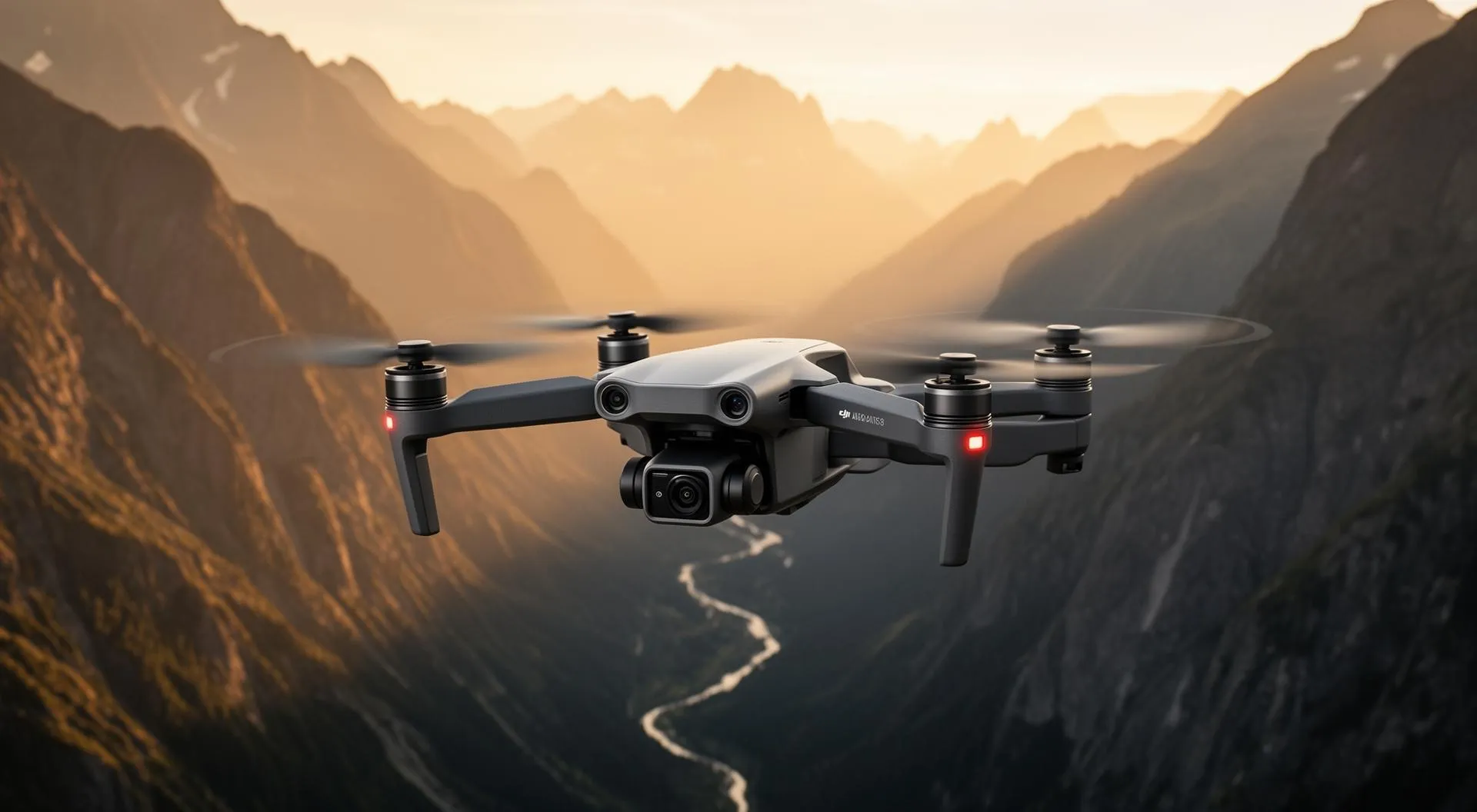
The DJI Air 3 sits in the most contested part of the drone market: too capable to be a toy, too affordable to be a true flagship. Its defining move was adding a second camera, a 70mm telephoto, alongside the usual wide lens. This review is for the buyer trying to work out whether that dual-camera idea is genuinely useful, how the Air 3 holds up in 2026 now that the newer Air 3S exists, and who should still buy it versus spending more (or less). No marketing gloss, just the specs that matter and an honest read on where it fits.
The one thing to know: the Air 3 is the value pick of DJI's dual-camera Air line. The 1/1.3-inch sensors are smaller than a true 1-inch chip, but you get two genuinely useful focal lengths, roughly 46 minutes of flight time, O4 transmission, and full omnidirectional obstacle sensing for noticeably less than the Air 3S or the Mavic line. If low-light performance is not your top priority, it remains an excellent buy.
Specifications at a glance
Every figure below comes from DJI's published specifications (DJI Air 3 spec sheet). Note the two cameras share the same sensor, which keeps colour and exposure consistent when you switch between them.
| Spec | Wide camera | Telephoto camera |
|---|---|---|
| Sensor | 1/1.3-inch CMOS, 48MP | 1/1.3-inch CMOS, 48MP |
| Focal length (equiv.) | 24 mm | 70 mm (3x) |
| Aperture | f/1.7 | f/2.8 |
| Field of view | 82° | 35° |
| Max video | 4K up to 100 fps, FHD up to 200 fps (both cameras), 10-bit D-Log M and HLG | |
Airframe and flight
720 g
46 min
21 m/s (19 m/s EU)
O4, up to 20 km (FCC) / 10 km (CE)
Omnidirectional + downward infrared
8 GB + microSD
The dual-camera system: why 70mm earns its place
The headline feature is two cameras instead of one. The primary 24mm wide handles the sweeping establishing shots drones are known for. The second 70mm medium telephoto (3x relative to the wide) is the part that changes how you compose. This is optical reach, not a digital crop, so it keeps full sensor resolution rather than upscaling a cropped frame.
The practical payoff is perspective compression. At 70mm, backgrounds pull closer and stack into distinct layers, which flatters mountains, city skylines, and any subject you want to isolate from a busy scene. It also lets you frame architectural detail or wildlife without flying the aircraft dangerously close, which is both safer and often the only legal option near structures or people. If you want a deeper grounding in how these chips behave, our explainer on drone camera sensors covers why sensor size and aperture matter more than the megapixel count printed on the box.
Wide camera (24mm)
- • 1/1.3-inch CMOS, 48MP
- • f/1.7 aperture (strong in dim light)
- • 82° field of view
- • Best for landscapes and context
Telephoto camera (70mm)
- • 1/1.3-inch CMOS, 48MP
- • f/2.8 aperture
- • 35° field of view, 3x reach
- • Best for compression and isolation
Image quality: very good, with one honest caveat
Both cameras capture 48MP stills and shoot 4K video at up to 100 fps, with 10-bit D-Log M and HLG colour profiles for those who grade footage. DJI's colour science is mature: out of camera, files need little correction, skin tones read naturally, and saturation stays sensible. The bright f/1.7 wide lens gathers a lot of light, so blue-hour and golden-hour clips hold up better than the older Air 2 generation.
The honest caveat is the sensor size. At 1/1.3 inch, these are smaller than the 1-inch chip in the older Air 2S or the larger Four Thirds Hasselblad in the Mavic 3 line. In good light the difference is academic, and the wide lens partly offsets it with that fast aperture. Push into deep shadow or night, though, and the bigger-sensor drones pull ahead on noise and dynamic range. TechRadar reached the same conclusion, calling the Air 3 "a strong all-rounder" that stays compelling unless you specifically need the low-light edge of the newer Air 3S (TechRadar review).
Flight time, transmission, and obstacle sensing
DJI rates the Air 3 at 46 minutes per battery, measured hovering in ideal conditions. Real mixed flying, with cruising, repositioning, and switching cameras, realistically lands in the high 30s to low 40s, which is still class-leading and roughly double what the Mavic Air 2 managed. For a full shooting session that means fewer battery swaps and less anxiety about a low-battery warning cutting the perfect pass short.
Transmission runs on DJI's O4 system, rated to 20 km (FCC) or 10 km (CE) with a stable 1080p feed. The headline range is mostly irrelevant in practice because you are legally required to keep the drone within visual line of sight in nearly every jurisdiction. What actually matters is stability in cluttered radio environments, and O4 holds connections in congested urban 5GHz spectrum where older drones tend to stutter. If you fly in the US, the Air 3 is also Remote ID compliant out of the box; our Remote ID compliance guide explains what that means for your flights.
Flight time, realistically
Safety is a genuine highlight. The Air 3 has true omnidirectional vision sensing (forward, backward, up, down, and both sides) backed by a downward infrared sensor, a first for the Air line at launch. The APAS 5.0 assistance system also strikes a better balance than earlier versions: it routes around trees and obstacles at moderate speed without the constant over-cautious stopping that made older systems frustrating. Just remember that vision sensing degrades in low light, which is one reason the Air 3S later added LiDAR.
Price tiers and what you actually get
The Air 3 ships in three configurations. The base kit pairs the drone with the screenless DJI RC-N2 (you supply a phone). The Fly More Combo adds two extra batteries, a charging hub, spare props, and a bag, and comes with either the RC-N2 or the screen-equipped DJI RC 2. As of mid-2026 the Air 3 is widely discounted because it has been superseded by the Air 3S: DJI's European store lists the base around 879 EUR (from 989 EUR) and the RC 2 Fly More Combo around 1,239 EUR (from 1,389 EUR), with US retail typically tracking near 1,099 USD base and roughly 1,349 USD for the RC 2 combo (DJI Air 3 store page). Because the model is now sold through, exact figures move with stock, so confirm current pricing before buying.
For most buyers the RC 2 Fly More Combo is the configuration worth getting. The built-in screen is brighter in sunlight, removes the phone-and-cable hassle, and the extra batteries are close to essential once you start flying for real. If you already own DJI batteries or are on a tight budget, the base RC-N2 kit is a legitimate way to save money. Still weighing the whole purchase? Our piece on whether buying a drone is worth it in 2026 walks through the running costs beyond the sticker price.
How it compares: Air 3S, Mavic 3, and Air 2S
The Air 3 only makes sense once you see it next to its obvious rivals. The table below uses published DJI specs and reported pricing.
| Model | Main sensor | Cameras | Flight time | Position |
|---|---|---|---|---|
| Air 3 | 1/1.3" (both) | 24mm + 70mm | 46 min | Value dual-camera pick |
| Air 3S | 1" wide, 1/1.3" tele | 24mm + 70mm | 45 min | Better low light, LiDAR |
| Mavic 3 Classic | 4/3" Hasselblad | 24mm only | 46 min | Best image quality, pricier |
| Air 2S | 1" | 22mm only | 31 min | Older single-camera value |
The Air 3S is the direct successor and the most important comparison. It keeps the same 70mm telephoto but upgrades the wide camera to a 1-inch sensor, adds forward LiDAR for night obstacle sensing, and bumps video to 4K/120. Per multiple reviews it is the better drone, but the gap is modest in daylight, and current Air 3 owners are generally advised not to upgrade (TechRadar comparison). The Mavic 3 Classic wins outright on raw image quality thanks to its Four Thirds Hasselblad sensor, but it is a single-camera drone, larger, and meaningfully more expensive. The Air 2S has a 1-inch sensor too but only one fixed lens, shorter flight time, and older transmission, so it makes sense only as a discounted entry point. For a broader head-to-head across brands, see our DJI vs Autel comparison, or browse the full lineup on our drones overview.
Who the Air 3 is for
A great fit if you
- • Shoot travel, landscape, or real estate work
- • Want two real focal lengths in one aircraft
- • Value long flight time and stable transmission
- • Are upgrading from an Air 2 or Mini
- • Want one do-it-all drone at a fair price
Look elsewhere if you
- • Shoot mostly at night or in deep shadow
- • Need the best possible stills (Mavic 3)
- • Want maximum portability (Mini line)
- • Already own an Air 3S or Air 3
- • Are on a sub-300 USD budget
The verdict
The Air 3 remains one of the smartest value buys in consumer drones. It is not the best at any single thing, the Air 3S sees better in the dark and the Mavic 3 shoots cleaner stills, but it does almost everything well: two useful lenses, near-flagship flight time, dependable O4 transmission, and full obstacle sensing. Now that it is discounted against the Air 3S, the price-to-capability ratio is hard to beat for daylight shooters.
Frequently asked questions
Should I buy the Air 3 or the Air 3S in 2026?
If you shoot mainly in daylight and want to save money, the Air 3 is the better value: the daytime image gap is small. Choose the Air 3S if low-light quality, the 1-inch wide sensor, or LiDAR night obstacle sensing matter to you, or if you frequently fly around dusk.
Is the Air 3 a downgrade from the Air 2S because of the smaller sensor?
Not in practice. The Air 2S has a 1-inch sensor but only one fixed lens. The Air 3's smaller 1/1.3-inch chip pairs with a faster f/1.7 aperture, so wide-camera light gathering is broadly similar, and you gain a second 70mm lens, far longer flight time, and newer O4 transmission.
Does the DJI Air 3 need to be registered?
Yes. At 720 g it is far above the 250 g threshold everywhere. US pilots register with the FAA and the drone is Remote ID compliant out of the box. EU pilots must register as an operator and label the drone with their e-ID. See our guides on the FAA registration process and registering a drone in Germany.
Is the 70mm telephoto real optical zoom or a crop?
It is a separate physical camera with its own 70mm lens and full 48MP sensor, so it is true optical reach, not a digital crop of the wide camera. That means full resolution and image quality at the longer focal length, which a digital zoom cannot match.
Which controller should I choose, RC-N2 or RC 2?
The DJI RC 2 with its built-in screen is worth the premium for most people: it is brighter outdoors and removes the phone-and-cable workflow. The screenless RC-N2 (you attach your own phone) is the right call if you want to keep the cost down.
What is the realistic flight time per battery?
DJI's 46-minute figure is measured hovering in ideal conditions. In normal mixed flying expect the high 30s to low 40s, dropping toward the low 30s in aggressive sport-mode flying or strong wind. The Fly More Combo's extra batteries make all-day sessions practical.
This review is based on DJI's published specifications and reputable third-party reporting. It is not sponsored by DJI, and the site may earn an affiliate commission on purchases made through retailer links. Specifications and prices verified June 2026.
Frequently Asked Questions
Should I buy the DJI Air 3 or the Air 3S in 2026?
If you shoot mostly in daylight and want to save money, the Air 3 is the stronger value because the daytime image difference is small. Pick the Air 3S if low-light quality, the larger 1-inch wide sensor, or LiDAR night obstacle sensing are important to you.
Is the 70mm telephoto real optical zoom or a digital crop?
It is a separate physical camera with its own 70mm lens and full 48MP sensor, so it delivers true optical reach at full resolution, not a cropped-and-upscaled digital zoom.
Does the DJI Air 3 need to be registered?
Yes. At 720 g it is well above the 250 g threshold. US pilots register with the FAA (the drone is Remote ID compliant out of the box), and EU pilots must register as an operator and label the drone with their e-ID.
What is the realistic flight time per battery?
DJI's 46-minute rating is a hover figure in ideal conditions. In normal mixed flying expect the high 30s to low 40s, falling toward the low 30s in aggressive sport mode or strong wind.