
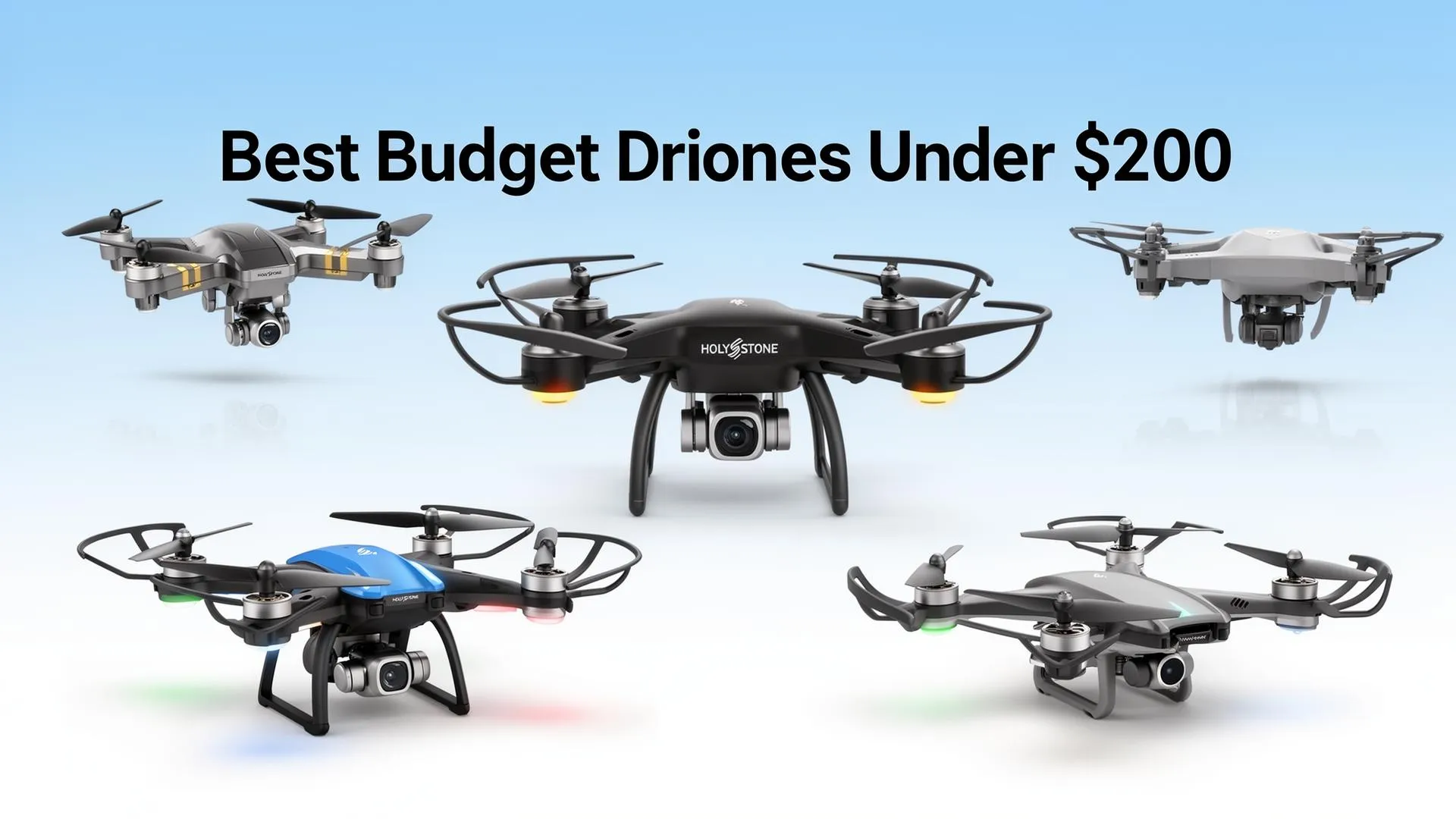
The sub-$200 drone market changed completely once DJI dropped the Neo into it. For years a $200 budget meant choosing between unreliable no-name quadcopters or paying double for anything you would actually trust to come home. In 2026 that gap has narrowed dramatically. This guide is for the first-time buyer, the gift shopper, and the experienced pilot who wants a cheap second drone, and it focuses on what genuinely matters at this price: GPS that holds position, the sub-250 g weight that skips registration, real-world flight time, and camera output you will not be embarrassed to post. No fake testing claims, just current specs, honest trade-offs, and sources you can check.
The one thing to remember: at $200 you are buying a learning tool and a casual content camera, not a professional rig. The best buy is the one that matches how you will actually fly. Want a follow-me selfie camera with zero setup? The DJI Neo. Want a classic GPS drone you steer with sticks and fly for ages? The Potensic Atom LT. Pick the use case first, then the spec sheet.
Affiliate disclosure
Drone Nomad earns commissions on qualifying purchases through affiliate links. That never changes our rankings, which are based on published manufacturer specifications, current pricing, and aggregated owner feedback rather than commission rates. Where a figure matters, we link the source so you can verify it yourself.
What $200 actually gets you in 2026
Expectations first, because most disappointment comes from buying a $180 drone hoping for $800 results. At this price you are not getting a 1-inch sensor, true obstacle avoidance across the whole price band, transmission ranges that hold a clean feed past a couple of kilometres in practice, or flight times that survive cold and wind without sagging. Those still belong to the $400-and-up class, which we cover in the drone buying guide hub.
What you can reliably get is the part that used to be expensive: GPS positioning with return-to-home, brushless motors that do not wear out in a season, 4K/30fps capture, and 25 to 40 minutes of flight per battery. A few standouts even add a small downward sensor for stable hovering. The single biggest shift is that DJI now sells the Neo, a fully stabilized 4K drone, for as little as $149, which drags the entire budget tier upward in quality and forces the cheaper brands to compete on flight time and price.
⚠️ The 249 g number is doing a lot of work
Most of the best budget drones land at "under 249 g" on purpose. In the United States a recreational drone under 250 g (0.55 lb) does not need FAA registration or Remote ID, while anything 250 g or heavier must be registered for $5 and broadcast Remote ID (FAA recreational flyers). In the EU the weight saves you nothing on operator registration if the drone has a camera, so a German buyer of even a 135 g camera drone still registers with the LBA. See our guide to registering a drone in Germany for the detail.
Our top picks for 2026 at a glance
| Drone | Approx. price | Weight | Camera | GPS | Flight time (rated) |
|---|---|---|---|---|---|
| DJI Neo | $149 to $199 | 135 g | 4K/30, EIS | No (vision positioning) | ~18 min |
| Potensic Atom LT | from $179 | under 249 g | 2.5K/30, EIS | Yes | ~40 min |
| Holy Stone HS720E | ~$180 to $200 | ~460 g | 4K/30, EIS | Yes | ~23 min/battery |
| Potensic Atom SE | often above $200* | under 249 g | 4K/30, EIS | Yes | ~31 min |
*Prices move constantly on these models, especially around Prime Day and the holidays. The Atom SE list price has crept up, so it counts as "under $200" only on sale; we still include it because it regularly dips into range. Always check the live price before you buy, and treat flight times as the manufacturer's best case. Expect roughly 15 to 20 percent less in real wind and cold.
1. DJI Neo: best overall and best for hands-off content
Why it wins
- ✓ Genuine DJI stabilization in a 135 g body
- ✓ 4K/30fps with usable RockSteady EIS
- ✓ Palm takeoff and AI subject tracking with no controller needed
- ✓ Under 250 g, so no US registration or Remote ID
- ✓ Has been selling for as little as $149
Where it falls short
- • No GPS, so it relies on vision positioning and is happiest in calmer air
- • ~18 minute flight time is the shortest here
- • Loud props and limited manual range without the optional controller
The original 2024 version of this guide called a budget drone delivering "80 percent of the DJI experience" a win. That framing is obsolete, because now you can simply buy the DJI. The Neo packs DJI's stabilization, 4K/30fps capture and AI tracking into a 135 g palm-launch drone, and it has been discounted to as low as $149, the cheapest DJI has ever sold a camera drone (DroneDJ).
The trade-off is honest: the Neo has no GPS and leans on downward and forward vision sensors, so it is at its best for follow-me clips, vlogs and selfies rather than steady high-altitude cruising in wind. Flight time sits around 18 minutes, the shortest on this list (DJI Neo specs). If you mostly want footage of yourself doing things, nothing else under $200 comes close. If you have a little more to spend and want obstacle avoidance, the newer DJI Neo 2 adds omnidirectional sensing at around $209 to $249 (The Drone Girl).
2. Potensic Atom LT: best GPS drone and best flight time
If you want the classic drone experience, two sticks, GPS lock, return-to-home and long hovers over a landscape, the Atom LT is the smarter buy than the Neo. It stays under 249 g, flies only in GPS mode for a stable hold, and rates a category-leading 40 minutes per battery on a 3000 mAh pack, with two batteries in the kit for up to 80 minutes total (Potensic Atom LT).
The compromise is the camera. You get 2.5K/30fps with ShakeVanish electronic stabilization rather than true 4K, and like every drone at this price it relies on EIS, not a mechanical gimbal. Its brushless motor is rated to hold steady in Level 5 wind, and Pixsync 2.0 carries the feed out to a claimed 4 km. From around $179 it is the best all-round GPS flyer here, and the long flight time makes it a forgiving drone to actually learn on instead of constantly swapping a dying battery.
3. Holy Stone HS720E: best for true 4K on a budget
The HS720E was this guide's long-running champion and is still a sensible pick if you specifically want 4K/30fps from a Sony sensor and a larger, more wind-tolerant airframe. It has GPS with GLONASS, return-to-home, a brushless motor, integrated Remote ID, and ships in a kit with two batteries for around 46 minutes of total flight, roughly 23 minutes each (Holy Stone HS720E).
The catch is weight. At roughly 460 g it crosses the 250 g line, so a US recreational pilot must register it for $5 and run Remote ID, which Holy Stone has built in. That is not a dealbreaker, but it changes the calculus against the sub-250 g crowd. Stabilization is EIS only, the app feels dated next to DJI's, and there is no obstacle avoidance. Buy it if 4K resolution and a steadier airframe in breeze matter more to you than skipping paperwork.
4. Potensic Atom SE: strong on sale, watch the price
The Atom SE is a genuinely good sub-250 g GPS drone: a Sony 12MP sensor shooting 4K/30fps with RAW (DNG) stills, around 31 minutes of flight, and Pixsync 2.0 transmission rated to 4 km (Potensic Atom SE).
One correction to set the record straight, since older buying guides (including an earlier version of this one) got it wrong: the Atom SE uses electronic stabilization (ShakeVanish), not a 3-axis mechanical gimbal. The model with a real 3-axis gimbal is the standard Potensic Atom, which lists around $300 and sits above this budget entirely. The SE's list price has also drifted upward, so it qualifies as a sub-$200 pick mainly during sales. When it dips into range it is excellent value; at full price the Atom LT or DJI Neo make more sense.
How to choose: GPS vs vision, EIS vs gimbal, weight vs camera
GPS is the feature that brings the drone home
Any drone you fly outdoors over open ground benefits enormously from GPS. It lets the aircraft hold position in a breeze and trigger return-to-home when the battery runs low or the signal drops. The DJI Neo is the exception that proves the rule: it skips GPS but compensates with strong vision positioning and AI tracking, which works because it is designed to fly close to you, not far away. For everything else, treat GPS as non-negotiable, and learn how it actually works in our explainer on how drone GPS positioning works.
There are no real gimbals under $200, and that is fine
Every drone on this list stabilizes video with EIS (electronic image stabilization), which crops the frame slightly and works hardest in good light. None of them has a mechanical 3-axis gimbal at this price, despite what some listings imply. Modern EIS from DJI and Potensic is genuinely smooth for social media, so do not pay extra for a "gimbal" claim on a sub-$200 drone. If you truly need gimbal-grade footage, that is the step up to drones like the DJI Air 3.
Ignore the megapixel and "4K" marketing
Many cheap listings shout "48MP" or "8K". Those numbers are almost always interpolated from a small sensor and are meaningless. A real 12MP from a Sony sensor (as in the Neo, Atom SE and HS720E) beats a fake 48MP every time. Look at the sensor and at actual sample footage on YouTube, not the headline number.
Count batteries, not just minutes
A rated flight time is the manufacturer's best case in still air. Real flights run shorter, and batteries degrade over 200 to 300 charge cycles. The better question is how many batteries are in the box and what spares cost. A kit with two or three batteries beats a single-battery drone with a slightly higher headline number.
What to avoid at this price
- No-name brands with thousands of suspiciously glowing reviews. Filter for verified-purchase reviews and recent dates before trusting a rating.
- Any drone over $100 without GPS or return-to-home (the Neo aside). Without one of those, you will eventually watch it drift into a tree or out of sight.
- "48MP" or "8K" cameras on a $60 drone. Interpolated specs, not real resolution.
- Brushed-motor drones. Cheaper up front, but they wear out fast and lack the power to fight wind. Brushless is the floor for anything you want to keep.
- Sub-$50 "FPV" toys sold as camera drones. Fine as crash-and-learn trainers, not as a way to capture footage.
When to spend more (and when not to)
A budget drone is the right call if you are learning, buying a gift, flying casually, or want a cheap second drone you will not cry over. Master the basics, accept that you will crash at least once, and you will quickly learn which features you actually use. If you find yourself fighting the short flight time, wishing for obstacle avoidance, or wanting cleaner low-light video, that is your signal to step up to the $400-plus class. Not sure a drone is worth it at all yet? Our piece on whether buying a drone is worth it in 2026 is a useful gut-check before you spend anything.
Quick decision guide
Bottom line: for most first-time buyers the DJI Neo at $149 to $199 is the best drone under $200 in 2026, because it brings real DJI stabilization and AI tracking with no registration hassle under 250 g. If you want GPS, return-to-home and a 40-minute flight time to genuinely learn on, the Potensic Atom LT at $179 is the better pick. Buy for how you will fly, not for the biggest number on the box.
Frequently Asked Questions
Do I need to register a drone under $200?
It depends on weight and country, not price. In the United States, a recreational drone under 250 g (such as the DJI Neo or any sub-249 g Potensic Atom) does not need FAA registration or Remote ID, while a drone of 250 g or more (like the 460 g Holy Stone HS720E) must be registered for $5 and broadcast Remote ID. In the EU, the weight does not exempt you from operator registration if the drone has a camera, so check your national rules first.
Is the DJI Neo really the best drone under $200?
For most casual buyers, yes. The Neo brings DJI's stabilization, 4K/30fps video and AI subject tracking in a 135 g body that needs no US registration, and it has sold for as little as $149. Its limits are no GPS and roughly 18 minutes of flight time, so if you want a traditional stick-flown GPS drone that hovers for ages over a landscape, the Potensic Atom LT is the better choice at a similar price.
Do any drones under $200 have a 3-axis gimbal?
Not really. Every credible sub-$200 drone in 2026 uses electronic image stabilization (EIS), which crops the frame slightly but produces smooth footage in good light. The Potensic model with a true 3-axis mechanical gimbal is the standard Atom, which lists around $300. Be skeptical of any cheap listing that advertises a gimbal, as the term is often misused. Modern EIS is more than good enough for social media at this price.
How long do budget drone batteries actually last?
Per flight, expect 15 to 20 percent less than the rated number once wind and cooler temperatures are factored in. A "40-minute" Atom LT realistically gives you the low-to-mid 30s, and an "18-minute" Neo lands around 15. Over their lifespan, lithium packs typically hold up for 200 to 300 charge cycles before capacity noticeably drops. Always buy a kit with at least two batteries.
Is a sub-250 g drone always better than a heavier one?
Not always. Sub-250 g drones win on paperwork, since they skip US registration and Remote ID, and they are easier to carry. But a heavier airframe like the 460 g Holy Stone HS720E handles wind more confidently and, in this case, offers true 4K. If you fly mostly in calm conditions or want to avoid registration, go light. If you fly in breezier places and want resolution, the extra weight can be worth the $5 registration.
Should I just save up for a more expensive drone instead?
If your goal is serious aerial photography or paid work, yes, the jump to the $400-plus class buys you a bigger sensor, real obstacle avoidance and longer reliable range. But for learning to fly, casual content, and figuring out which features you actually use, a sub-$200 drone is the smarter first step. You will crash while learning, and crashing a $149 Neo hurts a lot less than crashing a $700 drone. Many pilots keep a cheap drone as a knockabout second aircraft even after upgrading.