
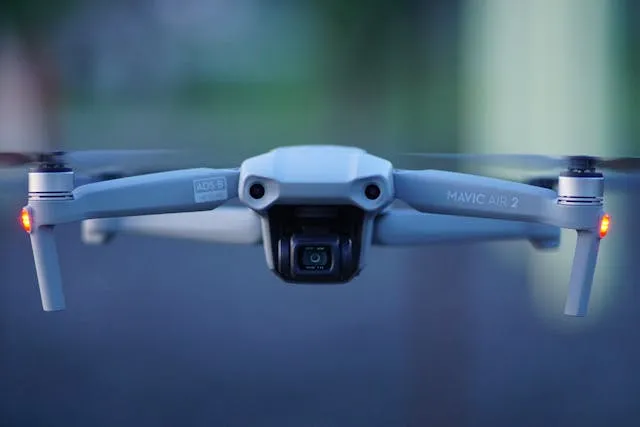
The DJI Mavic Air 2 was, in its day, one of the most important consumer drones DJI ever shipped. Launched in April 2020 at 799 USD, it pushed 4K/60fps video, a 48MP sensor, and 34 minutes of flight time into the mid-range and set the template every later Air model followed. This review is for one specific reader: the person eyeing a used Air 2 in 2026, wondering whether a six-year-old aircraft is a smart bargain or a trap. No nostalgia, no marketing gloss, just the verified specs, an honest read on where the Air 2 sits now, and a clear answer on whether the Air 2S or Air 3 are the better spend.
The one thing to know: the Mavic Air 2 is no longer a current product. It is bought today almost entirely on the used and refurbished market, and it makes sense only at a genuine discount (roughly under 350 to 400 USD for a clean unit). At anything close to the price of a used Air 2S or a new Mini 4 Pro, those drones beat it on sensor quality, obstacle sensing, and software support. It still flies well, but it is a budget stopgap, not a recommendation in its own right.
Who this drone is for in 2026
Be honest with yourself about why you are looking at an Air 2 specifically. There are really only three good reasons. First, you found one cheap (a friend's old unit, a clean refurb, a sub-350 USD listing) and you want a capable aerial camera without spending real money. Second, you are learning to fly and fully expect to crash, so risking an older airframe stings less than risking a new one. Third, you want a second-body backup that shares the same DJI Fly workflow you already know. If none of those describe you, you are better served by a newer drone, and the comparison section below explains exactly why.
Specifications at a glance
Every figure below is taken from DJI's official Mavic Air 2 support page (DJI Mavic Air 2 specs). These are the numbers that actually matter when you compare it against newer aircraft, not the marketing highlights.
| Spec | DJI Mavic Air 2 |
|---|---|
| Sensor | 1/2-inch CMOS, 48MP (12MP effective output) |
| Max video | 4K up to 60 fps, 1080p up to 240 fps |
| Colour profiles | Normal, D-Cinelike (no D-Log) |
| Takeoff weight | 570 g |
| Max flight time | 34 min (windless, DJI rated) |
| Max horizontal speed | 19 m/s (sport mode) |
| Transmission | OcuSync 2.0, up to 10 km (FCC) / 6 km (CE) |
| Obstacle sensing | 3-direction (forward, backward, downward), APAS 3.0 |
Camera: good for its era, clearly dated now
The Air 2 carries a 1/2-inch CMOS sensor that uses a Quad Bayer design: it can output a 48MP still by combining data, but the native effective resolution is 12MP. In 2020 this was a genuine step up for a drone this size. In 2026 it is the weakest part of the package. The sensor is smaller than the 1-inch chip in the Air 2S and even smaller than the 1/1.3-inch sensors in the Air 3 and Mini 4 Pro, and sensor size is the single biggest driver of low-light performance and dynamic range. If you want the full reasoning on why that matters more than the megapixel figure printed on the box, our explainer on how drone camera sensors work breaks it down.
Video tops out at a respectable 4K/60fps, with 1080p available up to 240fps for slow motion (heavily cropped). In daylight the footage is clean and the colours are pleasant straight out of the camera. The honest limitations show up in two places. First, dynamic range is modest, so bright skies clip and deep shadows lose detail faster than they do on bigger-sensor drones. Second, the only flat colour profile is D-Cinelike, not the 10-bit D-Log available on the Air 2S and every Air model since. For casual clips that is fine. For serious colour grading it is a real restriction.
Flight and safety: strong endurance, weak sensing
The Air 2's standout number is flight time. DJI rates it at 34 minutes in windless conditions, and even after years of real-world flying a healthy battery will still deliver high 20s in normal mixed use. That is genuinely good and, oddly, longer than the 31-minute rating of its own successor, the Air 2S. OcuSync 2.0 transmission is also still perfectly usable: rated to 10 km (FCC) or 6 km (CE), it holds a stable 1080p feed at any distance you can legally fly, since you must keep the drone within visual line of sight almost everywhere.
Obstacle sensing is where age really shows. The Air 2 senses in only three directions: forward, backward, and downward. It has no side or upward sensors, which leaves large blind spots that every modern Air and Mini drone has eliminated with omnidirectional vision. APAS 3.0 will route around obstacles directly ahead of you, but track a subject through a tree line with branches to the side and the system simply cannot see them. For learners flying in open fields this is a manageable limitation. For anyone tracking moving subjects in cluttered environments, it is a real safety gap, and it is the clearest single reason to choose a newer drone.
Flight time, realistically
Used-battery health varies. Always check cycle counts before buying second-hand, since worn cells lose noticeable capacity.
2026 status: discontinued in practice, alive on the used market
DJI never issued a loud "end of life" press release for the Mavic Air 2, but for all practical purposes it is a retired product. It has been superseded twice over (first by the Air 2S in 2021, then by the dual-camera Air 3 line), it is no longer a mainstream new-stock item, and DJI sells it primarily as a certified refurbished unit rather than as a current model. Firmware is in maintenance mode: the DJI Fly app still supports the aircraft and it received meaningful updates through 2022, but no new features are being developed for it, and eventual support sunset is a question of when, not if.
On the used market the Air 2 is plentiful and cheap. Across platforms like eBay and specialist used-gear sellers, clean bodies and Fly More Combos trade well below their original 799 USD launch price, often landing in the low-to-mid hundreds depending on condition and accessories. Because used pricing moves with stock and battery health, treat any figure as a snapshot and inspect the listing carefully. If you are weighing a used purchase against renting or buying new, our guide on renting versus buying a drone in 2026 is a useful sanity check before you commit.
How it compares: Air 2 vs Air 2S vs Air 3
The Air 2 only makes sense once you put it beside the two drones that replaced it. The table below uses published DJI specifications.
| Spec | Mavic Air 2 | Air 2S | Air 3 |
|---|---|---|---|
| Sensor | 1/2-inch | 1-inch | 1/1.3-inch (x2) |
| Cameras | Single 24mm | Single 22mm | 24mm + 70mm |
| Max video | 4K/60 | 5.4K/30 | 4K/100 |
| Log profile | D-Cinelike only | 10-bit D-Log | 10-bit D-Log M |
| Flight time | 34 min | 31 min | 46 min |
| Transmission | OcuSync 2.0 (10 km) | O3 (12 km) | O4 (20 km) |
| Obstacle sensing | 3-direction | 4-direction | Omnidirectional |
The Air 2S is the comparison that matters most, because it is the direct successor and now sits at used prices not far above the Air 2. Its 1-inch sensor is a real, visible upgrade in dynamic range and low light, it adds proper 10-bit D-Log for grading, and it shoots up to 5.4K. You give up a few minutes of flight time, but for most buyers that trade is worth making. If a used Air 2S is within reach of your budget, it is the smarter buy. Our DJI Air 2S review covers whether that older 1-inch drone still holds up today.
The Air 3 is a generation beyond both. Two cameras (a 24mm wide and a 70mm telephoto), 46 minutes of flight time, O4 transmission, and full omnidirectional obstacle sensing make it a different class of tool. It costs more, but it is the one to consider if you want a drone that will stay current for years rather than one already past its prime. The DJI Air 3 review goes deep on whether that dual-camera approach earns its price. You can also browse the wider lineup on our drones overview to see where the Air 2 falls in the current range.
Who the Mavic Air 2 is for
Consider it if you
- • Find a clean unit well under 400 USD
- • Are learning and expect a crash or two
- • Need an inexpensive backup body
- • Shoot mostly in good daylight
- • Are happy with 4K/60 and casual editing
Look elsewhere if you
- • Are paying anything near new retail
- • Need reliable side and upward sensing
- • Want D-Log for serious colour grading
- • Plan paid or professional work
- • Want a drone that stays current for years
The verdict
The Mavic Air 2 was an excellent drone in 2020 and it still flies cleanly, with class-leading endurance for its generation. But it has been comprehensively passed by the Air 2S and Air 3 on the things that age worst: sensor quality, obstacle sensing, and software support. As a current recommendation at retail it does not stand up. As a cheap used find for a learner or a backup, under roughly 350 to 400 USD, it remains a sensible, functional choice. Buy it for the price, not for the spec sheet.
Frequently asked questions
Is the DJI Mavic Air 2 worth buying in 2026?
Only as a used or refurbished unit at a genuine discount, roughly under 350 to 400 USD. At that price it is a fine learner or backup drone. At anything near its original retail, a used Air 2S or a new Mini 4 Pro is a far better buy thanks to bigger sensors, better obstacle sensing, and ongoing software support.
Has DJI discontinued the Mavic Air 2?
In practice, yes. DJI never made a formal end-of-life announcement, but the Air 2 has been replaced twice (by the Air 2S and Air 3 line) and is now sold mainly as a certified refurbished unit rather than as a current model. Firmware is in maintenance mode with no new features being added.
Should I buy a used Mavic Air 2 or a used Air 2S?
If your budget can stretch to a used Air 2S, buy that. Its 1-inch sensor is a clear upgrade in dynamic range and low light, it adds 10-bit D-Log for grading, and obstacle sensing is improved. The Air 2 only wins on a slightly longer flight-time rating and a lower asking price.
Does the Mavic Air 2 have to be registered?
Yes. At 570 g it is far above the 250 g threshold everywhere, so registration is required in nearly all jurisdictions. US pilots register with the FAA, and EU pilots register as an operator and label the aircraft. See our guides on the FAA registration process and registering a drone in Germany. Note that the Air 2 predates the Remote ID era, so check current broadcast-module requirements for your country.
Can the Mavic Air 2 shoot in a flat log profile?
Only D-Cinelike, not the full 10-bit D-Log found on the Air 2S and newer Air models. D-Cinelike gives you a little grading headroom but far less than D-Log. If colour grading is central to your workflow, this is one of the strongest reasons to choose a newer drone.
What should I check before buying one second-hand?
Battery health above all: ask for cycle counts, since worn cells cut flight time noticeably. Also check the gimbal for play or damage, confirm the props and charger are included, and ask the seller to power it up and confirm a clean compass and IMU status. A tidy refurb with low-cycle batteries is worth paying a little more for.
This review is based on DJI's published specifications and reputable third-party reporting. It is not sponsored by DJI, and the site may earn an affiliate commission on purchases made through retailer links. Specifications verified June 2026.
Frequently Asked Questions
Is the DJI Mavic Air 2 worth buying in 2026?
Only as a used or refurbished unit at a genuine discount, roughly under 350 to 400 USD, where it works as a learner or backup drone. At prices near its original retail, a used Air 2S or a new Mini 4 Pro is a far better buy on sensor quality, obstacle sensing, and software support.
Has DJI discontinued the Mavic Air 2?
In practice, yes. There was no formal end-of-life announcement, but it has been replaced by the Air 2S and Air 3 line and is now sold mainly as a certified refurbished unit. Firmware is in maintenance mode with no new features being added.
Should I buy a used Mavic Air 2 or a used Air 2S?
If your budget can reach a used Air 2S, buy that. Its 1-inch sensor is a clear upgrade in dynamic range and low light, it adds 10-bit D-Log, and obstacle sensing is better. The Air 2 only wins on a slightly longer flight-time rating and a lower price.
Does the Mavic Air 2 have to be registered?
Yes. At 570 g it is well above the 250 g threshold, so registration is required in nearly all jurisdictions. US pilots register with the FAA and EU pilots register as an operator and label the aircraft. The Air 2 predates Remote ID, so check current broadcast-module rules for your country.