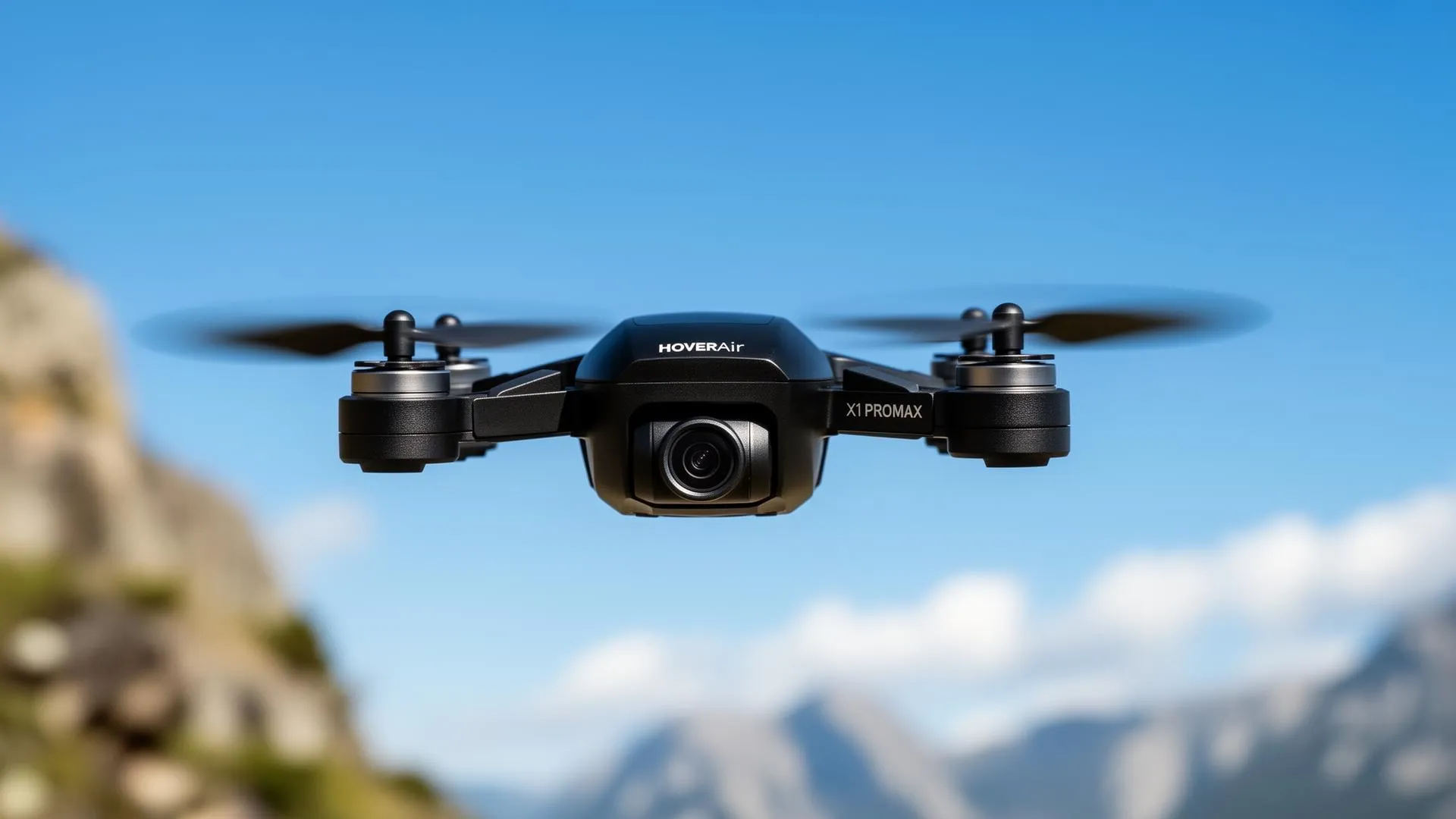
You have seen the shots even if you do not know the brand: a runner on a coastal trail, a cyclist carving down a switchback, a hiker cresting a ridge, all filmed from a smooth, drifting follow-cam with nobody else around. Most of those clips come from the HOVERAir X1 PRO and X1 PROMAX, the flagship self-flying cameras from ZeroZero Robotics. This review is for the solo creator deciding whether a palm-launched, GPS-free follow drone is worth $499 to $699, which of the two models actually makes sense, and how they stack up against DJI's Neo and Flip. No fabricated test logs here, just the published specs, what reputable reviewers have found, and an honest read on where these devices fit.
The one thing to know: these are not drones you "fly," they are autonomous action cameras that follow you. The PRO ($499) shoots 4K from a small 1/2-inch sensor; the PROMAX ($699) adds a larger 1/1.3-inch sensor, 48MP stills, and 8K/30 video. Both weigh about 192g (still under the 250g registration threshold), survive Level 5 wind, and have no GPS, no return-to-home, and a real-world flight time closer to 12 minutes than the rated 16. For hands-off follow footage they are excellent. For anything resembling traditional droning, they are not the tool.
What a "self-flying camera" actually is
The category these belong to is worth naming clearly, because it explains every strength and every limitation that follows. A self-flying camera has no transmitter sticks and no piloting in the usual sense. You unfold it like a small book, set it on your palm, pick a mode on the app or a button, and it lifts off, frames you with onboard AI tracking, films, and lands back in your hand. There is no first-person view to manage and, crucially, no GPS positioning. The X1 series holds position and follows using downward sensors and visual subject tracking rather than satellites, which is why it can fly indoors but cannot offer return-to-home or waypoint missions.
That design choice is the whole point. It removes the learning curve that keeps people from ever buying a "real" drone, and it sidesteps a lot of the intimidation around controllers and crash risk. It also means you are buying a device with a deliberately narrow job: getting cinematic footage of yourself, hands-free, in calm-to-moderate conditions. If you want to understand why the absence of GPS matters so much for positioning and safety, our explainer on how drone GPS works is a useful companion read.
Specifications at a glance
The figures below come from HOVERAir's published specifications and have been cross-checked against independent reviews, including New Atlas, which measured the PROMAX at roughly 195g (New Atlas review). The single most important difference between the two models is the sensor, and everything else flows from it.
| Specification | X1 PRO ($499) | X1 PROMAX ($699) |
|---|---|---|
| Sensor | 1/2-inch CMOS | 1/1.3-inch CMOS |
| Max video | 4K/60fps, FHD/120fps | 8K/30fps, 4K/120fps, 10-bit HLG |
| Stills | ~12MP (4000x3000) | 48MP (8000x6000), JPG + DNG |
| Field of view | ~107° (17mm equiv.) | 107° (16mm equiv.) |
| Internal storage | 32GB | 64GB + microSD |
| Weight | ~192g | ~192g |
| Battery / flight time | 1920 mAh, up to 16 min | 1920 mAh, up to 16 min |
| Follow speed | up to 42 km/h | up to 42 km/h |
| Wind resistance | Level 5 | Level 5 |
| GPS | No | No |
A note on flight time
The 16-minute rating is a best-case figure. Once active subject tracking is running, independent testers and owners report a realistic 11 to 13 minutes per battery, and the short scripted modes (Orbit, Dolly, Bird's Eye) each consume well under a minute on their own. Plan around two or three batteries if you want a real shooting session, and budget for them: spare cells are a recurring cost rather than an afterthought.
Tracking and flight modes: where the value lives
The reason anyone buys one of these instead of a cheap action cam on a stick is the autonomy, and HOVERAir leans hard into it. Both models share the same ten intelligent modes: Hover, Follow, Zoom Out, Orbit, Bird's Eye, Dolly Track, Dolly Zoom, Indoor Follow, Ski Mode, and Cycling Mode. The follow and orbit behaviours are the genuinely useful everyday tools; the scripted reveal modes are best thought of as one-button "set pieces" you trigger occasionally rather than fly continuously.
The tracking itself is the standout. ZeroZero's subject recognition locks onto a face or body and holds it steadily through dynamic movement, which is exactly what reviewers consistently praise: the experience of palm-launching, tapping a mode, and having usable footage within seconds of opening the box. Where it struggles is predictable. Dense vegetation, busy crowds, and fast lateral movement can confuse the AI, and because there is no forward obstacle avoidance you are responsible for keeping the flight path clear. In an open field or on a quiet trail it is close to magic; weaving through trees it is a liability.
Image quality and the sensor gap
This is where the $200 between the two models is spent, and it is a real gap rather than a marketing one. The PROMAX's 1/1.3-inch sensor is the same class of chip DJI uses in the Mini line, and it shows: 48MP stills with DNG raw, up to 8K/30 video, 4K at 120fps for slow motion, and 10-bit HLG for HDR grading. DronesGator went as far as saying its image quality rivals the DJI Mini 4 Pro (DronesGator review), which for a palm-launch camera is a serious claim.
The PRO's smaller 1/2-inch sensor caps out at 4K/60 and roughly 12MP stills. In good daylight the difference is modest and most social-media viewers will never notice. Push into shadow, dusk, or anything you want to grade heavily, and the PROMAX's larger sensor and 10-bit pipeline pull clearly ahead on noise and dynamic range. If you want the background on why sensor size matters more than the megapixel count on the box, our piece on drone camera sensors explained covers the physics in plain terms.
The good and the bad, honestly
Strengths
- • Truly effortless: palm launch, auto-follow, palm landing, no piloting skill
- • Steady AI subject tracking through dynamic movement
- • Pocketable and propeller-caged for safety near people
- • PROMAX image quality genuinely competes with sub-250g DJI drones
- • Under 250g, so no FAA registration for US recreational flying
- • Level 5 wind resistance, sturdier than its tiny size suggests
Limitations
- • Real flight time of 11 to 13 min with tracking on
- • No GPS, so no return-to-home or waypoint missions
- • No forward obstacle avoidance; you clear the path
- • Tracking falters in dense trees and crowds
- • Expensive for the category, especially the PROMAX
- • The optional Beacon controller has been flagged as buggy
That last point deserves a flag. The PROMAX can be paired with an optional Beacon remote for manual control and longer range, but New Atlas found it the weak link, citing connection drops, touchscreen freezes, and confusing setup, calling it the one extra it could not enthusiastically recommend. The drone is the strong part of the package; the accessory ecosystem is still maturing. Treat the Beacon as optional, not essential.
How it compares: HOVERAir vs DJI Neo and DJI Flip
DJI is the obvious cross-shop, and the comparison is more nuanced than "cheaper is better." The DJI Neo attacks the same self-flying niche from below on price, while the DJI Flip is a more capable traditional drone that happens to do palm launch. The table uses published manufacturer specs.
| Feature | X1 PROMAX | DJI Neo | DJI Flip |
|---|---|---|---|
| Price | $699 | $199 | $439 |
| Max video | 8K/30fps | 4K/30fps | 4K/60fps |
| Weight | ~192g | 135g | 249g |
| Flight time (rated) | ~16 min | ~18 min | ~31 min |
| GPS | No | Yes | Yes |
| Tracking focus | Best in class | Strong | Strong |
The honest read: at $199, the DJI Neo undercuts the HOVERAir dramatically and adds GPS, return-to-home, and access to DJI's wider control options, so on pure value for a casual self-filmer it is hard to argue against. What the HOVERAir buys you for the extra money is more refined autonomous tracking, the propeller cage that makes flying close to people feel safer, and, on the PROMAX, materially better image quality with 8K and 48MP raw. The DJI Flip is a different proposition again: at 249g with GPS, a 3-axis gimbal, real obstacle sensing, and 31 minutes of flight, it is a proper drone that also does palm launch, but it is bulkier and demands a little more of you as a pilot. For a wider buying view across the category, our drone buying guides hub lays out the trade-offs by use case.
Which one should you buy?
A great fit if you
- • Film yourself solo: running, cycling, hiking, skiing
- • Want footage with zero piloting and zero setup
- • Value the safety of a fully caged aircraft near people
- • Travel light and shoot mostly in calm conditions
- • Want the best portable autonomous tracking available
Look elsewhere if you
- • Need long flights or distance (no GPS, short battery)
- • Fly in strong wind or exposed coastal sites often
- • Want manual cinematic control and obstacle sensing
- • Are price-sensitive (the DJI Neo costs far less)
- • Shoot landscapes more than yourself
Between the two HOVERAir models, my recommendation is straightforward. For most creators the X1 PRO at $499 is the sensible pick: 4K/60 is plenty for social platforms and the autonomy is identical to its sibling. Step up to the PROMAX at $699 only if you genuinely use the bigger sensor, want 48MP raw stills, plan to grade 10-bit footage, or expect to crop into 8K in post. If neither the resolution nor the cage matters to you, the cheaper DJI Neo is the rational alternative. Still deciding whether to commit at all? Our guide on whether buying a drone is worth it in 2026 is worth a read first.
The verdict
The HOVERAir X1 PRO and PROMAX are the most polished self-flying cameras you can buy, and within that narrow brief they deliver: effortless launch, dependable tracking, and, on the PROMAX, image quality that punches above the category. They are not drones in the traditional sense, and the missing GPS, short real-world battery, and premium price keep them firmly in the niche of hands-free self-filming. Buy them for what they are, not what a DJI Air or Mini does, and they are genuinely excellent.
Frequently asked questions
Should I buy the X1 PRO or the X1 PROMAX?
For most people the PRO at $499 is the smarter buy: it has the same autonomous tracking and flight modes, and 4K/60 is more than enough for social media. Choose the PROMAX ($699) if you specifically need its larger 1/1.3-inch sensor, 48MP raw stills, 10-bit HLG, or 8K video for cropping in post.
How long does the HOVERAir X1 really fly per battery?
The rated figure is up to 16 minutes, but with active subject tracking running, real-world flight time lands around 11 to 13 minutes. The short scripted modes each use under a minute. Plan on carrying two or three batteries for any extended session.
Does the HOVERAir X1 have GPS or return-to-home?
No. The X1 series positions and tracks using downward sensors and visual subject recognition rather than satellite GPS, so there is no return-to-home or waypoint capability. That keeps it simple and lets it fly indoors, but it means you must keep the flight path clear yourself and stay within sight.
Do I need to register the HOVERAir X1 with the FAA?
At roughly 192g, both models sit under the 250g threshold, so US recreational pilots do not need to register them with the FAA. Always confirm current local rules before flying, as requirements differ by country. Our drone regulations hub keeps track of the thresholds by region.
Can the HOVERAir X1 handle wind?
Both models are rated for Level 5 wind resistance, which is solid for such a small aircraft, but they are still light and best used in calm to moderate conditions. In strong gusts or exposed coastal sites, a heavier drone with GPS such as the DJI Flip will hold position more reliably.
Is the optional Beacon controller worth it?
It is optional, not essential. The Beacon adds manual control and range, but independent reviewers have reported connection drops and software quirks, so most users get the best of the X1 through its app-driven autonomous modes. Treat the Beacon as a nice-to-have you can add later if you need it.
This review is based on HOVERAir's published specifications and reputable third-party reporting. It is not sponsored by HOVERAir or ZeroZero Robotics, and the site may earn an affiliate commission on purchases made through retailer links. Specifications and prices verified June 2026; confirm current pricing and availability before buying.
Frequently Asked Questions
Should I buy the HOVERAir X1 PRO or the X1 PROMAX?
For most people the PRO at $499 is the smarter buy, with identical tracking and 4K/60 that is plenty for social media. Choose the PROMAX ($699) only if you need its larger 1/1.3-inch sensor, 48MP raw stills, 10-bit HLG, or 8K video.
How long does the HOVERAir X1 really fly per battery?
The rated figure is up to 16 minutes, but with active subject tracking real-world flight time is closer to 11 to 13 minutes, and each short scripted mode uses under a minute. Carry two or three batteries for a real session.
Does the HOVERAir X1 have GPS or return-to-home?
No. The X1 positions and tracks using downward sensors and visual subject recognition rather than satellite GPS, so there is no return-to-home or waypoint capability. It can fly indoors, but you must keep the path clear and stay within sight.
Do I need to register the HOVERAir X1 with the FAA?
At roughly 192g, both models are under the 250g threshold, so US recreational pilots do not need to register them with the FAA. Always confirm current local rules before flying, as requirements differ by country.