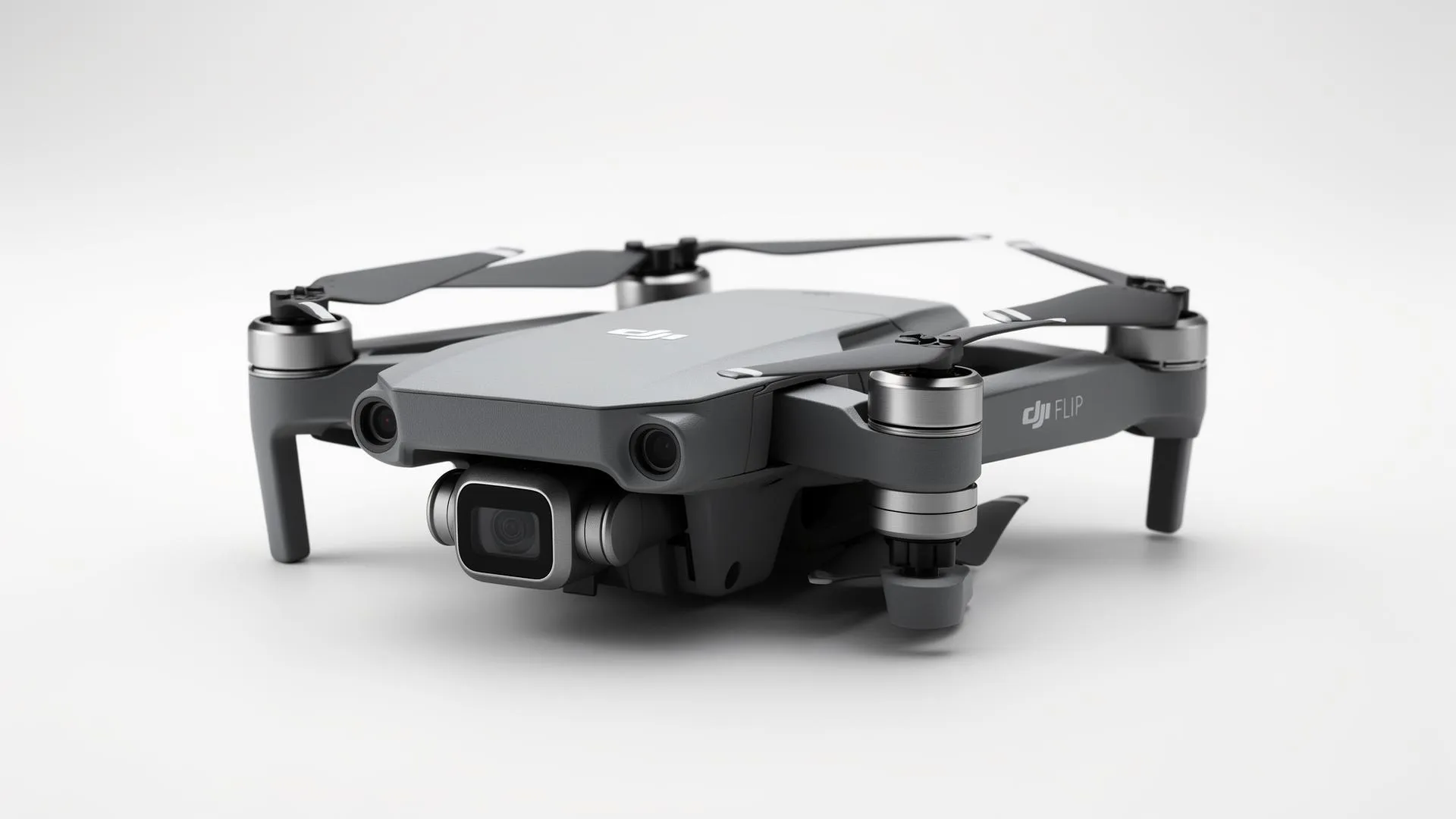
The DJI Flip answers a specific question: what does a camera drone look like if you design it so a nervous first-timer cannot easily hurt anyone or break a propeller? The answer is a sub-250g foldable drone wrapped in permanent full-coverage propeller guards, carrying the same 1/1.3-inch sensor class as the pricier Mini 4 Pro. This review is for the person deciding whether the Flip is the safe, low-stress way into aerial video, whether the DJI Neo 2 or Mini 4 Pro would serve them better, and what its honest weaknesses are. No invented test flights here, just verified specs, the consensus from reviewers who have flown it, and a clear read on where it fits in 2026.
The one thing to know: the Flip trades all-round obstacle sensing for physical safety. You get caged props you can fly near people and indoors, a genuinely good 1/1.3-inch camera, palm takeoff, and O4 transmission, but only forward and downward obstacle sensing, and even that switches off during the subject-tracking modes you bought the drone for. If your priority is a safe, beginner-friendly vlog and selfie drone for open spaces, it is excellent. If you want autonomous tracking through trees, look at the Mini 4 Pro.
Who the DJI Flip is actually for
DJI positioned the Flip between its tiny self-flying Neo line and the more serious Mini camera drones, and that middle ground defines who should buy it. It suits the absolute beginner who is intimidated by spinning propellers, the solo vlogger who wants a drone that can launch from a palm and orbit them hands-free, and the traveller who values a flat, pocketable form factor. The permanent guards mean you can hand it to a friend, fly it on a crowded beach, or buzz close to a subject for a portrait shot without the usual fear of a prop strike.
It is a poorer fit for anyone who wants the drone to weave through complex environments on its own, or who flies regularly in stronger wind. Reviewers consistently flag the Flip's wind handling as a weak point relative to denser drones, and the safety cage adds drag that the small airframe has to fight. If you are still weighing the whole decision, our guide on whether buying a drone is worth it in 2026 covers the running costs and realities beyond the sticker price.
Specifications at a glance
Every figure below comes from DJI's published specifications (DJI Flip spec sheet). Note the takeoff weight is held just under the 249 g line on purpose, which keeps the Flip in the lightest regulatory class in most countries.
| Aircraft | |
|---|---|
| Takeoff weight | Under 249 g (with battery and microSD) |
| Dimensions (folded) | 136 × 62 × 165 mm |
| Dimensions (unfolded) | 233 × 280 × 79 mm |
| Max flight time | 31 min (no wind), 28 min hover |
| Max speed | 12 m/s, up to 16 m/s in Sport mode |
| Wind resistance | 10.7 m/s (Level 5) |
| Service ceiling | 3,000 m above sea level |
| Obstacle sensing | Forward 3D infrared, downward vision and infrared |
| Transmission | DJI O4, up to 13 km (FCC) |
Camera system
1/1.3-inch CMOS, 48 MP
24 mm equiv., f/1.7
4K up to 60 fps HDR
4K/100 fps
Normal, 10-bit D-Log M, HLG
3-axis mechanical
The folding cage: the whole point of this drone
The Flip's defining feature is its permanent, full-coverage propeller guard. Where most drones leave their blades exposed (or offer flimsy clip-on cages as an afterthought), the Flip's guards are part of the airframe and fold flat with it, so the props are protected the moment you take it out of the bag. That single design choice is what makes this a credible first drone: a brushed prop on a hand or a wall is the most common rookie accident, and the Flip is built to shrug it off.
That protection buys real freedom. You can fly indoors, hand-catch the drone, and frame close portrait shots without flinching. The honest trade-off is bulk and weight. To stay under 249 g while carrying the cage, DJI had little headroom left, and reviewers note the guards add drag that hurts wind performance and makes the folded unit thicker than a Mini. It is a deliberate compromise: safety and approachability in exchange for the lean efficiency of an uncaged Mini.
What the cage gives you
- • Fly indoors and near people with confidence
- • Survive light bumps into walls and branches
- • Safe palm takeoff and hand catch
- • Close-range shots without prop-strike fear
What it costs you
- • Extra drag and weaker wind handling
- • Thicker, heavier than an uncaged Mini
- • No room left for side or rear sensors
- • Less efficient, so flight time is modest
Camera: Mini 4 Pro DNA in a safer body
The camera is the reason the Flip is more than a toy. It uses a 1/1.3-inch, 48 MP CMOS sensor with a bright f/1.7 lens, the same sensor class found in the Mini 4 Pro. It records 4K up to 60 fps with HDR, slow motion to 4K/100 fps, and offers 10-bit D-Log M and HLG for colour grading. In good light that yields clean, naturally coloured footage that genuinely outclasses smaller-sensor selfie drones, and Engadget's reviewer praised its "sharp 4K video" while scoring the drone 82/100 (Engadget review).
Be realistic about the limits. A 1/1.3-inch sensor is still small in absolute terms, so low-light and night footage gets noisy, and the fixed single lens means no optical zoom and no second focal length. The f/1.7 aperture helps in dim conditions, but this is a daylight-first camera. If you want to understand why sensor size matters more than the megapixel figure on the box, our explainer on drone camera sensors is a useful primer before you buy.
Smart features and the obstacle-sensing caveat
For controller-free creators, the Flip is well equipped. Palm takeoff lets you launch it straight from your hand with no controller at all, and a set of one-tap QuickShots (Dronie, Rocket, Circle, Boomerang and more) plus ActiveTrack and Direction Track will orbit and follow a subject automatically. For a solo vlogger filming themselves, that is the core workflow, and it works as advertised.
The important caveat, and it is a real one, concerns obstacle sensing. The Flip is DJI's first lightweight drone with a forward-facing 3D infrared sensor that brakes before head-on collisions, plus downward vision and infrared for landing. There are no upward, side, or rear sensors. More significantly, multiple reviewers confirm that automatic obstacle avoidance does not operate during the tracking modes, so when the Flip is following you, it will not dodge a tree behind you. The propeller cage is your backup, not the sensors. In open spaces this rarely bites; in a wooded park it absolutely can.
Worth knowing before your first flight
Treat the Flip as a drone that protects itself physically, not one that navigates for you. Fly tracking modes in open areas, keep an eye on the live feed, and lean on the cage for the inevitable contact. That mindset matches what the hardware actually delivers and avoids the most common disappointment new owners report.
Flight time, transmission, and battery
DJI rates the Flip at 31 minutes of flight and 28 minutes of hover in still air. As with every drone, that is a best-case lab figure; real flying with wind, repositioning, and tracking will land lower, so plan for the low-to-mid 20s per pack. A single battery charges in roughly 70 minutes through the aircraft, or about 45 minutes in the charging hub, which is why a multi-battery bundle is close to essential if you want more than one short session out. If you want the wider context on what limits these numbers, our overview of drone battery technology explains the trade-offs.
Transmission is handled by DJI's O4 system, rated to 13 km in FCC regions with a stable, low-latency feed. As always, the headline range is mostly academic because you are legally required to keep the drone in visual line of sight nearly everywhere. What matters is that O4 holds a clean signal in cluttered radio environments, which it does well, and it is a meaningful step up from older Mini transmission for live-view reliability at normal distances.
How it compares: Neo 2 and Mini 4 Pro
The Flip only makes sense next to its two obvious siblings. Below it sits the tiny DJI Neo 2; above it sits the Mini 4 Pro. The table uses published DJI specs and recent reported pricing.
| Feature | DJI Flip | DJI Neo 2 | Mini 4 Pro |
|---|---|---|---|
| Sensor | 1/1.3" 48 MP | 1/2" 12 MP | 1/1.3" 48 MP |
| Max video | 4K/60 HDR | 4K/60 | 4K/60 HDR |
| Weight | <249 g | ~151 g | <249 g |
| Flight time | 31 min | ~19 min | 34 min |
| Obstacle sensing | Forward + down | Omnidirectional | Omnidirectional |
| Prop guards | Built-in cage | Built-in cage | Optional |
| Approx. price | from $329 | from ~239 EUR | from ~$759 |
The DJI Neo 2 is the more interesting comparison than it first appears. It is far smaller and cheaper, yet it now offers full omnidirectional obstacle sensing with forward LiDAR, something the larger Flip lacks. What the Neo 2 gives up is the camera: a smaller 1/2-inch sensor, less detail, and shorter flight time. Choose the Neo 2 if you want the smallest, safest self-flying companion and can live with phone-quality footage; choose the Flip if image quality matters and you want a proper 3-axis gimbal and the bigger sensor.
The Mini 4 Pro is the upgrade path. It shares the Flip's 1/1.3-inch sensor and HDR video but adds true omnidirectional obstacle avoidance that works during tracking, slightly longer flight time, and a more efficient uncaged airframe, all for a notably higher price. If you will fly autonomous tracking shots in cluttered places or want the most capable sub-250g drone, it is worth the premium. If you want safety near people and a friendlier price, the Flip wins. For the full lineup, browse our drones overview.
Price, configurations, and 2026 status
The Flip launched at $439 but has fallen steadily, and as of mid-2026 it starts around $329, with bundles regularly discounted further during sales events. The screenless kit pairs the drone with the RC-N3 (you attach your own phone); a step up adds the screen-equipped DJI RC 2; and a battery combo adds extra packs, a charging hub, and a bag. For most buyers the battery combo is the configuration worth getting, because the modest flight time makes a second and third battery close to mandatory. The cheapest kit is the right call only if you already own compatible accessories or are strict on budget. Confirm live pricing on DJI's store before buying, since promotional figures move with stock (DJI Flip store page).
On US availability, the picture in 2026 is more stable than the scare headlines suggest. There is no nationwide ban on owning or operating DJI drones, and units that are legally on sale remain legal to buy and fly (DJI ban overview). The ongoing policy uncertainty centres on future federal review and customs friction, not a retroactive ban on the Flip itself. If you are buying in the US, register and fly under current FAA rules; our FAA drone license guide covers what recreational and Part 107 pilots need.
Who should buy the DJI Flip
A great fit if you
- • Are a nervous beginner who wants caged props
- • Vlog yourself with hands-free palm takeoff and tracking
- • Fly indoors or near people and want safety first
- • Want Mini-class image quality at a lower price
- • Shoot mostly in daylight and open spaces
Look elsewhere if you
- • Need tracking that dodges obstacles automatically
- • Fly often in strong wind
- • Want the smallest, lightest drone (Neo 2)
- • Want omnidirectional sensing (Mini 4 Pro)
- • Shoot a lot at night or in deep shadow
The verdict
The DJI Flip is the most approachable real camera drone DJI makes. The folding safety cage genuinely lowers the barrier to flying, the 1/1.3-inch camera punches well above its price, and palm takeoff with tracking makes solo vlogging easy. The honest catch is that its obstacle sensing is limited to forward and down, and it does not protect you during the very tracking modes you will use most, so it asks for open spaces and a bit of judgement. Now that it sits around $329, it is the easy recommendation for safety-minded beginners and self-filming creators. Demanding pilots should step up to the Mini 4 Pro.
Frequently asked questions
Does the DJI Flip need to be registered?
It is held just under 249 g, so in the US recreational flyers do not need to register it (commercial Part 107 operators still do). Rules differ by country, and the EU still requires operator registration and an A1/A3 sub-category even for sub-250g camera drones, so check local law. See our FAA drone license guide for the US details.
Does the Flip avoid obstacles automatically?
Only partly. It has a forward 3D infrared sensor that brakes before head-on collisions and downward sensors for landing, but no side, rear, or upward sensing. Crucially, automatic avoidance does not run during tracking modes like ActiveTrack, so the propeller cage is your real protection. Fly tracking shots in open areas.
How does the Flip compare to the Mini 4 Pro?
They share the same 1/1.3-inch sensor and HDR video, so daylight image quality is very close. The Flip adds a built-in safety cage and palm takeoff at a lower price; the Mini 4 Pro adds true omnidirectional obstacle avoidance that works during tracking, a more efficient airframe, and slightly longer flight time. Pick the Flip for safety and value, the Mini 4 Pro for autonomy and capability.
Flip or Neo 2 for a first drone?
The Neo 2 is smaller, cheaper, and surprisingly has full omnidirectional sensing, but its 1/2-inch camera and short flight time make it more of a casual self-flying companion. The Flip costs more but delivers far better image quality with its larger sensor and 3-axis gimbal. Choose by whether footage quality or compact convenience matters more to you.
Is the DJI Flip legal to buy and fly in the US in 2026?
Yes. There is no nationwide ban on owning or operating DJI drones, and units legally sold remain legal to purchase and fly. The ongoing policy debate concerns future federal review and import friction, not a retroactive ban on existing drones. Fly under current FAA rules.
Can I fly the Flip without a controller?
Yes. Palm takeoff lets you launch it straight from your hand, and QuickShots plus subject tracking can capture cinematic shots with the DJI Fly app alone. For longer-range or manual flying you will still want the RC-N3 or DJI RC 2 controller.
This review is based on DJI's published specifications and reputable third-party reporting. It is not sponsored by DJI, and the site may earn an affiliate commission on purchases made through retailer links. Specifications and prices verified June 2026.
Frequently Asked Questions
Does the DJI Flip need to be registered?
It is held just under 249 g, so US recreational flyers do not need to register it (commercial Part 107 operators still do). Rules differ by country, and the EU still requires operator registration even for sub-250g camera drones, so check local law.
Does the Flip avoid obstacles automatically?
Only partly. It has a forward 3D infrared sensor and downward sensors, but no side, rear, or upward sensing, and automatic avoidance does not run during tracking modes. The propeller cage is your real protection, so fly tracking shots in open areas.
How does the Flip compare to the Mini 4 Pro?
They share the same 1/1.3-inch sensor and HDR video, so daylight image quality is very close. The Flip adds a built-in safety cage and a lower price; the Mini 4 Pro adds true omnidirectional obstacle avoidance that works during tracking and a more efficient airframe.
Is the DJI Flip legal to buy and fly in the US in 2026?
Yes. There is no nationwide ban on owning or operating DJI drones, and units legally sold remain legal to buy and fly. The ongoing policy debate concerns future federal review and import friction, not a retroactive ban on existing drones.
Can I fly the Flip without a controller?
Yes. Palm takeoff lets you launch it from your hand, and QuickShots plus subject tracking work with the DJI Fly app alone. For longer-range or manual flying you will still want the RC-N3 or DJI RC 2 controller.