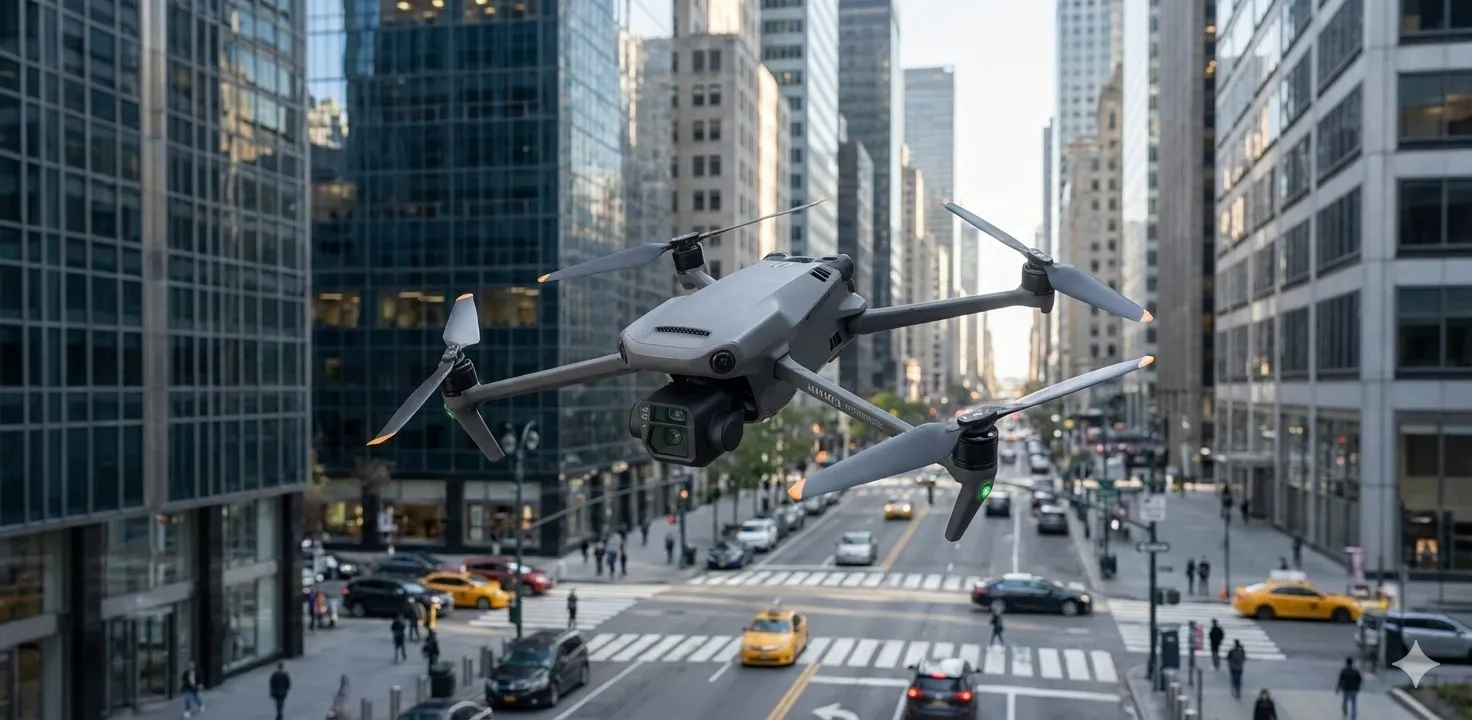
The DJI Mavic 4 Pro is DJI's most ambitious folding camera drone yet, and it lands directly on top of the Mavic 3 Pro, the triple-camera flagship it replaces. This 2026 head-to-head is written for one decision: which one belongs in your bag, and if you already own the Mavic 3 Pro, whether the jump is actually worth it. No hands-on heroics, just the published specs that matter, an honest read on where each drone wins, and the messy reality of buying a Mavic 4 Pro in the United States.
The one thing to know: the Mavic 4 Pro is a generational leap on paper, a 100MP Four Thirds Hasselblad main camera, a 360-degree Infinity Gimbal, forward LiDAR, O4+ transmission, and a 51-minute flight time. But the Mavic 3 Pro is not obsolete: its triple-camera system still shoots gorgeous Hasselblad footage, it is now heavily discounted, and in the US it is the easier of the two to buy through normal channels. For many buyers the older drone is still the smarter money.
Quick verdict: who should buy which
Buy the Mavic 4 Pro if you
- + Want the highest-resolution drone stills DJI makes (100MP)
- + Need the 360-degree Infinity Gimbal for unusual angles
- + Fly at dusk or night and want LiDAR obstacle sensing
- + Deliver 6K HDR or want maximum reframing headroom
- + Are buying your first flagship and want the longest runway
- + Can confirm stock and warranty support in your country
Buy the Mavic 3 Pro if you
- + Want flagship Hasselblad quality for hundreds less
- + Are happy with 5.1K video and a 43-minute battery
- + Value a clean US purchase path and easy support
- + Already own Mavic 3 batteries or accessories
- + Do not need 100MP, LiDAR, or the rotating gimbal
- + Are catching the current discounts on outgoing stock
Specifications at a glance
Every figure below comes from DJI's published specifications and reputable launch coverage, including DPReview's Mavic 4 Pro report and the official Mavic 3 Pro spec sheet. Both drones share the folding Mavic form factor and stay under the same weight class, but almost everything inside has moved on.
| Specification | Mavic 4 Pro | Mavic 3 Pro | Edge |
|---|---|---|---|
| Main sensor | 4/3" Hasselblad, 100MP | 4/3" Hasselblad, 20MP | Mavic 4 Pro |
| Camera cluster | 28mm + 70mm + 168mm | 24mm + 70mm + 166mm | Both triple-cam |
| Tele sensors | 1/1.3" 48MP + 1/1.5" 50MP | 1/1.3" 48MP + 1/2" 12MP | Mavic 4 Pro |
| Gimbal | 360-degree Infinity Gimbal | Standard 3-axis | Mavic 4 Pro |
| Max video (main) | 6K/60fps HDR | 5.1K/50fps | Mavic 4 Pro |
| Slow motion (4K) | 4K/120fps | 4K/120fps | Tie |
| Max flight time | 51 minutes | 43 minutes | Mavic 4 Pro |
| Transmission | O4+, up to 30km (FCC) | O3+, up to 15km (FCC) | Mavic 4 Pro |
| Obstacle sensing | Omnidirectional + forward LiDAR | Omnidirectional vision | Mavic 4 Pro |
| Takeoff weight | approx. 1,063 g | 958 g | Mavic 3 Pro (lighter) |
| Starting price | approx. $2,199 | approx. $1,879 (often less) | Mavic 3 Pro |
Camera systems: the biggest difference
Both drones are triple-camera Hasselblad machines, and on paper that sounds similar. In reality the camera story is where the Mavic 4 Pro separates itself most clearly. The headline number is the main sensor: a new-generation 4/3 Four Thirds Hasselblad chip that captures 100MP stills and shoots 6K/60fps HDR with a quoted dynamic range above 15 stops. The Mavic 3 line uses the same 4/3 sensor format but at 20MP, so the Mavic 4 Pro offers roughly five times the pixel count for cropping, large prints, and reframing.
The telephoto situation matters too. The Mavic 3 Pro pairs its main camera with a 70mm 1/1.3" medium tele and a 166mm 1/2" tele that tops out at just 12MP, which is fine for reach but weak for stills. The Mavic 4 Pro keeps the 48MP 70mm medium tele but replaces the long lens with a sharper 168mm camera on a larger 1/1.5" sensor at 50MP. For wildlife, sports, and any subject you cannot fly close to, that upgraded long lens is the more useful tool. If you want to understand why sensor size and aperture matter more than raw megapixels, our explainer on drone camera sensors breaks it down.
Camera cluster breakdown
Mavic 4 Pro (3 cameras)
- Main: 4/3" 100MP, 28mm eq., f/2.0-f/11
- Medium tele: 1/1.3" 48MP, 70mm eq.
- Tele: 1/1.5" 50MP, 168mm eq., f/2.8
- Gimbal: 360-degree Infinity Gimbal, tilts up
Mavic 3 Pro (3 cameras)
- Main: 4/3" 20MP, 24mm eq., f/2.8-f/11
- Medium tele: 1/1.3" 48MP, 70mm eq.
- Tele: 1/2" 12MP, 166mm eq.
- Gimbal: standard 3-axis, no rotation
The other genuine first is the 360-degree Infinity Gimbal. The Mavic 4 Pro can rotate its camera a full turn and tilt it upward past the horizon, which unlocks vertical shooting without quality loss, true Dutch tilts, and upward-looking angles that simply were not possible on the Mavic 3 Pro's conventional three-axis gimbal. Whether that is a must-have or a nice-to-have depends entirely on how you shoot, but it is the kind of feature you cannot replicate in post.
Video: 6K HDR vs 5.1K
The Mavic 4 Pro records 6K/60fps HDR on the main camera, while the Mavic 3 Pro maxes out at 5.1K/50fps. Both drones shoot 4K up to 120fps for slow motion, and both offer 10-bit D-Log M and HLG profiles for colour grading, so the real difference is resolution headroom and HDR pipeline rather than a night-and-day jump in everyday footage. If you deliver in 4K, the practical question is how much extra reframing and future-proofing you actually need.
6K HDR makes sense if you
- + Want maximum reframing and crop flexibility
- + Deliver 4K but want a higher-resolution master
- + Work with HDR delivery and wide dynamic range
- + Have the storage and a capable editing machine
5.1K is plenty if you
- + Deliver 4K or below and rarely crop hard
- + Prefer smaller files and faster edits
- + Run older or lighter editing hardware
- + Care more about price than resolution
Flight time, transmission, and obstacle sensing
DJI rates the Mavic 4 Pro at 51 minutes per battery against the Mavic 3 Pro's 43 minutes. As always, those are best-case hover figures, and real mixed flying with cruising and repositioning lands lower for both, but the relative gap holds: the newer drone gives you noticeably more time in the air per charge, which over a full shoot means fewer battery swaps and fewer cut-short passes.
Transmission is a clear generational step. The Mavic 4 Pro runs DJI's O4+ system, rated to 30km (FCC) with a more stable 10-bit HDR feed, while the Mavic 3 Pro uses the older O3+ at up to 15km (FCC). The headline range is largely academic because you must keep the aircraft within visual line of sight almost everywhere, so what actually matters is feed stability in congested radio environments, and O4+ holds up better there. The bigger safety upgrade is sensing: both drones have omnidirectional vision sensors, but only the Mavic 4 Pro adds forward-facing LiDAR for obstacle detection down to roughly 0.1 lux, which is a real advantage for dusk and night flying where vision sensors struggle.
Flight and safety at a glance
Mavic 4 Pro
Mavic 3 Pro
Price and the US availability problem
The Mavic 4 Pro starts around $2,199 for the base kit, with Fly More and Creator combos climbing well past $3,000. The Mavic 3 Pro launched higher but now sells around $1,879 and is frequently discounted further as outgoing stock clears, so the real-world gap between the two can easily be $500 or more once you factor in deals.
There is a catch that does not show up on a spec sheet. DJI never officially launched the Mavic 4 Pro in the United States, even though it has FCC authorization and has shown up in stock at major retailers like B&H through authorized dealers, as Imaging Resource reported. Separately, DJI was added to the FCC Covered List at the end of 2025. That rule is forward-looking: it blocks new, unauthorized models, but it does not ground or recall drones you already own, and previously FCC-authorized models such as the Mavic 3 Pro remain legal to buy from existing stock and to fly. The practical upshot is that the Mavic 3 Pro is the easier, more predictable US purchase today, while Mavic 4 Pro buyers should confirm stock, pricing, and warranty support before committing. Our explainer on the DJI ban and the NDAA situation covers the regulatory picture in more depth.
Price snapshot
Mavic 4 Pro
- Base kit: approx. $2,199
- Fly More Combo: $3,000+
- US status: no official launch, retailer stock only
Mavic 3 Pro
- Base kit: approx. $1,879 (often less)
- Fly More combos: widely discounted
- US status: FCC-authorized, freely sold
Prices move with stock and region. Confirm current pricing before buying.
Should you upgrade from a Mavic 3 Pro?
If you already fly a Mavic 3 Pro, the honest answer is: probably not, unless a specific Mavic 4 Pro feature fills a real gap. The 100MP main sensor, the 360-degree Infinity Gimbal, forward LiDAR for night work, and the longer flight time are all genuine upgrades, and a working professional who can monetise sharper stills, vertical shooting, or safer dusk flights will recover the cost. But the Mavic 3 Pro already delivers excellent Hasselblad footage, and for hobbyists and most semi-pro shooters the day-to-day difference in good light is smaller than the spec gap suggests. Hold your money unless the new gimbal or LiDAR specifically solves a problem you keep running into.
The verdict
Mavic 4 Pro
The new high-water mark for folding camera drones. The 100MP sensor, Infinity Gimbal, LiDAR, O4+, and 51-minute battery make it the right pick if you are buying fresh and want the longest relevance, provided you can secure clean stock and support where you live.
Best for: new flagship buyers, working pros, night and vertical shooters.
Mavic 3 Pro
Still a superb triple-camera Hasselblad drone, now at a friendlier price and with a clean US purchase path. For most buyers who do not need 100MP, LiDAR, or the rotating gimbal, it is the value champion of this matchup.
Best for: budget-aware pros, hobbyists, anyone upgrading from older drones.
Buying fresh with money to spend and access to stock? The Mavic 4 Pro is the future-proof choice. Working to a budget, wanting a simple US purchase, or already happy in the Mavic 3 ecosystem? The Mavic 3 Pro remains a genuinely excellent buy. For a wider look at the lineup, see our roundup of the best DJI drones, compare brands in our DJI vs Autel comparison, or browse the full catalogue on our drones overview.
Keep reading
This comparison is based on DJI's published specifications and reputable third-party reporting. It is not sponsored by DJI, and the site may earn an affiliate commission on purchases made through retailer links. Specifications, prices, and US availability verified June 2026 and subject to change.
Frequently asked questions
Is the Mavic 4 Pro worth upgrading to from a Mavic 3 Pro?
For most Mavic 3 Pro owners, no. The Mavic 4 Pro adds a 100MP main sensor, a 360-degree Infinity Gimbal, forward LiDAR, longer flight time, and O4+ transmission, but the Mavic 3 Pro already shoots excellent Hasselblad footage. Upgrade only if the new gimbal, LiDAR night sensing, or 100MP stills solve a problem you keep hitting.
What is the real camera difference between the two drones?
Both use a triple-camera Hasselblad system. The Mavic 4 Pro's main 4/3 sensor captures 100MP versus the Mavic 3 Pro's 20MP, its long 168mm tele uses a larger 1/1.5" 50MP sensor versus a 1/2" 12MP tele, and it adds a rotating Infinity Gimbal. It also records 6K/60fps HDR against the Mavic 3 Pro's 5.1K/50fps.
Can you buy the Mavic 4 Pro in the United States?
DJI never officially launched the Mavic 4 Pro in the US, but it has FCC authorization and has appeared in stock at major retailers like B&H through authorized dealers. The DJI Covered List rule that took effect in late 2025 is forward-looking, so previously authorized models remain legal to buy from existing stock and to fly. Confirm stock and warranty support before buying.
Does the FCC Covered List mean my drone will stop working?
No. Both the Mavic 3 Pro and the Mavic 4 Pro are FCC-authorized, and the Covered List rule does not recall, ground, or remotely disable drones you already own or buy from current inventory. It restricts future, unauthorized models. You can keep flying either drone legally.
How much longer does the Mavic 4 Pro fly?
DJI rates the Mavic 4 Pro at 51 minutes and the Mavic 3 Pro at 43 minutes, both measured in ideal hover conditions. Real mixed flying lands lower for both, but the roughly eight-minute gap holds, which means fewer battery swaps over a full shoot.
Which one is the better value in 2026?
If pure value is the goal and you do not need 100MP, LiDAR, or the rotating gimbal, the discounted Mavic 3 Pro wins, especially in the US where it is the simpler purchase. If you are buying fresh and want the longest relevance, the Mavic 4 Pro justifies its premium.