
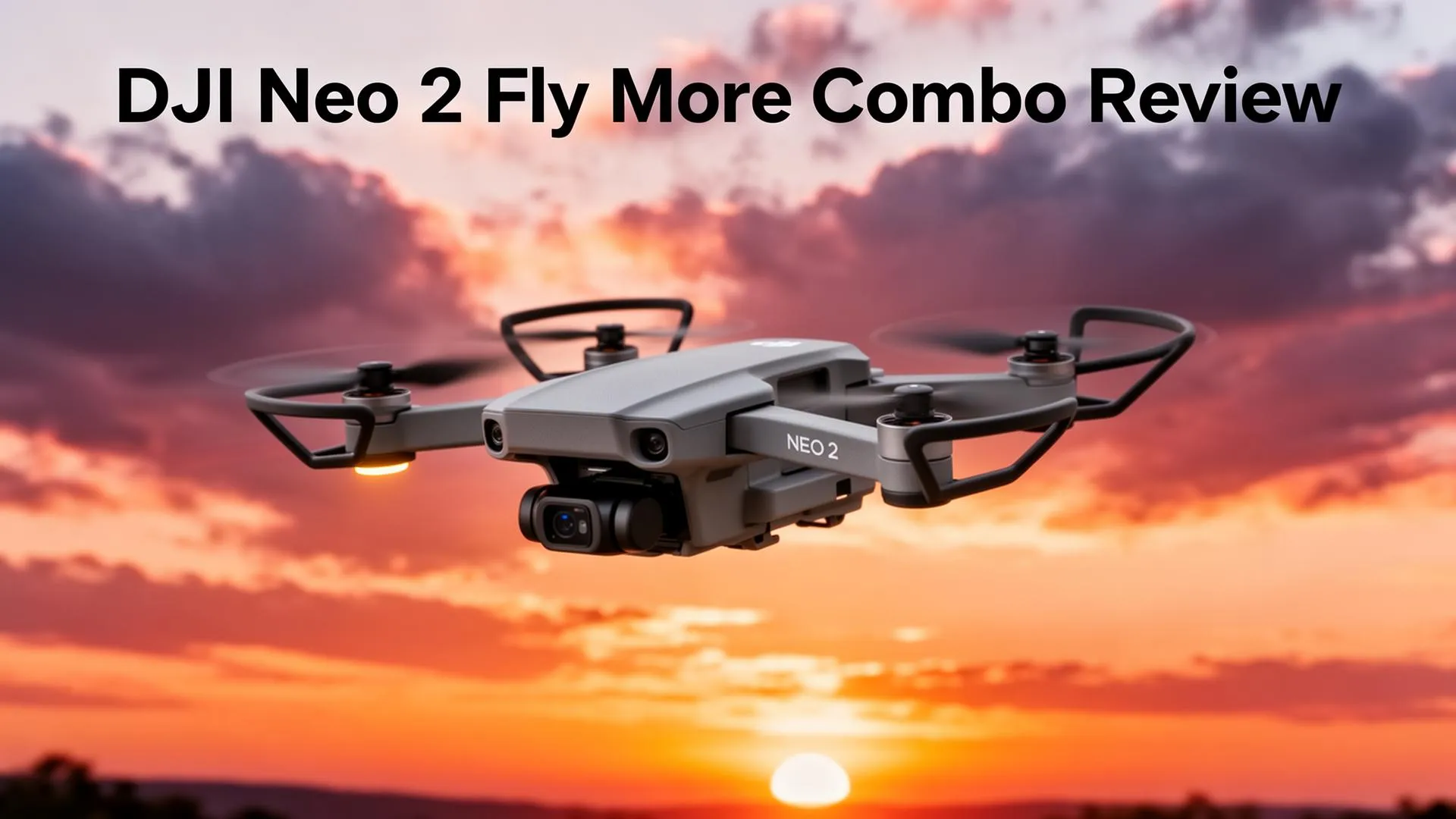
The DJI Neo 2 is the rare sequel that fixes nearly every complaint about the original. It is a palm-launched, self-flying micro drone built for people who want aerial footage of themselves without learning to fly or carrying a controller. This review is for the buyer trying to decide whether the Fly More Combo is the right way to buy it, how the Neo 2 stacks up against the DJI Flip, the first Neo, and the HoverAir X1 line, and what its complicated US status means in 2026. No invented test flights here, just the verified specs that matter and an honest read on where this tiny drone fits.
The one thing to know: the Neo 2 is the most capable sub-160g drone DJI has made, and the Fly More Combo is the version most people should buy. The single-battery kit is fine for a quick test, but real flight time is short (DJI rates roughly 19 minutes per battery, and aggressive subject-tracking drains it faster), so three batteries plus a charging hub turn it from a novelty into something you can actually shoot a session with. The headline upgrades over the first Neo are full omnidirectional obstacle sensing, a wider f/2.2 lens, 4K up to 100 fps, and more than double the onboard storage.
Specifications at a glance
Every figure below comes from DJI's published specifications (DJI Neo 2 spec sheet). A quick note for anyone reading the older version of this review: the Neo 2 weighs 151g, not 135g, carries 49GB of internal storage, and does have obstacle sensing. Those were facts about the first-generation Neo, and they are wrong for this model.
DJI Neo 2 key specifications
Two numbers deserve emphasis. First, the 151g weight matters for regulations: it keeps the Neo 2 under the 250g line that triggers tougher rules in most countries, although the optional Digital Transceiver pushes it to 160g, still under the limit. Second, the obstacle sensing is genuinely new for this size class. DJI calls it an omnidirectional monocular vision system, backed by a forward LiDAR sensor and downward infrared. That combination is why reviewers describe the Neo 2 as far harder to crash than the original, which had none of it.
What the Fly More Combo actually adds
The Neo 2 sells in three configurations, and the differences are about how you fly it, not just how many batteries you get. The standalone kit gives you the drone plus one battery, controlled by your phone, voice, or hand gestures. The Fly More Combo adds the extra batteries, the charging hub, and the screenless RC-N3 controller for proper line-of-sight range. The Motion Fly More Combo swaps that for the RC Motion 3 controller and Goggles N3, turning the Neo 2 into an entry point for immersive FPV flying (Heliguy feature breakdown).
| What you get | Drone only | Fly More Combo |
|---|---|---|
| Batteries | 1 | 3 |
| RC-N3 controller | Not included | Included |
| Two-way charging hub | Not included | Included |
| Spare propellers & guards | Guards only | Spares included |
| Practical session flight time | ~15-19 min | ~45-55 min |
Be realistic about the flight time. DJI's 19-minute figure is a best-case rating, and continuous subject tracking, sport mode, or wind cut into that quickly, with some reviewers reporting closer to 10 to 15 minutes of hard use per pack. For a drone whose whole purpose is following you while you ski, ride, or run, one battery is simply not enough. The hub also charges sequentially and can transfer charge between packs, which keeps you moving on a day out. For most buyers the Fly More Combo is the configuration that makes sense, and it is the version this review is built around.
Camera and flight: honest expectations
The Neo 2 keeps the 1/2-inch, 12MP sensor of the original but pairs it with a brighter f/2.2 lens that lets in noticeably more light, and adds 4K capture at up to 100 fps for smooth slow motion. There is also a 2.7K vertical mode aimed squarely at social video. This is a small sensor, so set expectations accordingly: it is excellent in good daylight and clearly a step up from the first Neo, but it will not match the dynamic range or low-light cleanliness of a 1/1.3-inch or 1-inch drone. If you want to understand why sensor size sets the ceiling here, our explainer on drone camera sensors covers it without the marketing spin.
The gimbal is 2-axis (tilt and roll), with electronic stabilization filling the gap. In calm conditions footage looks smooth and stable, but in gusts you will see more shake than a 3-axis Mavic or Air would produce. Where the Neo 2 genuinely shines is the experience: palm takeoff, hands-free tracking up to 12 m/s, gesture and voice control, and that new omnidirectional sensing that lets it weave around trees and people rather than barreling into them. DPReview summed up the appeal as making it "even easier for the drone-curious to get great footage" (DPReview).
Standout strengths
- • Omnidirectional sensing plus LiDAR, rare at this size
- • Palm takeoff and hands-free tracking that just work
- • 4K up to 100 fps and a brighter f/2.2 lens
- • 49 GB internal storage (no card needed)
- • Under 250g, with propeller guards built in
- • Flexible: phone, controller, or FPV goggles
Honest limitations
- • Short real-world flight time per battery
- • Small 1/2-inch sensor struggles in low light
- • 2-axis gimbal, not the 3-axis of larger DJI drones
- • 12MP stills, no large-sensor detail
- • Long range needs the optional O4 transceiver
- • US availability is legally complicated (see below)
How it compares: Flip, original Neo, and HoverAir
The Neo 2 only makes sense once you see it next to the obvious alternatives. The table below uses published manufacturer specs.
| Model | Sensor | Video | Obstacle sensing | Position |
|---|---|---|---|---|
| Neo 2 | 1/2" | 4K/100 | Omnidirectional + LiDAR | Best self-flying micro drone |
| Neo (1st gen) | 1/2" | 4K/30 | None | Cheaper, now heavily discounted |
| DJI Flip | 1/1.3" | 4K/60 | Forward + downward | Better camera, longer flights |
| HoverAir X1 Pro Max | 1/1.3" | 8K | Limited | Highest resolution rival |
The original Neo is the easy call: the Neo 2 beats it on every meaningful axis (sensing, frame rates, storage, lens), so the only reason to choose the first Neo is a steep discount on existing stock. The DJI Flip is the more interesting comparison. It carries a larger 1/1.3-inch sensor, captures 48MP stills, and flies longer (around 31 minutes), but it is bigger and folds rather than living in your palm. If image quality is your priority over pocketability, the Flip wins, and our DJI Flip vs Neo 2 comparison breaks down exactly who should pick which. The full DJI Flip review goes deeper on that drone alone.
The HoverAir X1 Pro Max is the most direct outside rival in the self-flying niche, with a 1/1.3-inch sensor and 8K capture, though independent cold-weather and action testing has favored the Neo 2's reliability and obstacle handling in tougher conditions. Our HoverAir X1 Pro and Pro Max review covers where HoverAir still pulls ahead. For a wider look at the whole lightweight field, browse our drones overview.
Price and current 2026 status
On DJI's US store the Neo 2 lists at 259 USD drone-only, 349 USD for the Fly More Combo (drone plus three batteries and hub), and 429 USD for the Fly More Combo with the RC-N3 controller (DJI USA store). In Europe the drone-only kit starts around 239 EUR with the Fly More Combo near 399 EUR. Prices move with stock and promotions, so confirm before you buy.
The US situation needs a clear, honest explanation. As of December 23, 2025 the FCC added all foreign-made drones to its Covered List, which halts new FCC authorizations for DJI hardware going forward. Drones that already received authorization, including the Neo 2, remain legal to own, fly, buy from existing inventory, and sell in the US, but the long-term supply picture is uncertain (The Drone Girl). In short: if you are in the US and want one, it is currently available, but do not assume it will stay easy to find. Wherever you fly, the 151g weight keeps the Neo 2 in the friendliest regulatory tier, though recreational US pilots still take the TRUST test and follow local rules; our FAA drone license and registration guide walks through what applies.
Who the Neo 2 is for
A great fit if you
- • Want hands-free footage of yourself in action
- • Value true pocket portability above all
- • Are new to drones and want zero learning curve
- • Shoot social clips, vlogs, and travel B-roll
- • Want an FPV starter via the Motion combo
Look elsewhere if you
- • Need the cleanest image quality (DJI Flip, Air)
- • Shoot mostly at night or in deep shadow
- • Fly in consistently strong wind
- • Want long flight time per battery
- • Need a true 3-axis gimbal for cinematic work
The verdict
The Neo 2 is the best self-flying micro drone DJI has made, and the Fly More Combo is the version worth owning. It is not a camera-quality champion, the small 1/2-inch sensor and 2-axis gimbal set hard limits, but for capturing yourself in motion with almost no skill required, nothing this small does it better or safer thanks to the new omnidirectional sensing. Buy it for spontaneous, hands-free footage, not for professional cinematics, and set expectations on flight time and low light accordingly.
Frequently asked questions
Is the Fly More Combo worth it over the drone-only kit?
For most buyers, yes. Real-world flight time per battery is short, often well under the rated 19 minutes when subject tracking, so the three batteries and charging hub in the Fly More Combo are close to essential for an actual shooting session. The included RC-N3 controller also unlocks longer line-of-sight range than phone or gesture control alone.
Can I fly the Neo 2 without a controller?
Yes. The Neo 2 supports palm takeoff, hand gestures, voice commands, and smartphone control out of the box. The Fly More Combo adds the RC-N3 controller for precise manual flying and range, and the separate Motion combo adds RC Motion 3 plus Goggles N3 for FPV flight.
How is the Neo 2 different from the original Neo?
The Neo 2 adds full omnidirectional obstacle sensing with forward LiDAR (the original had none), a brighter f/2.2 lens, 4K at up to 100 fps instead of 4K/30, and 49 GB of storage versus 22 GB. It is slightly heavier at 151g but still under the 250g threshold. It is a substantial upgrade, not a minor refresh.
Neo 2 or DJI Flip, which should I buy?
Choose the Neo 2 for the smallest, most pocketable self-flying drone and the easiest hands-free experience. Choose the DJI Flip if you want a larger 1/1.3-inch sensor, 48MP stills, and longer flight time, and you do not mind a bigger folding airframe. See our dedicated comparison for a full breakdown.
Is the DJI Neo 2 available and legal in the US?
As of mid-2026 it is sold on DJI's US store and remains legal to own and fly, because it received FCC authorization before the December 2025 Covered List cutoff. However, no new DJI models will get FCC authorization going forward, so US supply long term is uncertain. At 151g it sits in the lightest regulatory tier, but recreational pilots still complete the TRUST test and follow local rules.
What is the realistic flight time per battery?
DJI rates the Neo 2 at about 19 minutes (around 17 with propeller guards), measured in ideal conditions. Continuous subject tracking, sport mode, and wind reduce that meaningfully, with hard use sometimes landing in the 10 to 15 minute range. That is exactly why the three-battery Fly More Combo is the recommended way to buy it.
This review is based on DJI's published specifications and reputable third-party reporting. It is not sponsored by DJI, and the site may earn an affiliate commission on purchases made through retailer links. Specifications and prices verified June 2026.
Frequently Asked Questions
Is the Fly More Combo worth it over the drone-only kit?
For most buyers, yes. Real flight time per battery is short, so the three batteries and charging hub are close to essential for an actual session, and the included RC-N3 controller adds line-of-sight range beyond phone or gesture control.
How is the Neo 2 different from the original Neo?
The Neo 2 adds full omnidirectional obstacle sensing with forward LiDAR, a brighter f/2.2 lens, 4K at up to 100 fps instead of 4K/30, and 49 GB of storage versus 22 GB. It is slightly heavier at 151g but still under 250g. A substantial upgrade, not a minor refresh.
Is the DJI Neo 2 available and legal in the US?
As of mid-2026 it is sold on DJI's US store and remains legal to own and fly because it was FCC-authorized before the December 2025 Covered List cutoff. No new DJI models will get authorization going forward, so long-term US supply is uncertain.
What is the realistic flight time per battery?
DJI rates it at about 19 minutes (around 17 with guards) in ideal conditions. Continuous tracking, sport mode, and wind cut that down, sometimes to the 10 to 15 minute range, which is why the three-battery Fly More Combo is the recommended way to buy it.