
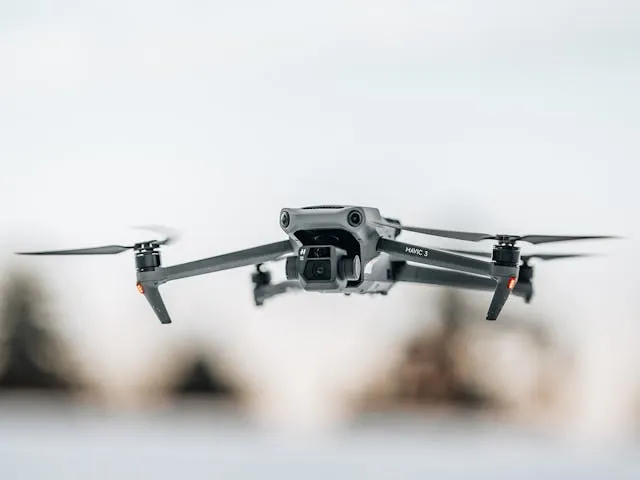
The DJI Mavic 3 was the drone that put a genuine Four Thirds sensor into a folding consumer airframe, and in 2021 that felt like a small miracle. Years later the picture is more complicated: DJI stopped building it in early 2025, the Mavic 4 Pro has taken the flagship crown, and the cheaper dual-camera Air line has crept up on its capabilities. This review is for the buyer weighing a discounted or used Mavic 3 in 2026 and asking the only questions that matter now: is that Hasselblad camera still worth it, what do you give up versus a current drone, and who should still buy one. No nostalgia, just the specs that count and an honest read on where it lands today.
The one thing to know: the Mavic 3's 4/3 Hasselblad sensor still shoots cleaner, more gradeable footage than almost anything in its price band, and 46 minutes of flight time remains excellent. But it is a discontinued model: the standard Mavic 3's secondary telephoto is a weak 1/2-inch afterthought, it tops out at 5.1K rather than 6K, and the newer Mavic 4 Pro beats it on nearly every spec. As a discounted or used buy for daylight stills and cinematic video, it is still a serious tool. At anything near its old retail price, it is not.
Specifications at a glance
Every figure below comes from DJI's published specifications and contemporary reporting from DPReview. One thing worth flagging up front: the original Mavic 3 carried two cameras, but the later Mavic 3 Classic dropped the telephoto entirely. The table covers the original dual-camera model most buyers will encounter on the used market.
| Spec | Hasselblad wide camera | Telephoto camera |
|---|---|---|
| Sensor | 4/3 CMOS, 20MP | 1/2-inch CMOS, 12MP |
| Focal length (equiv.) | 24 mm | 162 mm (28x hybrid zoom) |
| Aperture | f/2.8 to f/11 (variable) | f/4.4 (fixed) |
| Field of view | 84° | 15° |
| Max video | 5.1K/50fps and 4K/120fps (wide camera), 10-bit D-Log, 12.8 stops dynamic range | |
Airframe and flight
895 g
46 min
21 m/s (19 m/s EU)
O3+, up to 15 km (FCC)
Omnidirectional + APAS 5.0
8 GB + microSD (Cine: 1 TB SSD)
The Hasselblad camera: still the reason to buy
The whole case for the Mavic 3 rests on one component: a 4/3 CMOS sensor developed with Hasselblad. It is physically far larger than the 1/1.3-inch chips in the Air line and the 1-inch sensor in the old Air 2S, and sensor area is what actually drives image quality. The wide camera shoots 20MP stills, captures up to 5.1K/50fps and 4K/120fps video, and records 10-bit D-Log with a claimed 12.8 stops of dynamic range. In practice that means deep shadows and bright skies hold detail in the same frame, and graded footage rarely falls apart the way smaller-sensor clips do when you push them.
The variable f/2.8 to f/11 aperture is a genuine professional feature, not a gimmick. It lets you nail correct exposure and keep shutter speed near the cinematic 180-degree rule without bolting on ND filters for every lighting change. Add Hasselblad's Natural Colour Solution and the files come out of camera looking close to finished: skin tones, foliage, and skies read accurately with minimal correction. If you want to understand why a bigger chip beats a higher megapixel count, our explainer on drone camera sensors covers exactly this trade-off, and the Mavic 3 is the clearest illustration of it in the consumer range.
The telephoto camera: the part to be honest about
The original Mavic 3's second camera was controversial at launch and the criticism still stands. It is a 1/2-inch, 12MP sensor behind a 162mm equivalent lens with a fixed f/4.4 aperture, marketed as a 28x hybrid zoom. The reach is real and occasionally useful: it is excellent for scouting a location, framing a distant subject, or grabbing a compressed perspective without flying the aircraft dangerously close to people or structures.
The problem is quality. That tiny sensor and slow aperture produce noticeably softer, noisier images than the main camera, and "hybrid zoom" past the optical range is digital cropping. Treat it as a framing aid rather than a second hero camera. DJI clearly knew this: the Mavic 3 Pro that followed replaced it with a proper 70mm medium telephoto plus a 166mm long telephoto, and the current Mavic 4 Pro carries an even stronger triple-camera setup. If a versatile tele matters to you, the original Mavic 3 is the wrong drone in the family.
Hasselblad camera (24mm)
- • 4/3 CMOS, 20MP
- • Variable f/2.8 to f/11 aperture
- • 5.1K/50fps, 4K/120fps, 10-bit D-Log
- • The reason to own this drone
Telephoto camera (162mm)
- • 1/2-inch CMOS, 12MP
- • Fixed f/4.4 aperture, 28x hybrid zoom
- • Useful for scouting and reach
- • Soft and noisy, a framing aid only
Flight time, transmission, and safety
DJI rates the Mavic 3 at 46 minutes per battery, measured hovering in ideal conditions. Real mixed flying, with repositioning, cruising, and the occasional aggressive move, realistically lands in the high 30s to low 40s. That was class-leading in 2021 and remains so today: even the Mavic 4 Pro only stretches it to 51 minutes. For commercial work like mapping, inspection, or real estate, those extra minutes per battery genuinely reduce how often you land to swap packs.
Transmission runs on DJI's older O3+ system, rated to 15 km (FCC) with a 1080p feed. The headline range is mostly academic because you are legally required to keep the drone within visual line of sight nearly everywhere. What matters in daily use is link stability, and here the Mavic 3 shows its age slightly: newer O4 drones hold connections better in congested urban radio environments. The Mavic 3 is also Remote ID compliant out of the box, which US pilots need; our FAA registration and licensing guide covers what that means before your first legal flight.
Flight time, realistically
Safety holds up well. The Mavic 3 has true omnidirectional obstacle sensing backed by the APAS 5.0 assistance system, which routes around trees and buildings at moderate speed instead of simply stopping dead. Advanced Return-to-Home plans a smarter path back rather than retracing the outbound route. It is not the AI-assisted, LiDAR-equipped sensing of the newest drones, but for confident flying in cluttered environments it remains dependable. The one consistent limit, shared by every vision-based system, is that sensing degrades in low light.
How it compares: Mavic 4 Pro and Air 3S
The Mavic 3 only makes sense once you place it next to what is actually on sale now. The table uses published DJI specifications.
| Model | Main sensor | Max video | Flight time | Position |
|---|---|---|---|---|
| Mavic 3 | 4/3 CMOS, 20MP | 5.1K/50fps | 46 min | Discontinued, value Four Thirds |
| Mavic 4 Pro | 4/3 CMOS, 100MP | 6K/60fps | 51 min | Current tri-camera flagship |
| Air 3S | 1-inch wide, 1/1.3" tele | 4K/120fps | 45 min | Lighter, cheaper, dual-camera |
The Mavic 4 Pro is the direct successor and beats the Mavic 3 on essentially every axis: a 100MP 4/3 Hasselblad sensor with a brighter f/2.0 aperture, 6K/60fps HDR video, a proper triple-camera system (70mm and 168mm telephotos), the rotating Infinity Gimbal, faster O4 transmission to 30 km, and 51 minutes of flight. If you want the best and your budget allows it, buy the new one; our Mavic 4 Pro review covers whether the leap is worth the price. The interesting wrinkle is the Air 3S. It is much cheaper and lighter, yet its 1-inch wide sensor narrows the daylight image gap to the Mavic 3 considerably, while adding two useful focal lengths, LiDAR night sensing, and newer O4 transmission. For many buyers the real decision is no longer Mavic 3 versus Mavic 3, it is whether to step down to the dual-camera Air line instead. The Mavic 3 still wins on outright sensor size and shadow latitude, but the margin is smaller than it once was.
Current status and price in 2026
Be clear-eyed here: the Mavic 3 is a discontinued product. DJI ceased production in early 2025 and the units still appearing through retailers are leftover stock. The good news is that the consumer Mavic 3 line is not yet on DJI's end-of-support list (the company is winding down service for the older Mavic 2 generation through 2026), and it continues to receive occasional firmware. So a Mavic 3 bought today still flies, updates, and works with current accessories, but you are buying near the end of its commercial life.
On price, the Mavic 3 launched around 2,049 USD for the base kit and 4,999 USD for the loaded Cine Premium Combo. In 2026 the only sensible way to buy one is discounted new old-stock or clean used, where the Four Thirds sensor becomes genuinely good value against its old sticker. Used pricing moves with condition and what accessories are included, so check current listings and prefer sellers who can show low battery cycle counts and recent firmware. Paying anything close to original retail makes no sense when the Mavic 4 Pro exists. If you are still deciding whether to commit at all, our piece on whether buying a drone is worth it in 2026 walks through the running costs beyond the purchase price, and you can compare it against current options in our drone reviews hub.
Who the Mavic 3 is for
A great fit if you
- • Want a Four Thirds sensor at a discounted price
- • Shoot daylight stills, landscape, or cinematic video
- • Grade footage and need D-Log latitude
- • Value long flight time for mapping or inspection
- • Find clean, low-cycle used or new old-stock inventory
Look elsewhere if you
- • Need 6K, 100MP, or the latest features (Mavic 4 Pro)
- • Want a versatile telephoto camera
- • Shoot heavily at night or deep shadow
- • Prefer to buy a currently produced drone
- • Could be just as happy with a cheaper Air 3S
The verdict
The Mavic 3's Hasselblad camera and 46-minute flight time still produce results that embarrass much newer, smaller-sensor drones, and that is exactly why it remains worth considering at the right price. But it is a discontinued model with a weak telephoto, older transmission, and a direct successor that beats it everywhere. Buy it discounted or used for daylight imaging on a budget, with eyes open about its age. Pay near old retail, or need the latest features, and the Mavic 4 Pro or a cheaper Air 3S is the smarter spend.
Frequently asked questions
Is the DJI Mavic 3 still worth buying in 2026?
Only at a discount or used. The 4/3 Hasselblad sensor and 46-minute flight time remain genuinely strong, so as discounted new old-stock or clean used hardware it is good value for daylight stills and cinematic video. At anything near its original retail price it makes no sense, because the newer Mavic 4 Pro beats it on nearly every spec.
Has the Mavic 3 been discontinued?
Yes. DJI ceased production in early 2025, so any new units are leftover stock. It still receives occasional firmware and is not yet on DJI's end-of-support list, so a Mavic 3 bought today continues to fly, update, and work with current accessories. You are buying near the end of its commercial life rather than a current model.
Should I buy a Mavic 3 or the newer Mavic 4 Pro?
If budget allows, the Mavic 4 Pro is the better drone: a 100MP 4/3 sensor, 6K/60fps video, a real triple-camera system, faster O4 transmission, and 51 minutes of flight. Choose the Mavic 3 only when a steep discount makes its Four Thirds image quality and long flight time outstanding value for daylight shooting.
How good is the Mavic 3's telephoto camera?
Modest. The original Mavic 3's secondary camera is a small 1/2-inch, 12MP sensor at 162mm with a fixed f/4.4 aperture and a 28x hybrid (partly digital) zoom. It is handy for scouting and reaching distant subjects, but images are noticeably softer and noisier than the main camera. Treat it as a framing aid, not a second hero camera.
What is the difference between the Mavic 3 and the Mavic 3 Classic?
The Classic keeps the same 4/3 Hasselblad main camera but drops the telephoto entirely, leaving a single-camera drone at a lower price. If you never wanted the weak tele lens, the Classic is the cleaner value of the two. If the occasional extra reach matters, look for the original dual-camera Mavic 3.
Does the DJI Mavic 3 need to be registered?
Yes. At 895 g it is far above the 250 g threshold everywhere. US pilots register with the FAA and the drone is Remote ID compliant out of the box, and EU pilots must register as an operator and label the aircraft with their e-ID. See our FAA registration guide for the full process before your first flight.
This review is based on DJI's published specifications and reputable third-party reporting. It is not sponsored by DJI, and the site may earn an affiliate commission on purchases made through retailer links. Specifications verified June 2026; the Mavic 3 is a discontinued model, so confirm current pricing and stock before buying.
Frequently Asked Questions
Is the DJI Mavic 3 still worth buying in 2026?
Only at a discount or used. The 4/3 Hasselblad sensor and 46-minute flight time still hold up, so as discounted new old-stock or clean used hardware it is good value for daylight stills and cinematic video. At anything near its original retail price the newer Mavic 4 Pro is the smarter spend.
Has the Mavic 3 been discontinued?
Yes. DJI ceased production in early 2025, so new units are leftover stock. It still gets occasional firmware and is not yet on DJI's end-of-support list, so a Mavic 3 bought today continues to fly, update, and work with current accessories.
How good is the Mavic 3's telephoto camera?
Modest. It is a small 1/2-inch, 12MP sensor at 162mm with a fixed f/4.4 aperture and a 28x hybrid zoom. Useful for scouting and reach, but noticeably softer and noisier than the main camera, so treat it as a framing aid rather than a second hero camera.
Should I buy a Mavic 3 or the newer Mavic 4 Pro?
If budget allows, the Mavic 4 Pro is the better drone: a 100MP 4/3 sensor, 6K/60fps video, a real triple-camera system, faster O4 transmission, and 51 minutes of flight. Choose the Mavic 3 only when a steep discount makes its image quality and flight time outstanding value for daylight shooting.