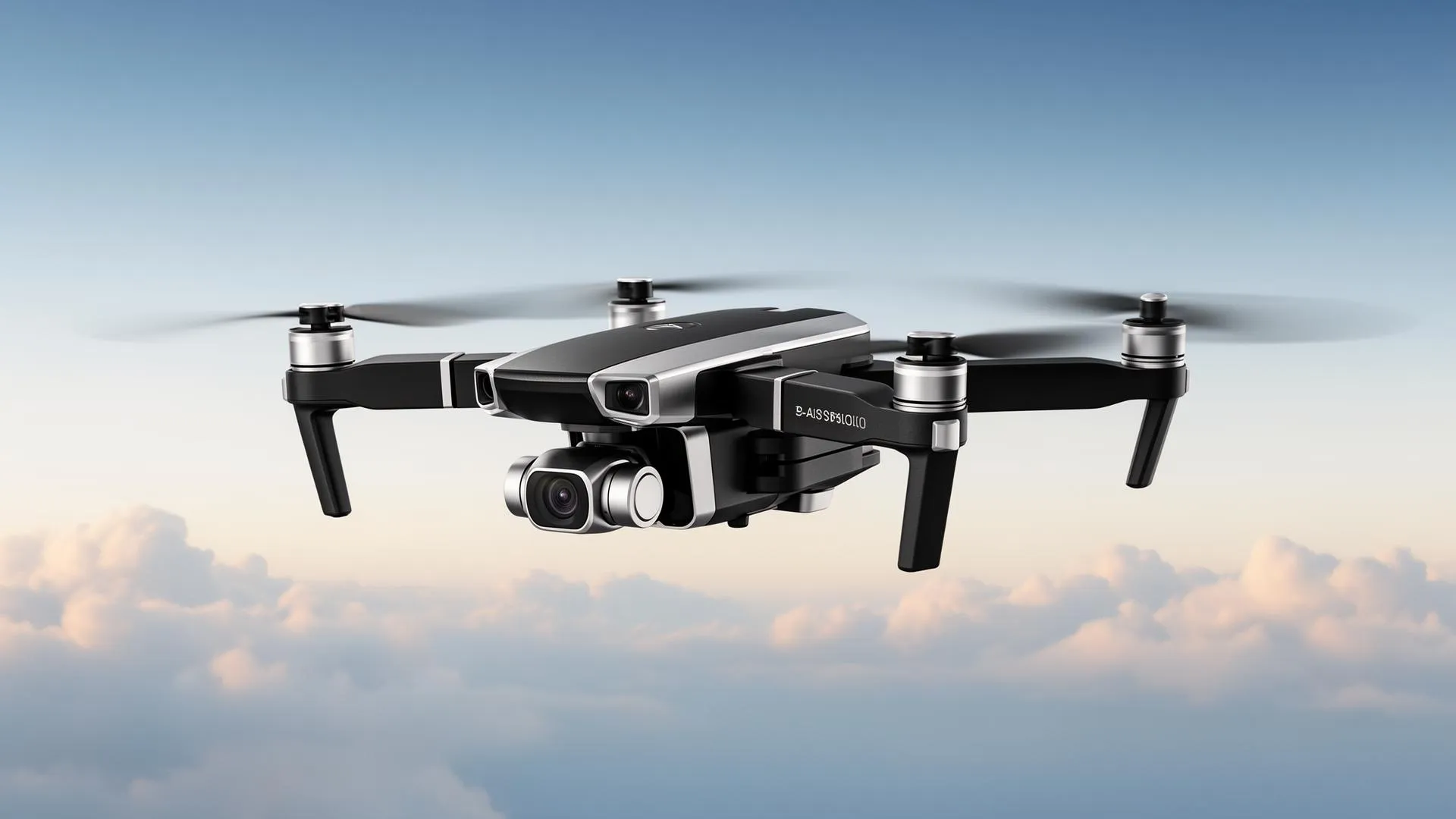
Holy Stone built its reputation on cheap, cheerful quadcopters, so a $459 foldable GPS drone with a three-axis mechanical gimbal is a clear step up the ladder. The HS790, announced in June 2025, headlines with 6K photos, 4K video, a 9km transmission figure, and 60 minutes of total flight time across two batteries. This review separates what those numbers actually mean from how Holy Stone markets them, checks the specs against the official listing and independent testing, and works out where the HS790 fits between the older HS720 series below it and DJI's Neo and Mini drones above it. No invented test flights, just the verifiable facts and an honest read on who should buy one.
The one thing to know: the HS790 is a legitimately better Holy Stone than anything in the HS720 line, thanks to a real three-axis gimbal and a Sony sensor, and it undercuts DJI on price while including two batteries. But it uses a small 1/3.2-inch sensor, tops out at 4K/30fps, and has no obstacle avoidance. It is a strong budget GPS drone for casual aerial footage, not a DJI Mini killer once you account for image quality and safety sensors.
Specifications at a glance
The figures below are drawn from Holy Stone's official store listing and product launch (Holy Stone HS790 page), with sensor, resolution, and weight details confirmed by independent hands-on testing at The Gadgeteer (HS790 review). Where a number is marketing language rather than a measured spec, the table says so.
| Spec | Holy Stone HS790 | Notes |
|---|---|---|
| Camera sensor | Sony 1/3.2" CMOS, f/2.0 | Small sensor by drone standards |
| Photo / video | 6K stills (5700x3200), 4K video at 30fps | No RAW, no higher 4K frame rates |
| Gimbal | 3-axis mechanical | The headline upgrade vs HS720 |
| Transmission | 9km / 30,000ft claimed | Theoretical max, not a usable VLOS figure |
| Flight time | 30 min per battery (60 min total, 2 included) | Ideal-condition rating |
| Weight | 377 g | Above the 250 g registration threshold |
| Positioning | GPS + optical flow | No obstacle avoidance sensors |
| Remote ID / price | Built-in (FAA), ~$459 MSRP / ~$389 sale | Two batteries and charging hub included |
The camera: better than it looks on paper, smaller than the headline numbers suggest
Holy Stone leads with "6K photo" and "4K video," and both claims need context. The video spec is the honest one: the HS790 records genuine 4K (3840x2160) at 30fps to a microSD card, which is a real, usable resolution for travel clips and casual filmmaking. The "6K photo" figure refers to a 5700x3200 still image, which is closer to 18 megapixels. That is fine, but the limiting factor is not pixel count, it is the sensor. The HS790 uses a Sony 1/3.2-inch CMOS chip, which is physically tiny next to the 1/1.3-inch or 1-inch sensors in the drones it gets compared to. If you are unsure why that matters more than the megapixel number on the box, our explainer on drone camera sensors walks through exactly how sensor size drives dynamic range and low-light performance.
In practice that small sensor means the HS790 is at its best in good daylight, where The Gadgeteer's reviewer called the footage "excellent" and clearly better than older Holy Stone cameras. Push into dusk, deep shadow, or backlit scenes and the limits show: more noise, less recoverable detail, and a narrower usable dynamic range than a larger-sensor drone. Holy Stone includes an AI Night Shot mode to compensate, but software cannot replace sensor area. There is also no RAW capture and 4K is locked to 30fps, so this is not a drone built for heavy colour grading or slow-motion work. Treat it as a capable point-and-shoot from the sky rather than a creator's primary camera.
The gimbal is the real story
The single most important upgrade in the HS790 is its three-axis mechanical gimbal. Earlier Holy Stone GPS drones, including the HS720G, relied on a two-axis gimbal paired with electronic image stabilization (EIS), which crops the frame and smooths footage in software. A true three-axis mechanical gimbal physically counteracts pitch, roll, and yaw, which is the difference between footage that looks like a hobby drone and footage that looks deliberately shot. This is the spec that finally lets a budget Holy Stone produce smooth, watchable aerial video without obvious jitter or the jelly artifacts EIS can introduce. It is genuinely the feature that justifies the step up in price over the 700 series.
Flight, range, and the missing safety sensors
Holy Stone rates the HS790 at 30 minutes per battery and includes two batteries plus a fast-charging hub, for 60 minutes of total airtime. As with every manufacturer figure, that 30 minutes is measured in ideal hovering conditions, so expect roughly the low-to-mid 20s in real mixed flying with wind and repositioning. The dual-battery bundle is a genuine value advantage over DJI, where a second battery is usually a paid extra. One caveat from independent testing: the included charging hub tops up batteries sequentially rather than at the same time, so back-to-back sessions take longer than you might expect.
The 9km transmission figure deserves scepticism. It is a theoretical maximum in perfect, interference-free conditions, and it is largely irrelevant in practice because you are legally required to keep the drone within visual line of sight almost everywhere. What matters is a stable feed at the few hundred metres you will actually fly, and reviewers found the connection responsive at realistic distances. The bigger gap is safety: the HS790 has no obstacle avoidance sensors of any kind. It holds position with GPS and downward optical flow, but it will not detect or stop for trees, branches, or buildings. For a beginner, that raises the stakes of every flight near obstacles. The HS790 is also Remote ID compliant out of the box, which keeps you legal in the US; our Remote ID compliance guide explains what that requirement actually involves.
Flight time, realistically
Pros and cons
What it gets right
- • True 3-axis mechanical gimbal for smooth footage
- • Two batteries and a charging hub included
- • Built-in FAA Remote ID compliance
- • Genuinely usable 4K/30fps daylight video
- • Foldable, travel-friendly design under 380 g
Where it falls short
- • Small 1/3.2" sensor struggles in low light
- • No obstacle avoidance of any kind
- • 4K capped at 30fps, no RAW capture
- • Hub charges batteries one at a time
- • Heavier than the sub-250 g registration-free class
How it compares: HS720 series, DJI Neo, and DJI Mini
The HS790 only makes sense once you place it between the Holy Stone drones it replaces and the DJI drones it competes with. The table below uses published manufacturer specs.
| Model | Gimbal | Sensor / video | Weight | Obstacle sensing |
|---|---|---|---|---|
| Holy Stone HS790 | 3-axis mechanical | 1/3.2", 4K/30 | 377 g | None |
| Holy Stone HS720G | 2-axis + EIS | Small sensor, 4K | ~380 g | None |
| DJI Neo | 1-axis + EIS | 1/2", 4K/30 | ~135 g | Downward only |
| DJI Mini 4 Pro | 3-axis mechanical | 1/1.3", 4K/100 | <249 g | Omnidirectional |
Against its own family, the HS790 is a clear win. The HS720G and the rest of the 700 series make do with a two-axis gimbal and software stabilization, so the HS790's three-axis mechanical gimbal is a real, visible upgrade in footage smoothness, and the newer Sony sensor edges ahead too. If your budget is closer to $300 the 720 series remains a reasonable entry point, but the HS790 is the one to stretch for if smooth video is the goal.
Against DJI the calculus flips. DJI's Neo line is far lighter and cheaper but only stabilizes electronically, while the DJI Mini 4 Pro stays under the 249 g registration threshold and adds a larger sensor, faster 4K, and full omnidirectional obstacle avoidance, things no Holy Stone offers. The HS790's pitch is price plus two included batteries plus a real gimbal. If you specifically want to avoid registration, or you value collision sensors and low-light image quality, a DJI Mini is the better tool even at a higher price. For the full picture of running costs and whether the purchase pays off, see whether buying a drone is worth it in 2026, or browse the wider field on our drones overview.
Who the HS790 is for
A good fit if you
- • Want smooth aerial video on a tight budget
- • Are upgrading from a toy or HS720-series drone
- • Fly mostly in open areas and good daylight
- • Like having two batteries in the box
- • Are comfortable registering a sub-380 g drone
Look elsewhere if you
- • Want to skip registration (go sub-250 g)
- • Shoot in low light or need RAW and high-fps 4K
- • Want obstacle avoidance for safer flying
- • Need the best image quality for paid work
- • Fly often near trees, buildings, or people
The verdict
The HS790 is the best GPS drone Holy Stone has made, and at around $389 on sale with two batteries and a real three-axis gimbal it is a strong budget buy for casual daylight footage. It is held back by a small sensor, no obstacle avoidance, and a 4K/30fps cap, so it cannot match a DJI Mini on image quality or safety. Judge it for what it is: an affordable, capable beginner GPS drone, not a DJI rival.
Frequently asked questions
Does the Holy Stone HS790 require FAA registration?
Yes. At 377 g it is well above the 250 g threshold, so US pilots must register it with the FAA before flying. The good news is that the HS790 has built-in Remote ID, so it is fully compliant out of the box. See our FAA registration guide for the process, or our Germany registration guide if you fly in the EU.
Is the HS790 a real upgrade over the HS720 series?
Yes, primarily because of the gimbal. The HS720G uses a two-axis gimbal with electronic image stabilization, while the HS790 has a true three-axis mechanical gimbal plus a newer Sony sensor. That difference produces noticeably smoother video. If smooth footage matters, the HS790 is worth the extra cost.
Does the HS790 have obstacle avoidance?
No. The HS790 has GPS and downward optical flow positioning, but it has no obstacle avoidance sensors and will not detect or stop for objects in its path. This is one of the clearest gaps versus a DJI Mini, and it means you need to fly carefully around trees, buildings, and people.
How good is the HS790's camera really?
It is the best camera Holy Stone has put on this class of drone, with genuine 4K/30fps video and good results in daylight. But it uses a small 1/3.2-inch Sony sensor, so low-light footage gets noisy, there is no RAW capture, and 4K is limited to 30fps. Think capable point-and-shoot, not a tool for paid cinematography.
HS790 or a DJI Mini, which should I buy?
Buy the HS790 if you want the lowest price, two batteries in the box, and a real gimbal, and you mostly fly in daylight. Choose a DJI Mini if you want to stay under 249 g to avoid registration, want a larger sensor and faster 4K, or value obstacle avoidance. The DJI costs more but is the more capable and safer aircraft.
What is the realistic flight time?
Holy Stone's 30-minutes-per-battery figure is a hover rating in ideal conditions. In normal mixed flying with wind and maneuvering, expect roughly the low-to-mid 20s per battery. Because two batteries are included, total real-world airtime per outing lands around 45 to 50 minutes.
This review is based on Holy Stone's published specifications and reputable third-party reporting. It is not sponsored by Holy Stone, and the site may earn an affiliate commission on purchases made through retailer links. Specifications verified June 2026.
Frequently Asked Questions
Does the Holy Stone HS790 require FAA registration?
Yes. At 377 g the HS790 is above the 250 g threshold and requires FAA registration in the US. It has built-in Remote ID, so it is fully compliant out of the box.
Is the HS790 a real upgrade over the HS720 series?
Yes. The HS720G uses a two-axis gimbal with electronic stabilization, while the HS790 has a true three-axis mechanical gimbal and a newer Sony sensor, which produces noticeably smoother footage.
Does the HS790 have obstacle avoidance?
No. It has GPS and downward optical flow positioning but no obstacle avoidance sensors, so it will not detect or stop for objects in its path. Fly carefully near trees, buildings, and people.
HS790 or a DJI Mini, which should I buy?
Pick the HS790 for the lowest price, two included batteries, and a real gimbal if you fly mostly in daylight. Choose a DJI Mini if you want to stay under 249 g, need a larger sensor and faster 4K, or value obstacle avoidance.