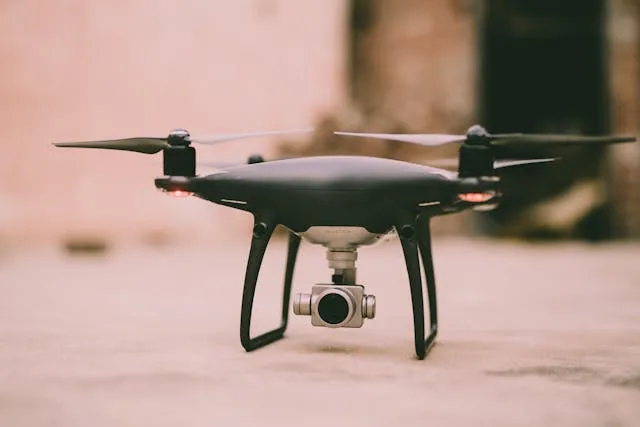
The DJI Phantom 4 and its higher-end sibling, the Phantom 4 Pro, defined what a serious consumer drone looked like in the late 2010s: a large white quadcopter with fixed arms, a gimbal-stabilised camera, and obstacle sensing that finally made flying forgiving. This review is for two kinds of reader. The first is the person who finds one on the used market and wants to know whether a decade-old platform is still worth money in 2026. The second is the surveyor or mapping operator who remembers the Phantom 4 Pro and Phantom 4 RTK as workhorses and wonders what replaced them. The short version: the Phantom 4 was genuinely important, but it is now a legacy product, and for almost everyone a modern foldable drone is the better buy.
The one thing to know: the Phantom 4 line is fully retired. The original used a small 1/2.3-inch sensor, while the Phantom 4 Pro upgraded to a 1-inch 20MP sensor with a mechanical shutter that made it a mapping favourite. DJI ended the consumer Phantom line and wound down the Phantom 4 RTK in favour of the Mavic and Matrice families. A clean used Phantom 4 Pro V2.0 still has niche value for photogrammetry, but if you need a primary drone, a current Mavic or Air model beats it on camera, portability, and battery in every way that matters.
Specifications at a glance
The figures below come from DJI's published support pages for the Phantom 4 and the Phantom 4 Pro. The single most important difference between the two is the camera: the Pro moved to a 1-inch sensor and a mechanical shutter, which is why professionals gravitated to it.
| Spec | Phantom 4 (2016) | Phantom 4 Pro / Pro V2.0 |
|---|---|---|
| Camera sensor | 1/2.3-inch CMOS, 12MP | 1-inch CMOS, 20MP |
| Shutter | Electronic (rolling) | Mechanical (8 s to 1/2000 s) |
| Max video | 4K up to 30 fps | 4K up to 60 fps (H.264) |
| Aperture | Fixed f/2.8 | Adjustable f/2.8 to f/11 |
| Obstacle sensing | Forward + downward | Forward, backward, downward + side infrared |
| Transmission | Original/Pro: Lightbridge (FCC 7 km / CE 3.5 km). Pro V2.0: OcuSync | |
Airframe and flight (Phantom 4 Pro)
1,388 g
~30 min
72 km/h (45 mph)
No (fixed arms)
March 2016
Discontinued, used market
Why the Phantom 4 mattered
When the original Phantom 4 launched in March 2016, it was the first mainstream consumer drone with forward obstacle sensing, using a pair of front-facing cameras plus downward vision and ultrasonic sensors to stop before flying into things. That single feature changed who could realistically own a drone, because a clipped tree or a misjudged building no longer meant a guaranteed crash. It also introduced subject-tracking and tap-to-fly automation that have since become standard across the entire industry.
The Phantom 4 Pro, released later in 2016, is the version that earned the professional reputation. Its 1-inch 20MP sensor was a large step up in detail, low-light behaviour, and dynamic range over the original's small 1/2.3-inch chip. If you want to understand why that sensor jump matters so much more than a megapixel figure, our explainer on drone camera sensors walks through the physics. The Pro also added an adjustable aperture (f/2.8 to f/11) and, crucially, a mechanical shutter.
The mechanical shutter and the surveying legacy
The Phantom 4 Pro became a fixture in aerial mapping and photogrammetry for one technical reason: its mechanical shutter. An electronic rolling shutter exposes an image line by line, which distorts a moving frame and smears the precise geometry that photogrammetry software depends on. A mechanical shutter captures the whole frame at once, so images taken from a drone moving over a survey grid stay crisp and dimensionally accurate. For years that made the Phantom 4 Pro, and later the survey-focused Phantom 4 RTK with centimetre-level GPS, one of the most popular mapping platforms in the field, as the drone industry widely documented (The Drone Girl).
That legacy is now exactly that: legacy. DJI has steered enterprise mapping toward its Matrice platform with detachable survey payloads, and the consumer Phantom line has ended. Modern foldable drones in the Mavic class also moved to mechanical shutters and far higher resolution, removing the Phantom 4 Pro's last real advantage for new mapping deployments. The platform survives mainly among operators who already own a fleet and a tested workflow around it.
Strengths and limitations in 2026
Still genuinely good
- • 1-inch sensor (Pro) still produces clean, usable stills in good light
- • Mechanical shutter remains ideal for photogrammetry geometry
- • Stable, heavy airframe handles wind better than tiny drones
- • Adjustable aperture gives real exposure control
- • Cheap to acquire used if you already know the platform
Showing its age
- • No folding: bulky and awkward to travel with
- • ~30 min flight time now beaten by 45-min foldables
- • Older Lightbridge transmission on most units
- • Official support and firmware updates have wound down
- • No 8K, no 10-bit log on the wide camera, no modern AI sensing
How it compares to modern drones
The honest comparison is brutal for anything but mapping. A current foldable drone weighs a fraction of the Phantom, fits in a jacket pocket, flies longer, transmits further, and sees in every direction. The table uses DJI's published specifications.
| Model | Sensor | Weight | Flight time | Foldable |
|---|---|---|---|---|
| Phantom 4 Pro | 1-inch, 20MP | 1,388 g | ~30 min | No |
| DJI Air 3 | 1/1.3-inch x2 (dual cam) | 720 g | 46 min | Yes |
| DJI Mavic 4 Pro | 4/3-inch Hasselblad, 100MP | ~892 g | ~51 min | Yes |
The DJI Air 3 is the natural modern equivalent for a creator who liked the Phantom's all-round capability: it gives you two focal lengths, far longer flight, and omnidirectional sensing in a body that folds into a bag. For anyone who chose the Phantom 4 Pro specifically for image quality, the Mavic 4 Pro and its larger Four Thirds Hasselblad sensor are a generation beyond it. To see where every current option sits, our roundup of the best DJI drones lays out the full lineup, or browse the complete catalogue on our drones overview.
Current status and used pricing
The Phantom 4, Phantom 4 Pro, and Phantom 4 Pro V2.0 are all discontinued, and DJI has progressively ended maintenance and firmware support across the older Phantom range (DJI support notice). That means no new features, limited official repair coverage, and a shrinking pool of genuine batteries and parts. There is no new-in-box retail channel worth recommending.
On the used market a Phantom 4 Pro or Pro V2.0 typically trades somewhere in the region of a few hundred to around a thousand US dollars depending on condition, included batteries, and accessories, with V2.0 units commanding a premium. Battery health is the thing to scrutinise, because original packs are years old and replacements are scarce. If you are weighing a cheap used buy against a new entry-level model, our piece on whether buying a drone is worth it in 2026 covers the running costs that the sticker price hides.
The verdict
The Phantom 4 Pro earned its place in drone history. The 1-inch sensor and mechanical shutter made it a serious imaging and mapping tool, and the original Phantom 4 brought obstacle avoidance to the masses. But in 2026 it is a legacy platform: bulky, short on flight time, no longer supported, and outclassed by foldables that cost the same or less. Buy one only if you have a specific photogrammetry workflow built around it, or if you already own batteries and want a cheap, capable second body. Everyone else is better served by a modern Air or Mavic.
Frequently asked questions
Is the DJI Phantom 4 still worth buying in 2026?
For general photography, no. It is discontinued, no longer actively supported, and a modern foldable like the Air 3 beats it on camera, flight time, transmission, and portability for similar money. The one real exception is photogrammetry users who already have a Phantom 4 Pro workflow and parts.
What is the difference between the Phantom 4 and the Phantom 4 Pro?
The original Phantom 4 has a small 1/2.3-inch 12MP sensor with an electronic shutter and 4K/30 video. The Phantom 4 Pro upgrades to a 1-inch 20MP sensor with a mechanical shutter, adjustable aperture, 4K/60 video, and more obstacle sensors. The Pro is the version worth seeking out.
Why was the Phantom 4 Pro popular for mapping and surveying?
Its mechanical shutter captures the whole frame at once instead of line by line, which avoids the geometric distortion that rolling shutters introduce on a moving aircraft. That kept survey images dimensionally accurate, making the Phantom 4 Pro and the GPS-precise Phantom 4 RTK long-running favourites in photogrammetry.
Can I still get batteries and parts for the Phantom 4?
Availability is limited and shrinking. Official DJI support has wound down across the Phantom 4 range, so you are largely reliant on remaining new-old-stock and used parts. Battery health is the biggest risk on any used purchase, since the packs are several years old.
Does a Phantom 4 need to be registered to fly?
Yes. At roughly 1,380 g it is far above every registration threshold. US pilots register with the FAA, and EU pilots must register as an operator and follow drone-class rules. See our guides on the FAA registration process and registering a drone in Germany. Note older drones like the Phantom 4 lack built-in Remote ID, so a broadcast module may be required.
What replaced the DJI Phantom line?
For consumers, the foldable Mavic and Air families. For enterprise mapping and surveying, DJI moved to its Matrice platform with detachable survey payloads. The Phantom 4 RTK, the last survey-focused Phantom, has been wound down in favour of those newer systems.
This review is based on DJI's published specifications and reputable third-party reporting. It is not sponsored by DJI, and the site may earn an affiliate commission on purchases made through retailer links. Specifications and status verified June 2026.
Frequently Asked Questions
Is the DJI Phantom 4 still worth buying in 2026?
For general use, no. It is discontinued and no longer actively supported, and a modern foldable like the Air 3 beats it on camera, flight time, transmission, and portability for similar money. The main exception is photogrammetry users who already own a Phantom 4 Pro workflow.
What is the difference between the Phantom 4 and the Phantom 4 Pro?
The original Phantom 4 has a small 1/2.3-inch 12MP sensor with an electronic shutter. The Phantom 4 Pro upgrades to a 1-inch 20MP sensor with a mechanical shutter, adjustable aperture, 4K/60 video, and more obstacle sensors. The Pro is the version worth seeking out.
Why was the Phantom 4 Pro popular for mapping and surveying?
Its mechanical shutter captures the whole frame at once instead of line by line, avoiding the geometric distortion rolling shutters introduce on a moving aircraft. That kept survey images dimensionally accurate, making it and the GPS-precise Phantom 4 RTK long-running photogrammetry favourites.
What replaced the DJI Phantom line?
For consumers, the foldable Mavic and Air families. For enterprise mapping and surveying, DJI moved to its Matrice platform with detachable survey payloads. The Phantom 4 RTK, the last survey-focused Phantom, has been wound down in favour of those newer systems.